Linguists Decode Rental Listing for 'Cozy' Lincoln Park Studio, Find 23 Euphemisms
The listing appeared on a Tuesday afternoon in early March, indistinguishable from thousands of others cycling through Chicago’s rental market: a studio apartment in Lincoln Park, $1,450 per month, available April 1st. It described the unit as “cozy,” “sun-drenched,” “efficiently designed,” and “perfect for a minimalist.” It mentioned “charming vintage details” and “easy access to the lake.” It included four photographs, all taken with a wide-angle lens from what appeared to be the same corner of the room — the only corner from which the entire apartment was visible.
Dr. Hannah Yoo, an associate professor of linguistics at Northwestern, saw the listing because her graduate student forwarded it as a joke. She did not laugh. She printed it out, brought it to her Tuesday seminar on euphemism and pragmatic implication, and assigned it as a case study. What her team found, over the course of a week’s analysis, was what she called “one of the most linguistically dense documents I’ve encountered outside of diplomatic communiqués.”
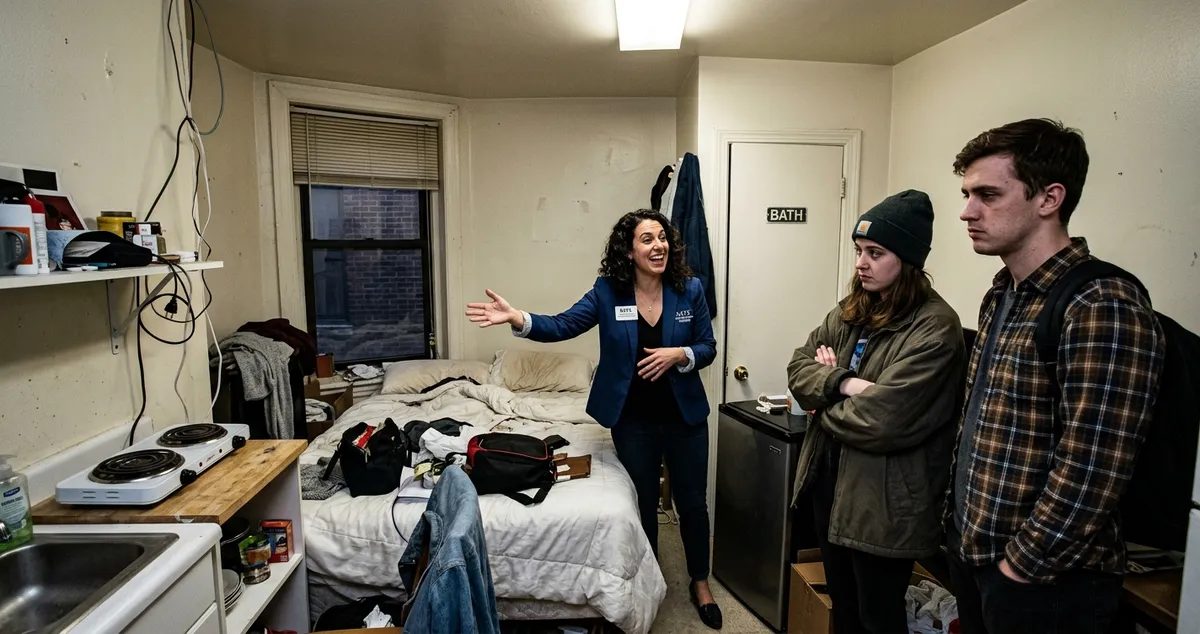
The listing contained ninety-four words. Twenty-three of them were identified as euphemisms — words or phrases whose conventional meaning differed materially from their intended referent. “Cozy,” for instance, which in standard English suggests warmth and comfort, was determined through cross-referencing with the unit’s square footage (listed in the fine print as 285 square feet) to mean “small.” Specifically, “too small to contain a standard sofa and a human being at the same time.”
“Sun-drenched” was flagged as potentially aspirational. The apartment faces west, meaning direct sunlight would enter the unit for approximately two hours on summer afternoons, assuming the adjacent building’s fire escape does not obstruct the window — which, based on Google Street View imagery, it does. “The term ‘drenched’ implies saturation,” Dr. Yoo noted. “The actual light conditions are closer to ‘lightly misted.’”
“Efficiently designed” drew particular attention from the research team. The phrase, Dr. Yoo argued, performs a rhetorical inversion — recasting a limitation (insufficient space) as an intentional feature (optimized space). “It implies an architect made deliberate choices,” she said. “In reality, the ‘efficiency’ is that the refrigerator is next to the bathroom door, which saves you steps when you want a snack after a shower. That’s not design. That’s geometry under duress.”
The listing’s most ambitious claim — “perfect for a minimalist” — was analyzed as what Dr. Yoo’s team classified as a “preemptive defense euphemism.” “It anticipates the viewer’s objection — ‘this is too small’ — and reframes it as a lifestyle choice,” she explained. “You’re not living in a 285-square-foot box because the rent is $1,450 and you work in publishing. You’re doing it because you’ve transcended material attachment.”
“Charming vintage details,” upon inspection of the photographs, appeared to refer to a radiator and an electrical outlet plate that was visibly painted over. “Vintage, in real estate, means ‘old,’” said Dr. Yoo. “Charming means ‘we’re not going to fix it.’”
The property management company that posted the listing, Lakeview Premier Properties, did not respond to multiple requests for comment. A representative who answered the phone said the listing was “standard” and that “all of our listings accurately reflect the properties.” When informed that a Northwestern linguistics department had formally analyzed one of their listings, there was a pause of approximately four seconds before the representative said, “I’ll have someone call you back.” No one called back.
Dr. Yoo plans to publish the analysis in a forthcoming paper titled “Habitable Fictions: Euphemistic Strategies in Urban Rental Discourse.” She has since collected thirty-seven additional Chicago rental listings for comparison and reports that the average euphemism density is rising. “The smaller the apartment gets,” she said, “the more creative the language becomes. It’s an inverse relationship. At some point, a listing for a closet will read like poetry.”