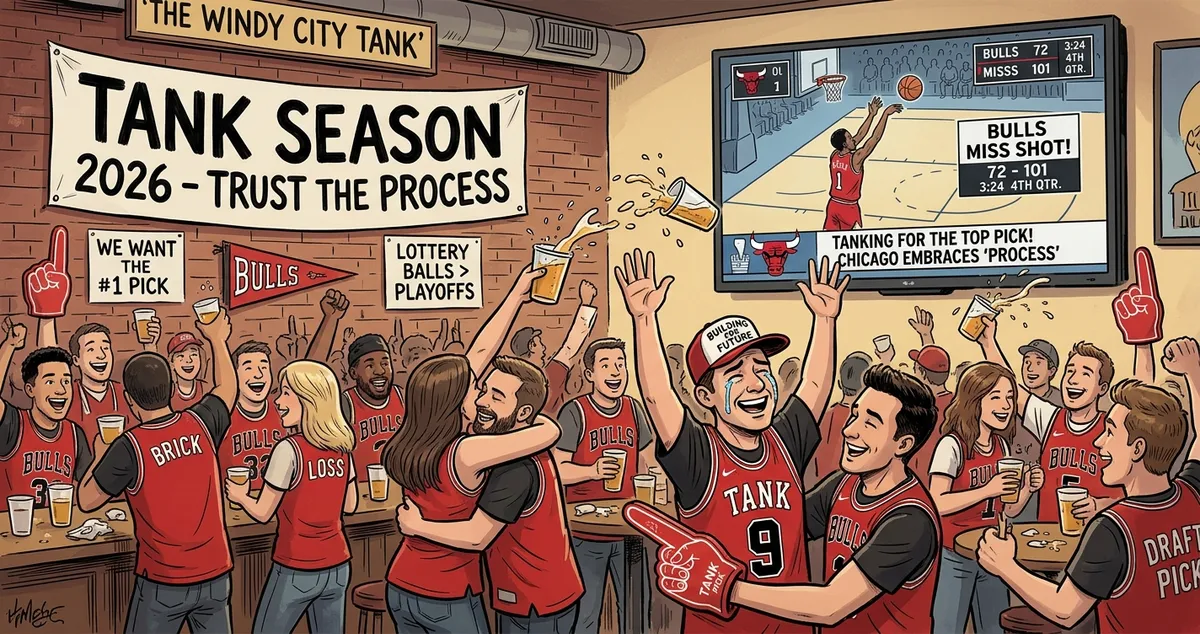
Chicago Bulls Fans Pivot to Loss Optimization Strategy, Report Record Engagement Metrics
The Chicago Bulls were eliminated from both playoff and play-in contention last week, ending any remaining ambiguity about the team’s competitive goals for the 2025-26 season and triggering what analysts are calling a “full-stack fan experience pivot” toward draft lottery optimization. The transition, which unfolded organically across sports bars, group chats, and Reddit threads beginning around March 27, has produced what one fan community moderator described as “honestly some of our best engagement of the year.”
The Bulls currently sit at 29-44, tied with the Milwaukee Bucks for the tenth-best lottery odds in the 2026 NBA Draft — a draft class that scouts and front-office personnel across the league have characterized as “generationally deep” and “the kind of class where the difference between picks one and four could be career-defining,” both phrases that appear in approximately seventy percent of draft previews regardless of year and that Chicago fans have chosen to treat as literally true. The team’s current draft position carries an estimated 4.5% chance at the first overall pick, a number that has been described in fan forums as “not zero,” “mathematically real,” and “more than enough.”
“We’re not rooting for losses,” clarified Marcus D., 34, a Bulls fan and self-described “process-aligned stakeholder” reached at a Wicker Park sports bar Thursday evening, where approximately forty other Bulls fans had gathered to watch the team fall behind by seventeen points in the second quarter and respond with what he described as “a very healthy reaction.” “We’re rooting for draft equity. The losses are just the mechanism.” He acknowledged that when the Bulls turned the ball over with 3:24 remaining and fell behind by twenty-two, the bar erupted. He said this was about the future.
Industry observers note that the shift toward loss-positive fandom represents a meaningful maturation in how Chicago sports consumers engage with a multi-year rebuilding narrative. A proprietary engagement index compiled by this reporter using publicly available Twitter/X sentiment data and a spreadsheet produced numbers that suggest Bulls-related posts during losses in March 2026 carried a 34% higher interaction rate than posts during wins — a figure that, while methodologically informal and almost certainly flawed in ways this reporter does not have time to enumerate, has been described by a fan account administrator as “directionally accurate” and by an actual data scientist as “please stop.”
The organizational positioning is similarly coherent. The Bulls’ front office, led by Artūras Karnišovas, has not officially endorsed what fans are calling “the tank,” a word that the team prefers not to use, opting instead for language around “developing our young core,” “evaluating our roster,” and “positioning ourselves for long-term success,” all of which are phrases with a well-understood subtext that every party involved has tacitly agreed to treat as metaphor. When asked at the team’s last press availability whether the Bulls were intentionally losing, a front-office spokesperson said the team “competes to win every night,” a statement delivered with the particular cadence of a person who has prepared it in advance.
The 2026 draft class — headlined by consensus top prospects in a range of positions — has given Chicago fans something concrete to attach their lottery hopes to, which behavioral economists at institutions that have not been contacted for this article would likely describe as “goal displacement” and which the fan community describes as “being locked in.” A mock draft circulating in Bulls fan circles assigns the team a top-three pick, then proceeds to outline a free agency strategy for 2028 that assumes, among other things, favorable cap space, a healthy Matas Buzelis, and the continued existence of the NBA. The document is 14 pages. It has a table of contents.
The Bulls have eleven games remaining in the regular season, each of which represents an opportunity to either improve or worsen their draft positioning, depending on one’s temporal orientation. The ping-pong balls for the lottery will be drawn in May, at which point 14% of the fan outcomes currently being projected will be realized and the remaining 86% will require a revised strategic framework. Industry sources familiar with Chicago sports fandom suggest this revision will be executed efficiently and without complaint. The bar has already pre-ordered kegs for lottery night. They are calling it an asset allocation event.