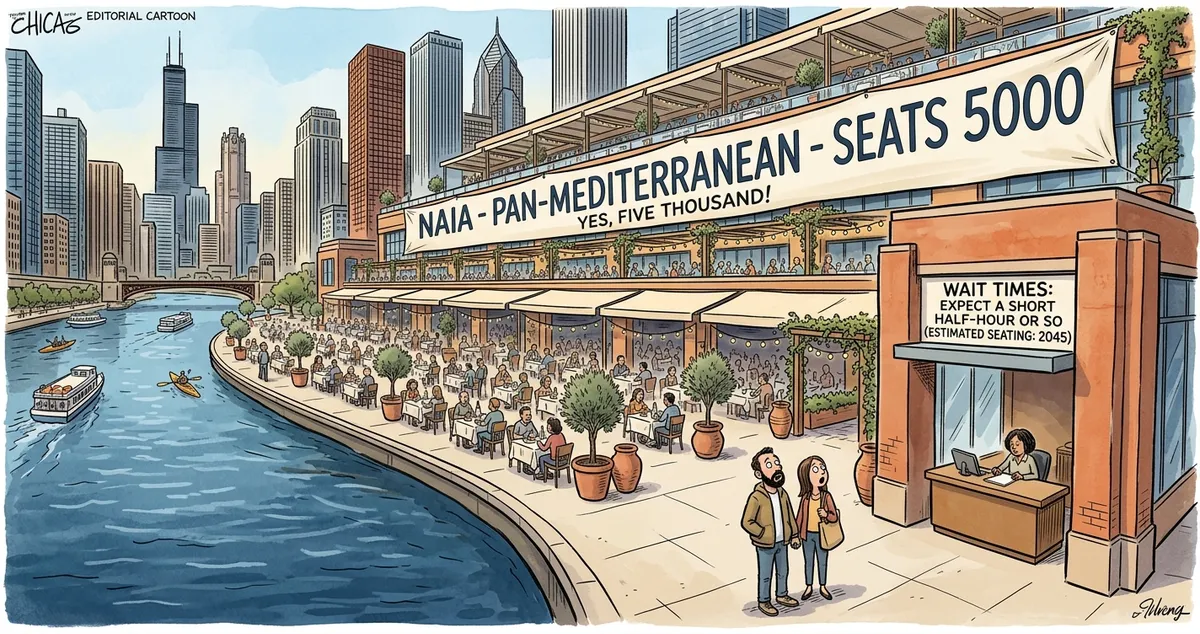
New 12,000-Square-Foot Pan-Mediterranean Restaurant Opening on Chicago Riverwalk Is Just a Restaurant, Developers Insist
A new restaurant called NAIA is scheduled to open on the Chicago Riverwalk at 300 North LaSalle Street, occupying 12,000 square feet of space across an entire river-level city block, featuring 150 feet of river frontage, seating for 500 guests, and a concept its backers describe as “pan-Mediterranean.” A spokesperson for the investment group behind the project — Meridian Table Partners, an experiential dining fund not previously known to this reporter — described NAIA in a press release as “an intimate gathering place where the flavors of the Mediterranean coastline meet Chicago’s dynamic waterfront energy.” The words “intimate” and “12,000 square feet” were used in the same document, separated by two paragraphs.
For context: the average Chicago restaurant occupies between 2,000 and 3,500 square feet. A full city block in the Loop measures approximately 300 feet by 300 feet. The term “pan-Mediterranean” refers to a culinary tradition spanning roughly 21 countries and 46,000 kilometers of coastline, which, when deployed as a restaurant concept in a 12,000-square-foot space on the Chicago River, achieves a kind of geographic compression that physicists have not yet fully theorized. NAIA’s executive chef, who was announced in a separate press release, described the menu as “a love letter to everywhere.”
The restaurant will span what the development team calls “an immersive dining environment” across three interconnected zones: a lounge area, a main dining room, and a riverview terrace with retractable glass walls. A fourth zone, described in planning documents as a “private event corridor,” can be separated from the main floor via partition walls to accommodate corporate bookings, which, at a 500-seat Mediterranean restaurant on the Chicago River, is presumably the kind of booking that comes in from companies that need to celebrate something very large. The reservation system, the spokesperson confirmed, is “digital-first.”
The 150 feet of river frontage is the detail that has attracted the most attention from the Chicago restaurant community, most of whom have spent careers competing for Riverwalk permits that are, in the words of one longtime Chicago restaurateur who asked not to be named, “the single most contested real estate in the city, per linear foot, that doesn’t involve a parking space.” NAIA’s allocation of 150 linear feet — equivalent to approximately half a standard city block — was awarded through the city’s Riverwalk concession process, a competitive bid that a Department of Transportation spokesperson described as “rigorous and transparent,” and that a second spokesperson in the same department described as “ongoing, in terms of documentation,” suggesting the two were thinking of different things.
Meridian Table Partners declined to disclose the total investment in NAIA but noted that the project includes “a significant capital commitment to interior finishes, custom millwork, and sourcing relationships with suppliers across the Mediterranean region,” a sentence that this reporter parsed as meaning the olive oils will be very good and the chairs will be expensive. A comparable Chicago restaurant buildout in the 3,500-square-foot range typically runs $2 to $4 million. Scaling proportionally to 12,000 square feet — which is not how restaurant economics work, but which is the math available to this reporter — produces a figure in the range of $7 to $14 million before equipment. When asked for an actual number, the spokesperson said “the economics are strong.”
The restaurant is expected to open in late spring. The Riverwalk, which runs along the south bank of the Chicago River through the Loop and is administered by the city’s Department of Transportation, currently hosts approximately a dozen food and beverage establishments ranging from small counter-service operations to full-service restaurants. NAIA will be the largest by a margin that the Dispatch estimates, conservatively, at a factor of three. Neighboring operators reached for comment said they had not been informed of the new tenant’s dimensions in advance, and one owner of a smaller Riverwalk food stand described the disclosure as “a lot to process,” a phrase that adequately summarizes the experience of learning that the empty block next to you is becoming a 500-seat Mediterranean experience destination.
Asked whether 500 seats represented a realistic nightly capacity or an architectural maximum, the NAIA spokesperson said the restaurant was “designed to flex.” Asked what that meant operationally, the spokesperson said the design team had “incorporated learnings from hospitality environments at scale.” This reporter, who has eaten at restaurants, noted that the word “flex” does not typically resolve the question of whether 500 people will all want hummus at the same time on a Friday in July, but was told the kitchen had been designed with that in mind. The kitchen, which the spokesperson described as “expansive,” was not included in the floor plan provided to press. Its square footage is, at this time, unconfirmed.