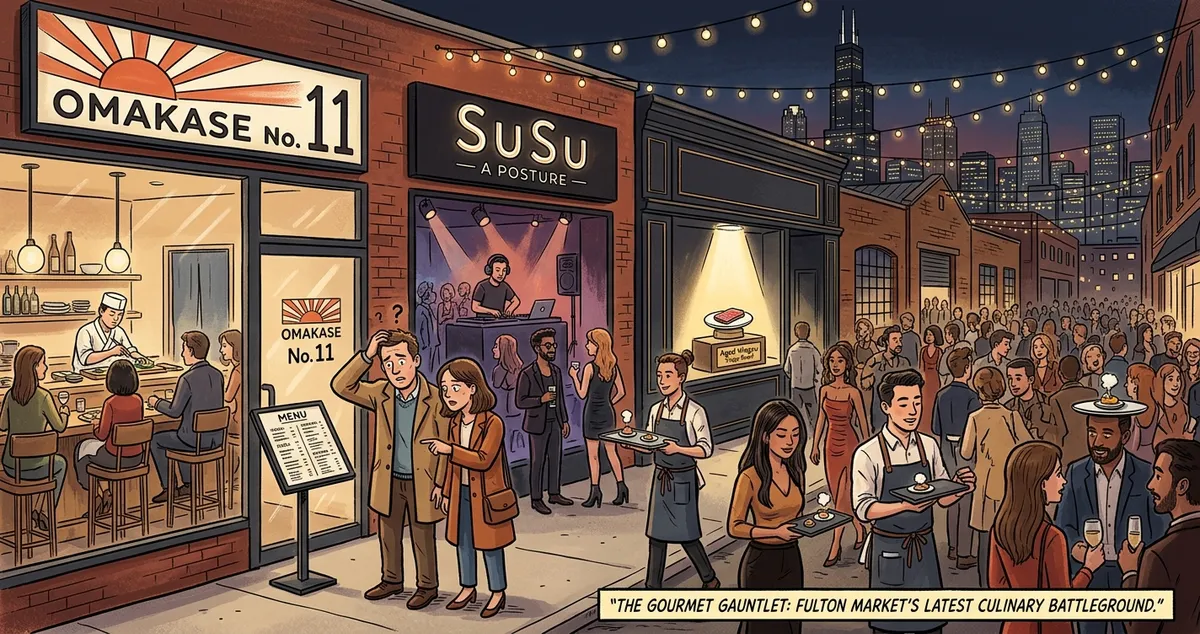
Fulton Market Welcomes Its 11th Omakase, First Restaurant With a DJ, and One Steakhouse Described as 'Opulent' in Its Own Press Release
Chicago’s Fulton Market neighborhood welcomed at least four significant new restaurant openings this week, continuing its decade-long project of converting every former meatpacking facility within a half-mile of Randolph Street into a venue where you can spend $285 per person on food you didn’t select and may not be able to identify.
The highest-profile arrival is SuSu, a steakhouse that has taken over the former home of Grace — later Yūgen, later briefly a private event space, later briefly a pop-up, and now SuSu — at 652 W. Randolph. The restaurant’s pre-opening materials describe its aesthetic as “opulent,” its sourcing as “relentlessly intentional,” and its clientele target as “guests who understand that a great steakhouse is really a great story.” What the story costs has not been publicly disclosed, though a preview tasting hosted for media last week prompted one food writer to post a photograph of a single wagyu slice atop what appeared to be a teaspoon of truffle foam and caption it simply: “Chicago, 2026.”
“SuSu is not just a restaurant,” said creative director Alexis Verhoeven in the brand’s official release. “It’s a posture.” Reached for clarification on what that meant, Verhoeven’s publicist said she would circle back.
In River North, the Boka Restaurant Group has opened Gingie at the former GT Prime space, representing what company materials call “an evolved approach to the modern chophouse.” Industry observers noted that GT Prime itself opened in 2016 as “an evolved approach to the modern steakhouse,” a distinction one local restaurateur called “load-bearing” and another called “essentially meaningless.” Gingie has already received a three-month waitlist, which its reservations platform — a $9/month subscription service called TableHold — describes as “a testament to appetite.”
The other major arrival is Osaka Nikkei, a Peruvian-Japanese concept in Fulton Market that will feature weekend DJ sets, which its ownership group, Meridian Hospitality Ventures LLC, calls “the logical next step in the evolution of dinner as an audio-visual experience.” The DJ, a local house music producer who performs under the name DJ Omakase, said he was “honored to be part of this food journey.” A Yelp reviewer who attended a preview event said the music was “very loud for raw fish.”
In Lincoln Park, a second location of a Jewish deli has opened, quietly, with no press release, no DJ, no foam, and a menu featuring brisket described as “brisket.” It was fully booked through July within 48 hours of its announcement on Instagram. No PR agency was involved.
The West Loop’s restaurant expansion has now outpaced its residential growth by a margin that real estate analysts at Heartland Equity Partners called “nutritionally unsustainable,” though Heartland Equity Partners was also an early investor in a SuSu-adjacent venture the firm describes as “hospitality-adjacent retail,” so their objectivity is limited. A spokesperson for the Fulton Market Business Association said the neighborhood remains “dynamic” and “curated” and “exactly where Chicago’s dining future is being written,” before acknowledging that she had been repeating some version of this statement since 2019 and “maybe it’s time to refresh the language.”
The Chicago Tribune’s dining critic, who has reviewed 23 Fulton Market restaurants since 2018, said this week’s openings represented “a maturation of the neighborhood’s identity,” then paused and said, “Actually, I’m not sure what that means anymore. There are a lot of restaurants. They’re expensive. Some of them are good.” She asked that her name not be attached to that quote. We have honored her request.
The Andersonville neighborhood, meanwhile, is in the middle of its annual Restaurant Week, during which local restaurants offer prix fixe menus at $25, $40, and $55 price points. No DJ sets have been announced. Foam has not been mentioned. The brisket at Svea is $18.