Startup Launches $14 Bottles of 'Premium' Lake Michigan Water, Sells Out in Hours
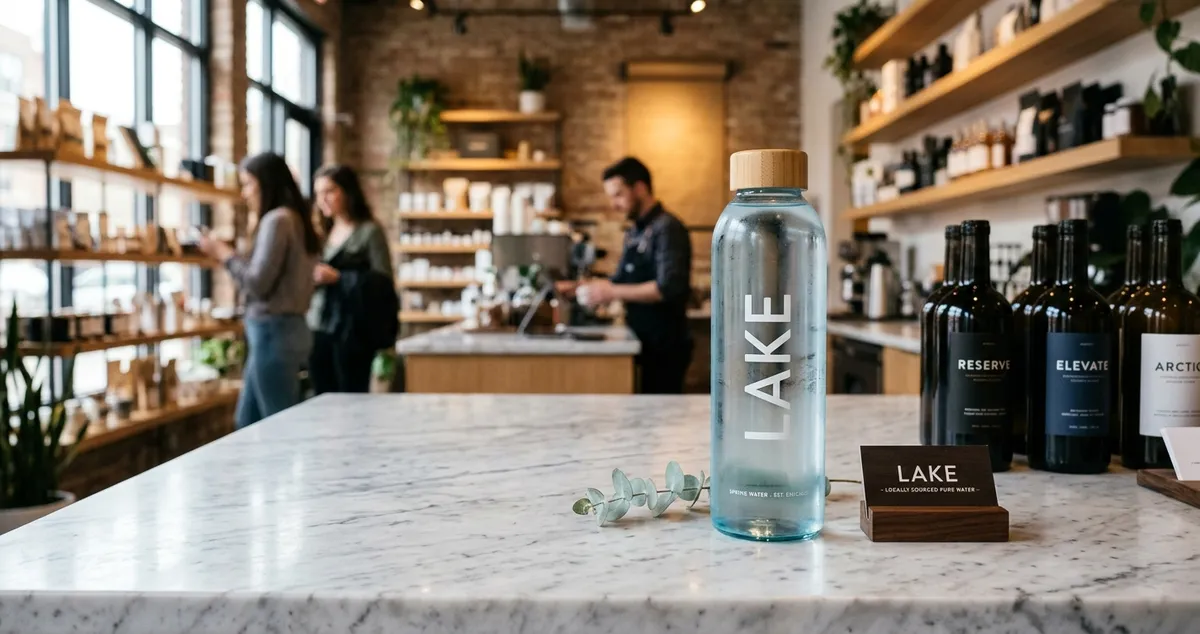
The bottle is beautiful. That much is not in dispute. Hand-blown borosilicate glass, bamboo cap, a single word — LAKE — etched in a custom sans-serif typeface that probably cost more to develop than most people’s cars. The water inside is clear, still, and sourced from Lake Michigan, which is also where the water in your kitchen faucet comes from. The bottle costs fourteen dollars. The faucet water costs roughly a tenth of a cent per glass. LAKE™ sold out its initial run of 5,000 bottles in under four hours.
“We’re not selling water,” said co-founder and CEO Brennan Whitley, sitting in LAKE’s Fulton Market showroom on a stool that appeared to be made of reclaimed driftwood. “We’re selling an experience. A relationship with your local watershed.” He paused, looked at the bottle in his hand, and added: “Also, we’re selling water.”
LAKE — stylized in all caps, trademarked, and incorporated in Delaware despite being ostentatiously Chicago — launched last week with a pop-up in the West Loop and an Instagram campaign featuring slow-motion pours against the city skyline. The company’s pitch is straightforward: Lake Michigan water, filtered through a proprietary seven-stage process, UV-treated, minerally “rebalanced” to what Whitley calls “the lake’s original intention,” and bottled in reusable glass. Each bottle includes GPS coordinates of the intake point and a QR code linking to that day’s EPA water quality report — data that is, it should be noted, freely available to anyone with a browser.
The seven-stage filtration process, when pressed for details, breaks down as follows: sediment filtration, activated carbon, reverse osmosis, UV sterilization, mineral re-addition, a “resting period” in copper vessels, and what the company’s website describes as “intentional stillness.” When asked what intentional stillness means in a water-treatment context, Whitley said it was “more of a philosophy than a step” and redirected the conversation to the packaging.
Investors appear unbothered by the philosophical ambiguity. Driftglass Ventures, a Chicago-based firm that specializes in what it calls “mindful consumer goods,” led a $2.3 million seed round in January. “The bottled water market is $350 billion globally,” said Driftglass partner Amara Osei. “LAKE is positioned at the intersection of sustainability, locality, and premium hydration.” She did not elaborate on what premium hydration means and how it differs from regular hydration, and a follow-up email requesting clarification went unanswered.
Chicago’s Department of Water Management, which oversees one of the largest municipal water systems in the world and delivers Lake Michigan water to 5.3 million people daily, declined to comment on LAKE specifically. A spokesperson did note that Chicago’s tap water “meets or exceeds all federal and state drinking water standards” and is “available 24 hours a day at a fraction of a cent per gallon.” The statement did not include a QR code.
Consumer reviews have been polarized along predictable lines. Five-star reviewers praise the taste (“noticeably smoother”), the packaging (“I display it on my counter”), and the concept (“finally, someone is honoring our lake”). One-star reviewers tend to use the word “tap” a lot. A widely shared Reddit post titled “I did a blind taste test: LAKE vs. my Brita vs. the drinking fountain at Millennium Park” concluded that all three were “fine” and that the author “would like those forty-five minutes of my life back.”
Whitley, for his part, seems unfazed by the criticism. The next production run — 15,000 bottles — is scheduled for April, and the company is exploring a subscription model called “LAKE Flow” that would deliver two bottles per week to your door. “People spend fourteen dollars on a cocktail without thinking twice,” he said. “This is water from one of the greatest freshwater bodies on the planet, in a vessel designed to last a lifetime. It’s an investment in hydration.” He took a sip from his own bottle, held it up to the light from the showroom’s floor-to-ceiling windows, and nodded approvingly, as though the water had just said something he agreed with.