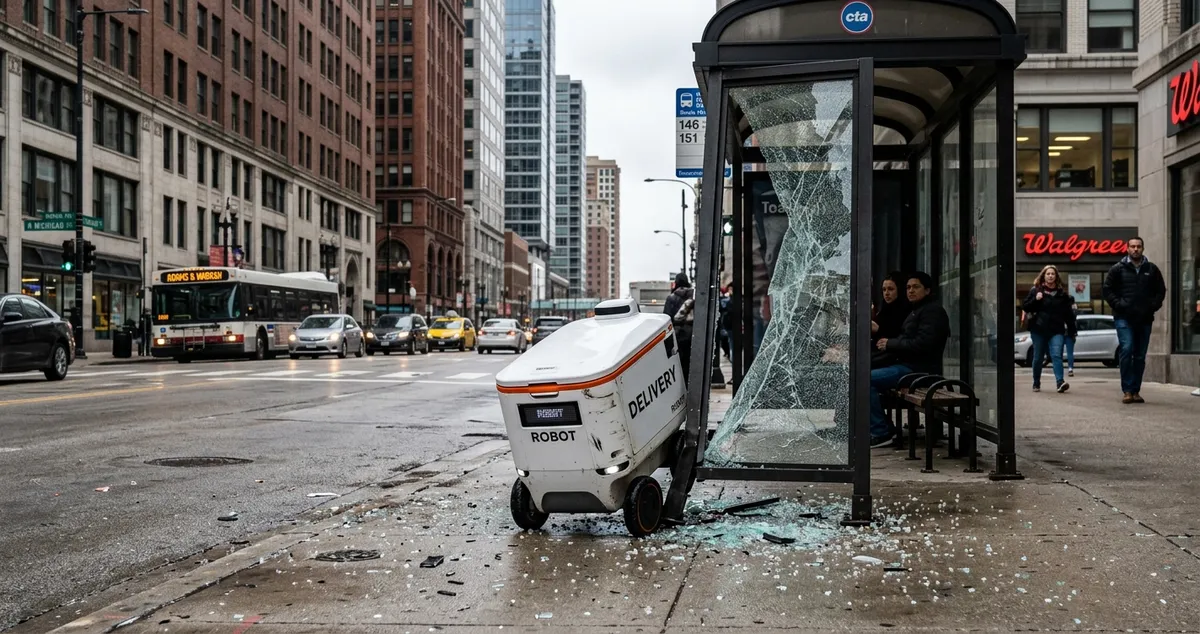
Two Food Delivery Robots Have Now Crashed Into CTA Bus Shelters, Which Raises Some Questions
In the span of a single week, two separate food delivery robots from two separate companies have now crashed into two separate CTA bus shelters on Chicago’s Near North Side, a coincidence so specific it suggests either a systematic flaw in autonomous sidewalk navigation or a deeply personal grudge against public transit infrastructure. A third possibility — that the bus shelters wandered into the robots’ path — has not been formally proposed but cannot, at this juncture, be entirely ruled out.
The first incident involved a Serve Robotics unit at the intersection of Racine and West Chicago Avenue in West Town, where surveillance footage captured the robot approaching a bus shelter at what witnesses described as “a confident pace” before making contact with the glass panel. The second, days later, involved a Coco Robotics unit at a nearby location and resulted in similar structural consequences. Both incidents produced broken glass. One produced viral video. Neither produced a satisfying explanation.
“These events represent a meaningful dataset,” said Dr. Patricia Welch, a researcher in urban autonomous systems at IIT who was contacted for comment and who did not ask to be called an expert but has been called one here anyway. “Two incidents in close geographic proximity, close temporal proximity, involving similar infrastructure, from different platforms — that is not random noise.” When asked what it was if not random noise, she said “a pattern” and requested that her institution’s name not be used in a sentence that also contained the phrase “robots are bad at their jobs.”
Serve Robotics and Coco Robotics both issued statements describing the incidents as “isolated” and noting their commitment to “continuous improvement.” Serve Robotics added that its unit had been “operating within normal parameters” at the time of impact, which is either reassuring or not reassuring at all depending on what one considers normal. Coco Robotics said it was “reviewing telemetry data,” which is the autonomous-vehicle-sector equivalent of saying “we’ll get back to you.”
The CTA, which owns the bus shelters and is currently managing a $2.1 billion federal funding dispute over an entirely unrelated but equally frustrating infrastructure matter, declined to provide a repair cost estimate for the damaged panels but noted that the shelters serve real riders on real transit lines and that the agency “takes infrastructure integrity seriously.” A CTA spokesperson confirmed that both shelters remained operational following the collisions, in the same spirit that a human being can remain operational after walking into a glass door.
What makes the incidents particularly interesting, from a data standpoint, is that both robots were presumably operating with the same fundamental mandate: get the food to the person who ordered the food without hitting anything. The second part of that mandate is generally considered non-negotiable. Both robots negotiated it anyway.
Chicago alderpersons representing the affected wards have requested a briefing on sidewalk robotics permitting, which is the kind of sentence that would have seemed like satire in 2018 and now appears on actual legislative calendars. The city currently has no specific ordinance governing delivery robot behavior near CTA infrastructure, an oversight that, in retrospect, seems obvious. “We regulate where food trucks can park,” noted one spokesperson for the Department of Business Affairs and Consumer Protection. “We probably should have gotten ahead of the robot thing.”
Industry analysts suggest the Chicago incidents are unlikely to slow the broader deployment of delivery robots, which have expanded to more than forty cities and whose boosters argue that occasional contact with fixed objects is a normal part of any autonomous system’s learning curve. “Cars hit things too,” said one unnamed operator at a sidewalk robotics conference in February, in what he apparently intended as reassurance. The key difference, several transit advocates noted, is that cars are generally not allowed on the sidewalk, a distinction the robots appear to be actively testing.
Both units have been returned to service following review. The bus shelters are awaiting replacement glass. The food, in both cases, was delivered.