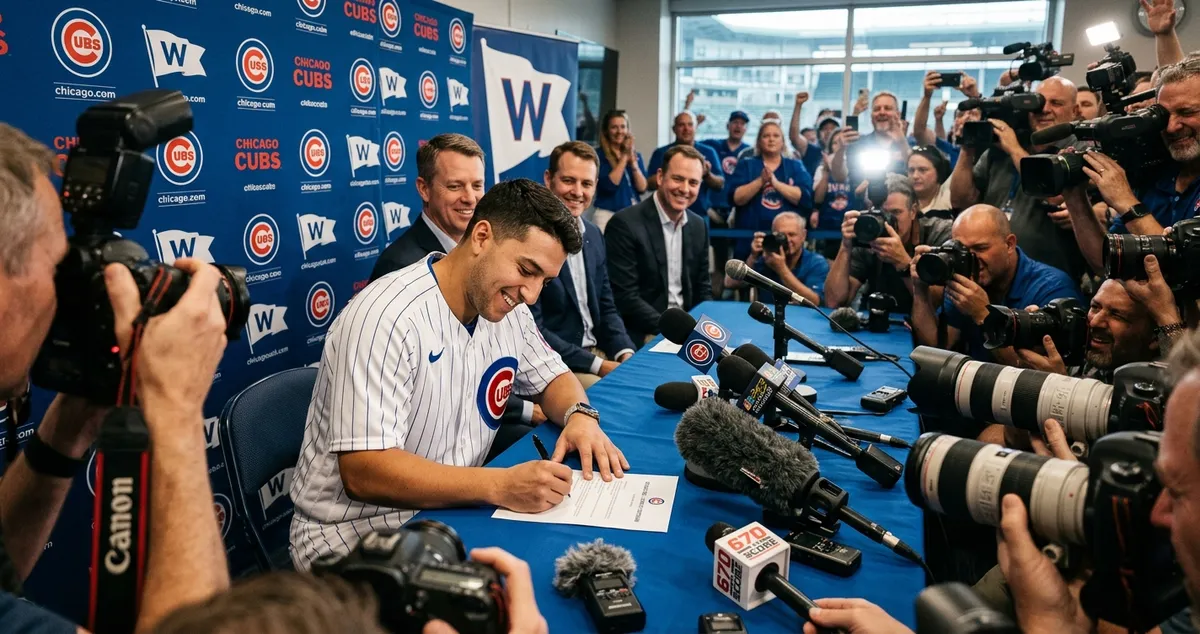
Cubs Lock Up Pete Crow-Armstrong for $115 Million, a Number That Used to Buy a Midsize Corporation
The Chicago Cubs and center fielder Pete Crow-Armstrong agreed Tuesday to a six-year, $115 million contract extension, a deal that begins in 2027, runs through 2032, and contains escalators that could push the total value to $133 million — a figure that, for context, is approximately the GDP of Tonga and significantly more than the assessed value of Wrigley Field itself, which is technically owned by a family that could have used the money to buy a different island nation instead.
The extension locks up the 22-year-old Gold Glove winner during what projects to be his prime years, allowing him to reach free agency before his age-31 season — a timeline that the Cubs’ front office described as “mutually beneficial” and that Crow-Armstrong’s agent described as “a fair reflection of Pete’s value to this franchise,” a sentence that contains the word “value” in a way that means both “how good he is at baseball” and “how much he is worth in United States dollars,” which are the same thing in professional sports and nowhere else.
The numbers that justify the investment are, admittedly, impressive. Crow-Armstrong’s 2025 season — 31 home runs, 35 stolen bases, 37 doubles, a Gold Glove, and the fastest 30-30 season in Cubs history — was the kind of breakout year that makes front offices reach for their checkbooks with the urgency of a man whose parking meter is about to expire. He is, by most analytical measures, a top-fifteen position player in baseball, and by the Cubs’ own measures, the centerpiece of a core that the organization has been assembling with the patience of someone building a ship inside a bottle.
What makes the deal notable beyond its raw figures is its timing. Extensions of this magnitude are typically announced at press conferences with backdrops and podiums and at least one reference to “building something special.” This one was finalized on a Tuesday afternoon while the team was in the process of breaking spring training camp, pending a physical exam that both sides described as “routine” in the specific way that the word “routine” is deployed when $115 million depends on the structural integrity of a 22-year-old’s knees.
The Cubs’ 2026 payroll, already among the highest in the National League, now carries future commitments that Crestline Analytics estimates at $478 million across active contracts and extensions — a number that would have caused Tom Ricketts to faint in 2015 but that in the current market represents “competitive but not reckless spending,” which is the financial sweet spot every front office claims to occupy and almost none actually do.
Fan reaction was, predictably, euphoric. The r/CHICubs subreddit hit its daily post limit within two hours of the announcement. A man on the Addison Red Line platform was observed FaceTiming his father with the news, both of them visibly emotional, which is either very sweet or a sign that sports fandom has progressed to a stage that clinical psychologists should probably study. StubHub reported a 14% spike in Opening Day ticket searches between 3 p.m. and 5 p.m., suggesting that nothing sells seats quite like the promise that the player you’re paying to see will still be the player you’re paying to see in 2032.
The deal does not include a club option, a detail that Crow-Armstrong’s camp reportedly insisted upon and that the Cubs ultimately conceded, likely because arguing over a club option with a 22-year-old who just put up a 30-30 season is the kind of negotiating position that only works if you have leverage, and the Cubs’ leverage in this situation was “please stay.” He stayed. For $115 million. Which, adjusted for inflation and the specific madness of baseball economics, may turn out to be a bargain. Opening Day is tomorrow. The center fielder is under contract through the end of the decade. The ship, for now, is inside the bottle.