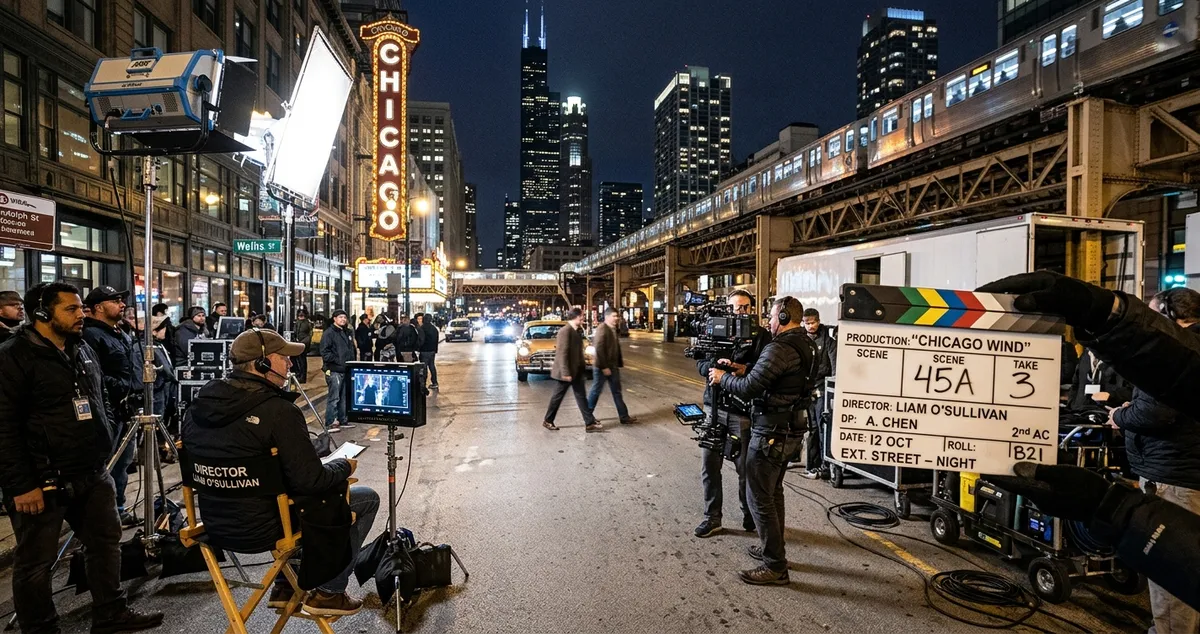
Illinois Film Industry Hits $703 Million in Spending, Residents Report Being Asked to Move Their Car at Least Once a Week
Governor JB Pritzker announced last week at Cinespace Studios that Illinois film production expenditures reached a record $703 million in 2025, a 25% increase over pre-pandemic levels and a figure that represents either a triumph of state economic policy or the reason you couldn’t park on your own block last Tuesday, depending on whether you work in the industry or simply live near it.
The announcement was accompanied by the kind of statistics that make press releases glow: 18,000 industry hires, $401 million in wages (up from $350 million in 2019), and an independent analysis showing a $6.81 return on investment for every dollar spent on the state’s 35% transferable film tax credit. That last number is the one the governor’s office would very much like you to focus on, because $6.81-to-one is the kind of ratio that makes fiscal policy sound like a slot machine that only pays out, which is exactly the kind of thing you say when you’ve extended the credit through 2039.
The practical reality of being the nation’s third-ranked film city, behind only Los Angeles and New York, is that Chicago now exists in a state of permanent low-grade production. At any given moment, somewhere between three and eleven city blocks are closed, coned, or festooned with “NO PARKING — FILM PRODUCTION” signs that appear overnight with the silent efficiency of a military operation and disappear 72 hours later, leaving behind nothing but tire marks and a vague sense that you may have seen someone famous through a catering tent flap.
“I’ve been asked to move my car six times since January,” said Lakeview resident Amanda Pratt, 38, a data engineer who works from home and whose street, North Southport Avenue, has apparently been deemed the most filmable block in the Midwest. “They leave a note on the windshield. Very polite. ‘Dear Resident, we are filming a major motion picture in your neighborhood.’ I don’t know what the movie is. I’ve never been told what the movie is. I’ve started calling it ‘The Movie’ like it’s a natural disaster.” Pratt added that she has received $75 in gift cards to a local coffee shop as compensation, a gesture she described as “nice but not quite equivalent to the experience of carrying groceries an extra three blocks because your street has become a soundstage.”
The economic ripple effects are real and well-documented. Hotels, restaurants, and equipment rental companies across the metro area report measurable bumps during active production periods. Cinespace’s Chicago studios — the largest independent studio complex outside of Hollywood — are operating at near-full capacity, and a planned expansion will add 200,000 square feet of production space by 2028. The ecosystem now includes pre-production houses, post-production facilities, and a talent base deep enough that Chicago can staff a major production without importing more than a handful of above-the-line personnel from the coasts, a milestone that the Illinois Film Office describes as “self-sustaining” and that Los Angeles describes as “concerning.”
Critics of the tax credit — and there are some, though they tend to speak quietly at economic policy conferences rather than loudly at press events at Cinespace — note that the $6.81 ROI figure includes indirect and induced spending, which is the economic equivalent of counting the money your neighbor spends after you give them a dollar. A narrower analysis focused on direct tax revenue recapture puts the return closer to $1.40 per dollar, which is still positive but considerably less cinematic. “It’s a good program,” said Northwestern economist Dr. Frank Hedges. “It’s not a magic program. The state is paying a premium for an industry that is, by nature, mobile. If Georgia or New Mexico offer 40%, some of these productions leave.” He paused. “But I understand why that doesn’t make the press release.”
For residents of Chicago’s most-filmed neighborhoods — Pilsen, Wicker Park, the West Loop, and increasingly Bronzeville — the question is less about macroeconomics than about micro-inconvenience. A Reddit thread titled “Is it just me or is every street in Chicago a film set now” garnered 1,200 comments in three days, ranging from the philosophical (“we are all extras in someone else’s movie”) to the practical (“they blocked the alley again and I had to parallel park on Ashland, which I consider a human rights violation”).
The governor’s office did not address the parking situation in its announcement, focusing instead on the broader narrative of Illinois as a cultural and economic hub. “This is what happens when you invest in your creative economy,” Pritzker said at the podium, flanked by studio executives and a lighting rig that someone had forgotten to move. Behind him, through the studio’s loading dock, a PA could be seen placing a “NO PARKING” sign on the street outside. The circle, as they say, was complete.