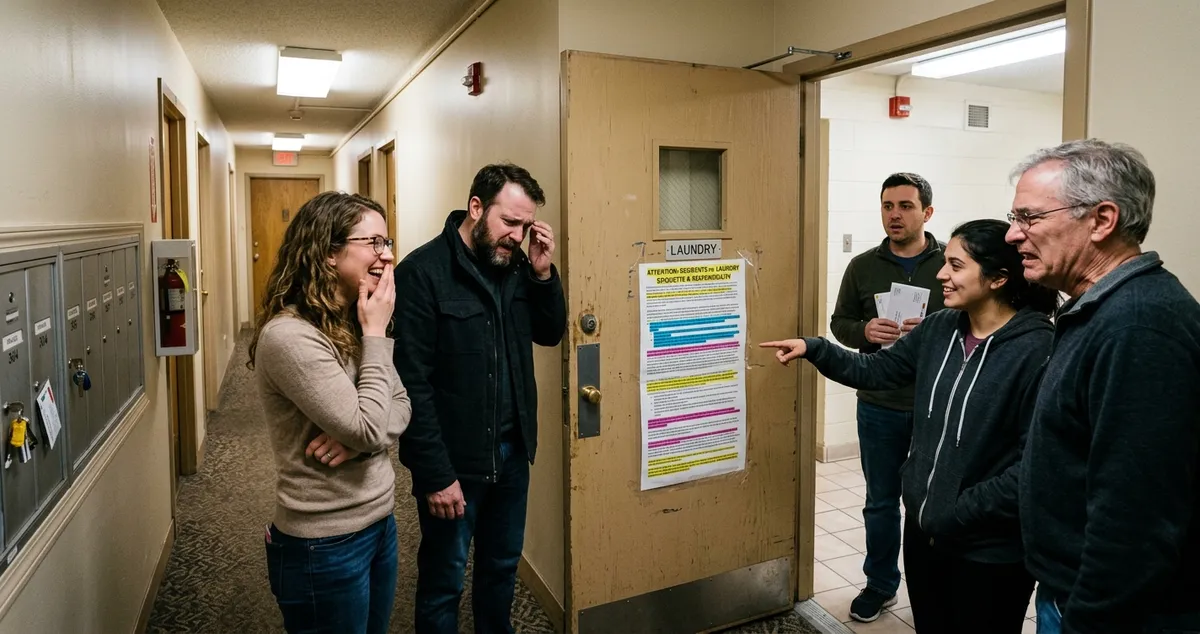
Lakeview Apartment Laundry Room Enters Third Week of Passive-Aggressive Note Escalation
The basement laundry room of 3242 North Sheffield Avenue is not large. It contains four washers, three dryers (one perpetually out of order), a folding table with a wobble, and, as of this week, fourteen laminated notes engaged in what residents have begun calling “the discourse.” The discourse started with lint. It has since expanded to encompass load timing, detergent brand selection, the ontological status of “forgot” versus “chose not to,” and at least one reference to the Geneva Convention.
The opening salvo appeared on February 28: a single sheet of printer paper taped above Dryer 2 reading, “PLEASE clean the lint trap after use. It’s a fire hazard. Thank you! :)” The smiley face, in retrospect, was doing a lot of heavy lifting. Within forty-eight hours, a response appeared: “I ALWAYS clean the lint trap. Maybe check your facts before posting accusations. — 4B.” The absence of a smiley face was noted by all parties.
“That’s when we knew it was serious,” said third-floor resident Dana Kowalski, who has been documenting the exchange in a group chat she created titled “Laundry Lore.” “The first note had a smiley. The response didn’t. In passive-aggressive note culture, that’s basically a declaration of war.”
The exchange accelerated through the first week of March. Note Three introduced the concept of “lint accountability” and suggested a sign-out sheet. Note Four called the sign-out sheet “authoritarian.” Note Five — printed in color, a significant escalation — proposed a rotating lint-trap schedule with assigned time slots, which Note Six rejected on the grounds that “this is a laundry room, not a co-op board meeting.” Note Seven simply read: “It is, in fact, a co-op board meeting. See bylaws, section 14.3.”
Building management has declined to intervene. Property manager Steve Lattimore, reached by phone, said he was “aware of the situation” and considered it “self-regulating.” When asked if he had read the notes, he said he had and described them as “honestly pretty well-written.” He added that he had no plans to remove them, as “they’re laminated, and I respect the commitment.”
The literary quality of the notes has, in fairness, improved markedly since the early days. What began as block-letter grievances scrawled in Sharpie has given way to carefully formatted documents with headers, bullet points, and in one case, a footnote. Note Eleven, widely regarded as the masterpiece of the collection, opens with an epigraph attributed to Marcus Aurelius (“The object of life is not to be on the side of the majority, but to escape finding oneself in the ranks of the insane”) before pivoting to a 200-word argument about fabric softener residue.
Residents who are not directly involved in the exchange have developed their own relationship with it. Several have reported visiting the laundry room solely to check for new installments. “I don’t even have laundry to do,” admitted second-floor tenant Miles Huang. “I just go down there with my coffee on Saturday mornings. It’s better than most podcasts.”
The identity of the original note’s author remains unconfirmed, though building speculation has narrowed the field to two suspects in units 2A and 3F, both of whom own laminating machines — a detail that several residents found “suspicious but also kind of impressive.” As the exchange enters its third week, there are no signs of resolution, de-escalation, or anyone actually cleaning the lint trap. The wobble in the folding table, meanwhile, persists.