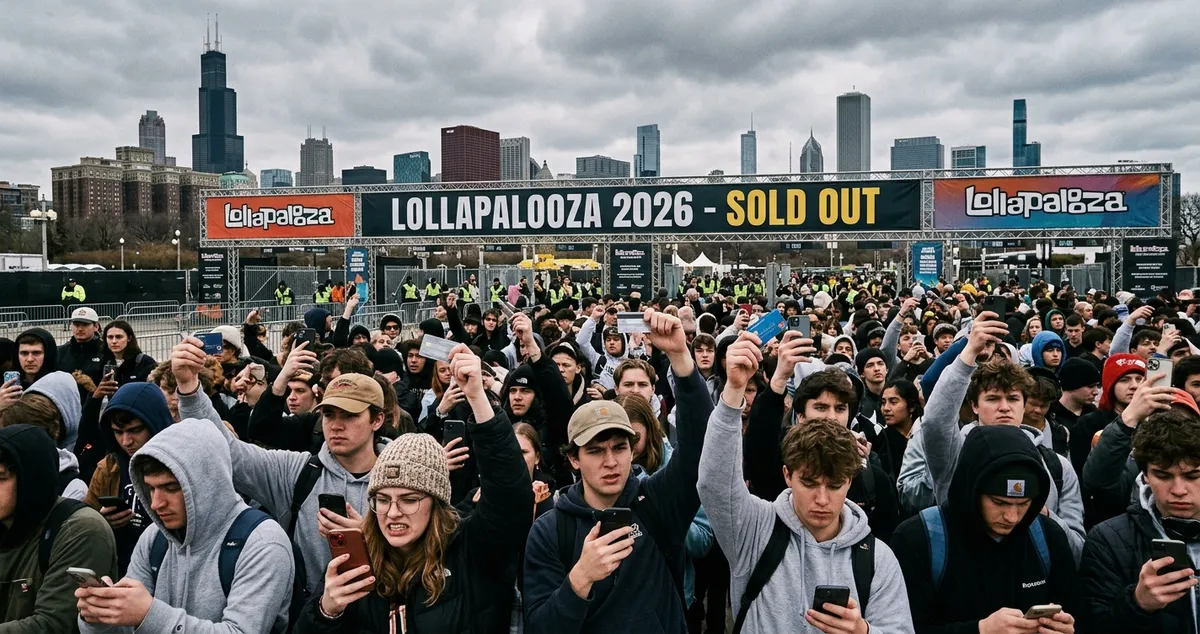
Lollapalooza 2026 Sells Out in 11 Minutes, Setting New Record for Fastest Way to Spend $399
Lollapalooza’s 2026 ticket sale lasted approximately eleven minutes on Thursday morning — long enough to brew a pour-over, not long enough to drink it — before every four-day general admission pass was claimed and the festival’s website began displaying the word “WAITLIST” in a font size that felt, to many, personally aggressive.
The sellout, which organizers called “a testament to the incredible demand for live music in Chicago,” was more precisely a testament to the incredible demand for anything that sells out in eleven minutes. By 10:50 a.m., GA, GA+, and VIP tiers had all been exhausted, leaving only the “Lolla Insider” package available at a price point that the festival’s own FAQ describes as “an elevated experience” and that everyone else describes as “more than my rent.” The Insider tier, which starts at $4,200 for four days, includes perks such as dedicated viewing platforms, climate-controlled restrooms, and the ability to tell people you spent $4,200 on a music festival without anyone being surprised.
The lineup, announced Monday, features headliners Charli XCX, Lorde, the Smashing Pumpkins, and Tate McRae — a combination that one music industry analyst described as “strategically engineered to appeal to every person who has ever had a Spotify account.” John Summit, the Chicago-born DJ whose real name is absolutely John Summit, will also headline, marking the first time a local act has topped the bill since the festival began its tradition of pretending to be a Chicago event while booking almost exclusively non-Chicago artists.
The secondary market responded to the sellout with the speed and restraint of a seagull near an unattended hot dog. Within an hour of the official sellout, four-day GA passes were listed on resale platforms at prices ranging from $800 to $1,600 — a markup of 100 to 300 percent that economists would call “price discovery” and that normal people would call “criminal, probably.” One listing on a popular resale site included the note “FIRM ON PRICE — I know what I have,” which is technically true in the same way that a person holding a winning lottery ticket knows what they have, except that what this person has is permission to stand in Grant Park in August.
Festival organizers urged disappointed fans to join the waitlist, which they described as “a great way to stay connected to the Lollapalooza experience.” When pressed on how many waitlisted fans could expect to receive tickets, a spokesperson said the number was “dynamic” and “dependent on a variety of factors,” which is corporate for “we genuinely do not know.” The spokesperson also noted that single-day lineups would be announced in the coming weeks, offering fans a chance to spend a different amount of money to see a smaller portion of the festival, which is apparently a selling point.
The Grant Park festival, now in its 35th year, has become something of a civic institution — a four-day period each summer when residents of the surrounding neighborhoods board up their windows, noise complaints to 311 spike by 4,000 percent, and the city collects an estimated $300 million in economic impact, most of which appears to be spent on $17 lemonades. This year’s expansion to a fourth day, July 30 through August 2, means an additional 24 hours of bass frequencies rattling the windows of condominiums whose owners paid a premium for “park views” without fully thinking through what that meant.
Local businesses near Grant Park expressed cautious optimism about the extended festival, though several noted that the 19 percent hotel tax recently approved by City Council would make the math interesting for out-of-town attendees. “So you’ve got a $399 ticket, a $350-a-night hotel room with a 19 percent tax surcharge, and a $17 lemonade,” said David Park, owner of a Michigan Avenue sandwich shop. “At some point you have to ask yourself: do I like Charli XCX four thousand dollars’ worth?” He paused. “Some people do. Those people are my customers now.”
For now, the waitlist grows. As of Thursday afternoon, the Lollapalooza website’s waitlist page had been visited more than 2.3 million times — a number that, if converted to ticket sales at $399 each, would generate roughly $918 million, or approximately enough to fund the city’s tourism marketing budget for eighteen years. Instead, it will generate nothing, because a waitlist is not a store. It is a place where hope goes to sit quietly and refresh the page.