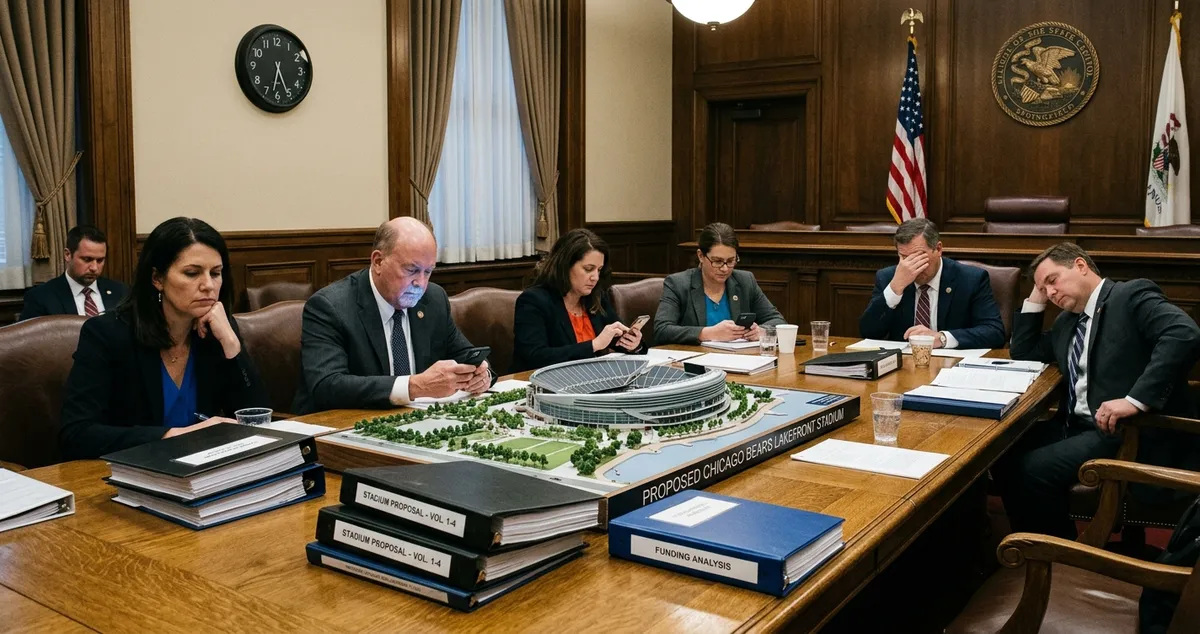
Bears Inform Springfield Stadium Bill Is 'Time-Sensitive'; Legislature Confirms Receipt, Plans to 'Circle Back'
The Chicago Bears organization has formally communicated to Illinois legislative leaders that its proposed lakefront stadium project has entered what internal documents describe as a “time-sensitive phase,” a designation that the franchise hopes will accelerate a bill that has been moving through Springfield at a pace best described as geological. Sources close to the negotiations say the Bears have begun using phrases like “critical window” and “escalating construction costs” in their communications, which legislative aides have acknowledged receiving and placed in a folder labeled “Stadium — Follow Up.”
“We are at a pivotal juncture,” said a Bears spokesperson in a statement that read like it was drafted by someone who has written many statements about pivotal junctures. “The project’s financial model is based on assumptions that become less favorable with each passing quarter. We believe the legislature understands the urgency.” A senior Springfield staffer, speaking on condition of anonymity, responded: “We understand that they believe it’s urgent. That’s different from us believing it’s urgent. It’s a subtle but important distinction.”
The core issue remains unchanged since the Bears first unveiled their lakefront stadium vision: the team wants public financing mechanisms that would offset a significant portion of the project’s cost, which has been estimated at somewhere between $3.2 billion and $4.7 billion depending on which rendering you’re looking at and whether the retractable roof is in the “open” or “closed” position. The legislature, meanwhile, has expressed a willingness to “explore frameworks” — a phrase that, in Springfield’s dialect, means approximately “we have not started.”

Compounding the pressure is the Bears’ current payroll situation. Head coach Ben Johnson, hired in January 2025, commands a reported $13 million per year — a figure that, combined with an aggressive free agency period that saw eleven signings in five days, has given the organization the financial profile of a franchise that is very much trying to win now while simultaneously asking the state to help it build the place where the winning would theoretically occur. “You can’t tell Springfield you need help paying for a stadium while also signing every free agent with a functioning ACL,” said Greg Hinz, a veteran political columnist. “I mean, you can tell them that. They just won’t find it compelling.”
The Bears’ frustration with the legislative timeline is not new, but it has taken on a sharper edge in recent weeks. The franchise has reportedly retained a second lobbying firm — its third overall — and has begun hosting what it calls “stakeholder alignment sessions” in both Chicago and Springfield, which attendees describe as PowerPoint presentations followed by a catered lunch and a long silence during the Q&A portion. One attendee, a downstate representative, told The Dispatch that the presentations are “very professional” and that the stadium model “looks great,” but that he remains unclear on “what, specifically, anyone is asking me to vote for.”
For their part, legislative leaders have signaled that a stadium bill is “on the radar” for the spring session, which ends May 31 — a deadline that creates its own urgency, or would, if the spring session did not routinely extend into the summer through a series of special sessions that make the original deadline largely decorative. “The Bears want certainty,” said one legislative aide. “Springfield offers process. Those are not the same thing, and I think both sides are beginning to understand that.”
The franchise, meanwhile, continues to play at Soldier Field, which it has occupied since 1971 and which, following a 2003 renovation that was itself a masterclass in public-private negotiation, now resembles — in the words of one architecture critic — “a spaceship that landed inside a coliseum and neither of them is happy about it.” The Bears’ lease runs through 2033, giving the legislature, by Springfield’s internal math, approximately seven more years of runway. The Bears, by their own math, need a bill by summer. The actual math, as is tradition, will be determined at a later date.
Rachel Kim covers business and the creative interpretation of deadlines from the West Loop.