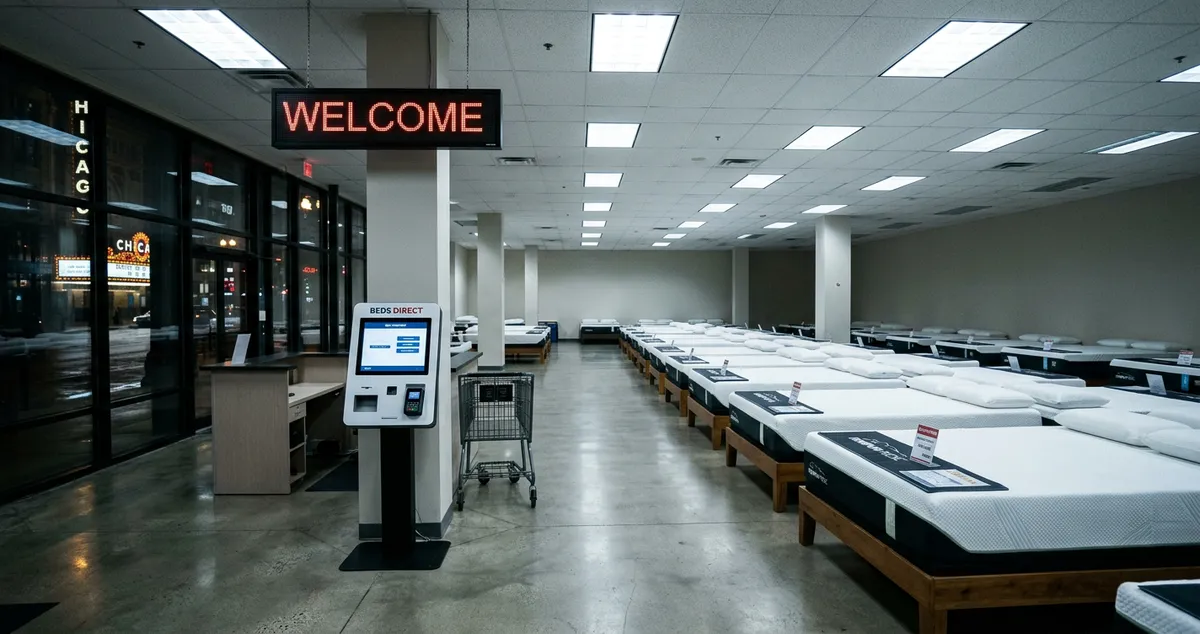
Chicago's First Fully Autonomous Mattress Store Reports Record Quarter Despite Zero Employees and, Apparently, Zero Customers
Beds Direct, the fully autonomous mattress showroom that opened on North Cicero Avenue in December, has completed its first full quarter of operations with what the company describes as “metrics that speak for themselves.” The metrics, obtained by The Windy City Dispatch through a public filing, are as follows: zero employees, zero walk-in customers, zero mattresses sold in-store, and one raccoon that somehow got past the QR-code entry system in January and lived on a Sealy Posturepedic for eleven days before anyone noticed.
“We’re incredibly pleased with the data,” said Beds Direct CEO Nathan Achterberg, speaking via video call from Austin, Texas, where the company is headquartered. “When you remove the friction of human interaction from the mattress-buying experience, you unlock a fundamentally new relationship between the consumer and the sleep surface.” Asked to clarify what that relationship looks like when no consumers have entered the store, Achterberg said the question “reveals a very traditional understanding of retail.”
The Old Irving Park location is part of a growing wave of autonomous businesses sweeping Chicago, from 24/7 unstaffed pickleball courts to self-serve laundromats that have replaced their last remaining attendant with a Slack bot. The trend has been celebrated by retail futurists and commercial landlords who appreciate any tenant willing to sign a five-year lease, and viewed with mild horror by everyone else.

Beds Direct’s model works, in theory, like this: a customer downloads the app, books a 30-minute “sleep appointment,” unlocks the front door with a QR code, lies on mattresses alone in total silence, selects their preferred model on a touchscreen kiosk, and completes the purchase without ever speaking to another human being. In practice, the app has been downloaded 43 times, and 41 of those users abandoned the process at the step requiring a selfie for “biometric entry verification.” The remaining two completed bookings but did not show up.
“The conversion funnel is performing within expected parameters for a pre-traction phase,” said Meredith Ng, an analyst at Lakeshore Ventures, the Chicago-based firm that led Beds Direct’s $4.2 million seed round. “You have to remember, nobody went to Amazon on day one either.” When it was pointed out that Amazon sold its first book within a month of launching, Ng said the comparison was “reductive” and ended the call.
The store itself remains immaculate, according to security camera footage reviewed by The Dispatch. Thirty-seven mattresses sit in pristine rows under fluorescent lighting. A digital welcome sign cycles through messages — “WELCOME,” “FIND YOUR SLEEP MATCH,” “ASK OUR AI CONCIERGE” — addressed to an audience of no one. The AI concierge, a chatbot accessible via a tablet mounted near the entrance, has fielded exactly one query since launch. It was from the raccoon, which stepped on the screen. The chatbot recommended a firm hybrid pillow-top.
Neighboring businesses have expressed a range of reactions. “I thought it was a front for something,” said Diane Kowalski, who owns the hair salon two doors down. “Then I realized it’s worse — it’s just a real business that nobody goes to.” The owner of the taqueria across the street said he stopped by once to see if anyone was inside and was asked by the app to create an account. He declined.
Achterberg maintains that physical foot traffic is “one metric among many” and points to what he calls “ambient brand awareness” — the idea that the store’s mere existence on a busy commercial strip constitutes marketing. “Every person who walks past that storefront and sees the Beds Direct logo is a potential future customer,” he said. A survey of fourteen pedestrians conducted by The Dispatch on a Tuesday afternoon found that twelve did not know the store existed, one thought it was closed permanently, and one asked if it was “the place with the raccoon.”