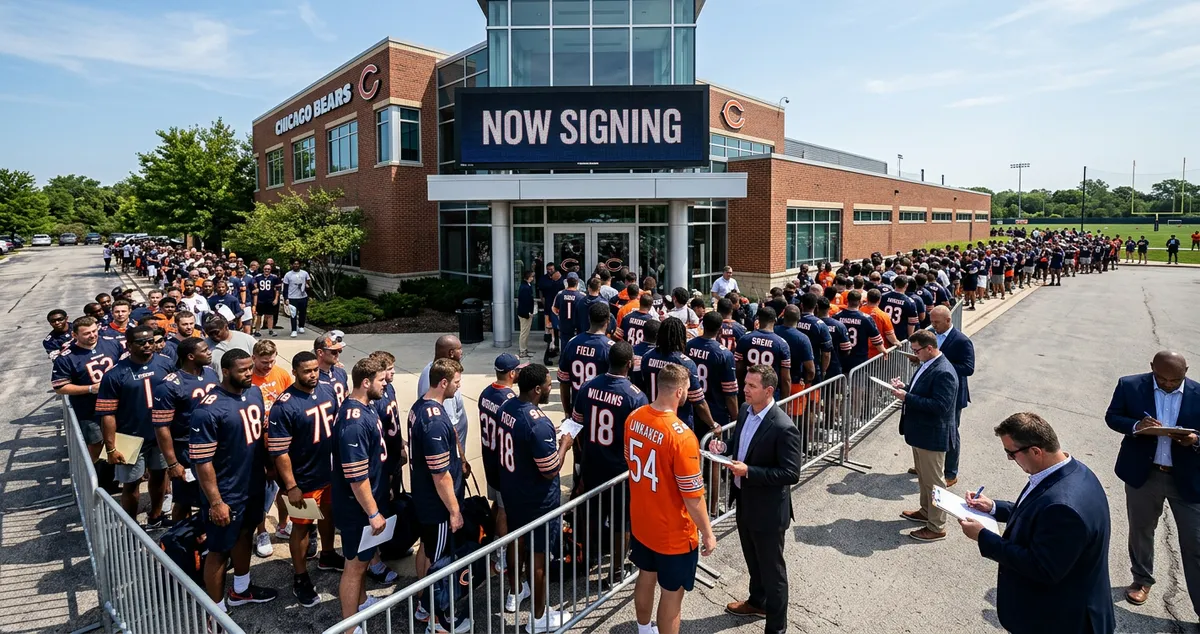
Bears Complete Eleven Free Agent Signings in Five Days, Front Office Calls It 'Strategic Portfolio Diversification'
The Chicago Bears signed eleven players in the first five days of the NFL’s free agency period, a pace that general manager Ryan Poles described in a Tuesday press conference as “strategic portfolio diversification across multiple positional asset classes.” When asked to clarify what that meant in football terms, Poles said it meant they had signed eleven players, and then he said the phrase “positional asset classes” again, and then he moved on to the next question.
The spending spree — which included a three-year, $40 million deal for safety Coby Bryant, a three-year, $30 million commitment to linebacker Devin Bush, and a trade sending a 2027 fifth-round pick to New England for center Garrett Bradbury — represents what the Bears’ official website describes as “a transformative acquisition cycle” and what the rest of the league describes as “the Bears doing that thing where they sign a lot of people and hope some of them work out.” Both descriptions may be accurate. Only one of them appeared in the press release.
The financial architecture of the deals suggests a front office that has read, or at least skimmed, several books about modern portfolio theory. The Bears’ free agency class includes two high-cost, multi-year “anchor investments” (Bryant and Bush), four mid-tier “bridge assets” (Gallimore, Raymond, Wills, and Bradbury), and five low-cost “optionality plays” that the team’s salary cap analyst, speaking on background, described as “basically free looks with asymmetric upside.” When I pointed out that “asymmetric upside” is a term from venture capital, not professional football, the analyst said, “It’s a term from winning,” and then ended the call.
The most instructive signing may be that of Case Keenum, the 38-year-old quarterback who re-signed on a two-year, $5.5 million deal with a maximum value of $8 million. The Bears’ press release described Keenum’s role as a “player-coach hybrid,” a designation that does not exist in the NFL’s collective bargaining agreement and which the NFLPA has reportedly asked the team to clarify. Keenum himself seemed comfortable with the ambiguity. “I’m here to help Caleb,” he told reporters, referring to second-year quarterback Caleb Williams. “Whatever that looks like day to day — whether I’m throwing routes or drawing on a whiteboard or just being a calm, experienced presence in the room — I’m here for it.” A source close to the team said Keenum’s actual duties would include holding a clipboard, offering encouragement, and “being the kind of guy who played in the NFC Championship Game once,” which the source described as “intangible but real value.”
The departures were equally telling. Former Bears safety Jaquan Brisker signed with the Pittsburgh Steelers, a move the Bears did not publicly address but which one anonymous front office source characterized as “a natural portfolio rebalancing event.” C.J. Gardner-Johnson left for Buffalo. Kevin Byard III went to New England. The three departures represent a combined 2025 salary of approximately $28 million, money the Bears reallocated across eleven new contracts in what the front office’s internal documentation apparently refers to as “a talent liquidity redistribution.” I know this because someone in the building texted me a screenshot of a PowerPoint slide with that phrase on it. The slide also contained a chart with two axes labeled “Upside Potential” and “Cultural Alignment.” I was not able to determine what units either axis was measured in.
The market response was cautiously positive. ESPN’s Bears beat reporter gave the class a B+, noting that “the Bears addressed needs at safety, linebacker, and center while maintaining cap flexibility,” which is the football-analysis equivalent of saying a company made “prudent capital allocation decisions.” Pro Football Focus graded the class slightly lower, at 14th overall, partly because its model does not have a variable for “cultural alignment” and partly because one of the eleven signings, defensive lineman Kentavius Street, graded out as the league’s 87th-ranked interior defensive lineman last season, a ranking that would seem to undermine the “asymmetric upside” thesis but which the Bears’ analytics department reportedly described as “a market inefficiency.”
What the Bears have built, viewed from a sufficient distance and with the right spreadsheet open, looks less like a football roster and more like a diversified fund. There are high-conviction bets (Bryant, Bush), speculative positions (Street, Lewis), a legacy asset being retained for advisory purposes (Keenum), and a portfolio manager (Poles) who speaks fluently in a dialect that is 60% football and 40% something he learned at a leadership retreat. Whether this approach produces wins remains to be seen. The 2025 Bears went 10-7 and missed the playoffs, a result that in financial terms would be described as “underperforming relative to expectations but demonstrating sufficient fundamentals to justify continued investment.” In football terms, it would be described as “disappointing.” The Bears appear to prefer the financial terms.