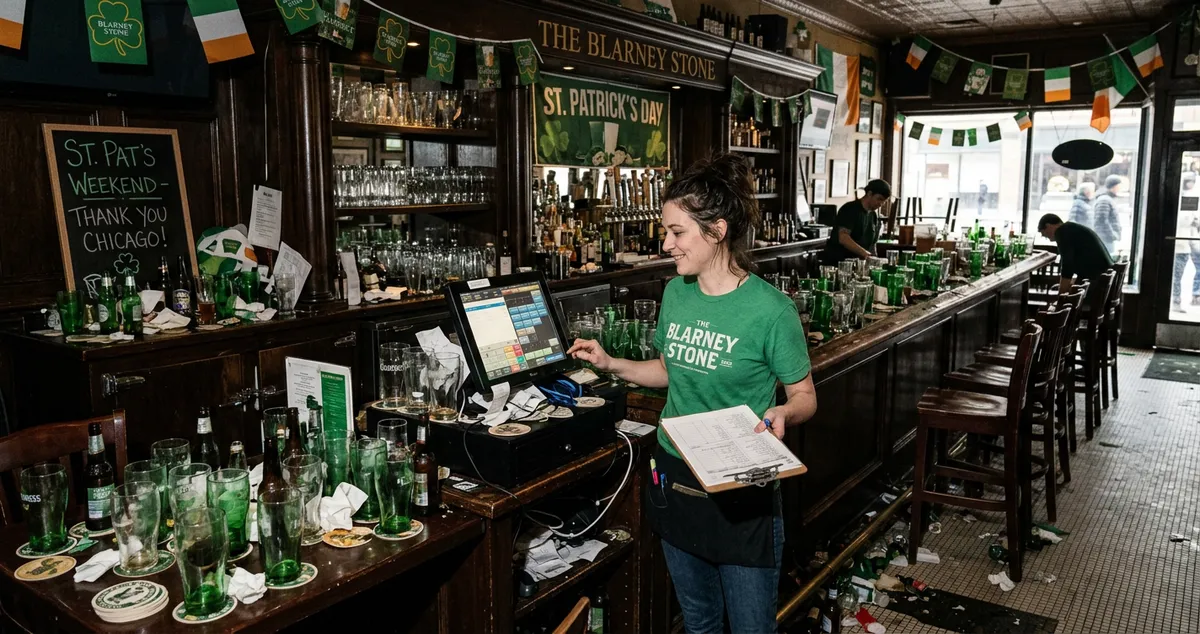
Chicago Hospitality Sector Reports 'Record' St. Patrick's Day Weekend, Declines to Specify Record of What
The Illinois Restaurant Association announced Sunday that Chicago’s St. Patrick’s Day weekend generated “record hospitality revenue” for the third consecutive year, a claim it supported with a press release containing four statistics, two of which were sourced to the Association itself, one of which cited “industry data” without specifying whose industry or which data, and one of which was a quote from a bar owner in River North who said business had been “absolutely insane,” a characterization the Association reproduced verbatim without follow-up.
“Chicago’s St. Patrick’s Day weekend is now a premier economic driver on the national hospitality calendar,” said IRA President Dana Cowell in a statement that also described the city as “the undisputed capital of civic celebration,” a phrase that is not measurable in any known way. When asked how 2026 revenue compared to 2025, a spokesperson said the Association was “not in a position to release a direct year-over-year comparison at this time.” When asked when it would be in a position to do so, she said “following full member reporting,” which she indicated could take several weeks. When asked why the Association had already announced a record if the full member reporting wasn’t complete, she said the record reflected “directional indicators,” and then she asked to be taken off the record, and then she asked to be back on the record, and then she sent a follow-up email clarifying that the “directional indicators” were “robust.”
The weekend’s economic footprint was also claimed by the Chicago Loop Alliance, the River North Business Association, the Wicker Park/Bucktown Chamber of Commerce, and a company called FestMetrics LLC, which emailed this newsroom at 11:47 PM Saturday night with a press release announcing that its proprietary “Nightlife Activation Index” had hit 97.3 for the Chicago metro area — a figure described as “near-maximum festivity saturation” — and that FestMetrics’ “AI-powered crowd sentiment platform” had processed 2.3 million social signals confirming the weekend was, in the platform’s phrasing, “deeply resonant.” The press release requested coverage. The press release did not explain what FestMetrics sells or to whom. A follow-up inquiry was met with an out-of-office reply indicating the company’s CEO was “traveling to a flagship client engagement” and would respond the following week.
The weekend also saw the debut of two new “experiential hospitality concepts” that had secured special event liquor licenses for the occasion. The first, called The Emerald Social, operated out of a rented event space in the West Loop and offered what its website described as “a curated, elevated St. Patrick’s Day narrative experience” for $175 per person, which included a buffet, unlimited domestic beer, and a 45-minute “Irish heritage immersion activation” that several attendees described as a slideshow. The second, called GreenFest Premium, operated a ticketed viewing platform on a parking structure overlooking the Chicago River and sold 1,200 tickets at $220 each before a wind advisory prompted the city to close the structure at 7:45 AM, approximately 45 minutes before the river dyeing began. GreenFest Premium issued a partial refund of $40 per ticket and a statement calling the wind “an unforeseen operational variable.” Its Instagram post about the refund received 847 comments, of which approximately 800 were about the $40.
Traditional establishments along the parade route reported strong sales through more conventional channels. Schaller’s Pump in Bridgeport — which has been operating since 1881 and does not have a Nightlife Activation Index — sold out of Guinness by 11 AM Saturday, a fact the owner relayed by telephone in a 45-second call that contained more useful information than any of the press releases this newspaper received about the weekend.
The one data point the IRA did release without qualification: 38% of this weekend’s Chicago hospitality revenue came from visitors staying in hotels rather than local residents, up from 31% in 2024. This figure came from the Chicago Convention and Tourism Bureau, which tracks hotel occupancy and spending in a way that produces actual numbers. When I asked the Association why this was the one statistic it cited with a source, the spokesperson said it was “the most illustrative indicator of the weekend’s regional draw.”
I asked if it was also the most flattering. She said those two things were not mutually exclusive. She said the weekend was a record. She remained unable to specify what it was a record of, but she said it in a way that suggested the record was real, and that if I wanted to verify it, I was welcome to wait for full member reporting, which remained several weeks away and which, directional indicators suggested, would confirm everything she had already told me.