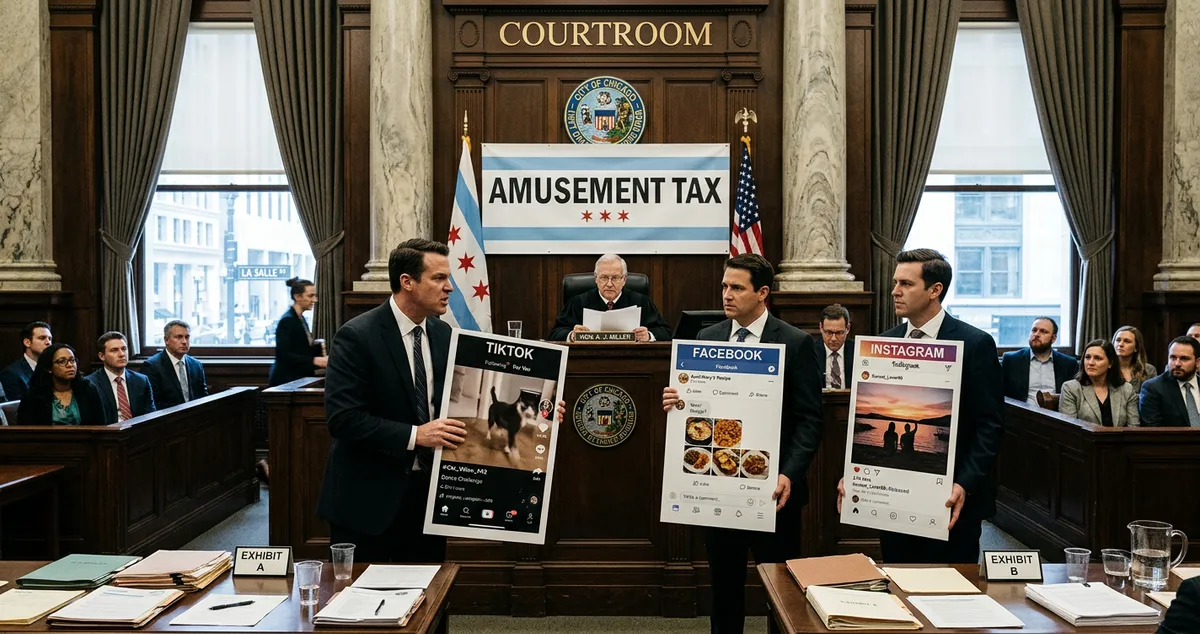
Chicago Officially Classifies Scrolling Through Instagram as an 'Amusement,' Files Now Being Prepared
The City of Chicago’s Social Media Amusement Tax, which took effect January 1st and which levies a charge of 50 cents per month for every active user after a platform’s first 100,000, is now the subject of a lawsuit filed Thursday in Cook County Circuit Court by NetChoice, the tech industry trade association whose members include Meta, Google, TikTok, and most of the other companies that would rather not pay the tax. The suit argues that the tax violates the First Amendment, federal internet commerce law, and what NetChoice’s legal filing describes as “basic principles of regulatory coherence.” What it does not argue — but what I think deserves acknowledgment — is that the City of Chicago has, through this ordinance, officially taken the position that looking at your phone is an amusement. Not a habit, not an addiction, not a coping mechanism. An amusement. The same legal category as attending a Bulls game or going to a comedy show.
The tax, which was included in the city’s 2026 budget and which I wrote about briefly when it was first proposed last fall, works as follows: any social media company with more than 100,000 active users in Chicago pays the city 50 cents per user per month. The city defines “active user” as anyone who accesses the platform at least once in a given month, which — and I want to be precise here — encompasses essentially every person in Chicago who owns a smartphone and has not recently died. The revenue projection in the budget documents is $47 million annually, a figure that the city’s chief financial officer described during budget hearings as “conservative” and that I would describe as “a number that assumes everyone in Chicago is on social media,” which is not so much conservative as observationally accurate.
NetChoice’s complaint is 38 pages long and makes several legal arguments, the most interesting of which is its invocation of Minneapolis Star Tribune v. Minnesota, a 1983 Supreme Court case in which the Court struck down a state tax on newspapers that only applied after a paper exceeded $100,000 in ink and paper costs. The parallels are not subtle: in that case, a government taxed a media platform based on audience size, and the Supreme Court said you can’t do that. Chicago, NetChoice argues, is doing exactly the same thing, except with “active users” instead of “ink and paper.” The city’s law department has responded that social media platforms are not newspapers, a distinction that is technically correct and that I suspect will be litigated at considerable length and expense.
The more philosophically interesting argument in the complaint concerns the word “amusement” itself. Chicago’s amusement tax — which has existed since 1980 and traditionally applies to events like concerts, sporting events, and movie screenings — is predicated on the idea that the taxed activity is a form of entertainment. NetChoice argues that social media does not fit this definition, noting that platforms are used for news consumption, civic engagement, professional networking, emergency communication, and, in what I consider the filing’s strongest rhetorical moment, “reading content that causes anxiety, anger, or existential dread.” The filing does not use the phrase “doomscrolling,” but the spirit of doomscrolling pervades the entire section. The question at the heart of the case is whether scrolling through TikTok at 11 PM is an amusement or a condition, and reasonable people may disagree.
The city has not yet filed a formal response to the lawsuit but issued a statement Thursday afternoon saying it “stands behind the legality of the Social Media Amusement Tax” and believes it “represents a fair and appropriate application of the city’s existing tax framework to modern digital platforms.” A spokesperson for the law department, asked whether the city had anticipated the lawsuit, said “we anticipated a range of responses to the ordinance” — a sentence that manages to say nothing while conveying a great deal. Governor Pritzker, whose office proposed a similar statewide social media tax in February, declined to comment on the Chicago lawsuit specifically but said in an unrelated press conference that “the conversation about how digital platforms contribute to the communities they profit from is an important one,” which is the kind of sentence you say when your legal team has told you not to say anything specific.
The financial stakes are not trivial. If every major social media platform with Chicago-area users is captured by the tax, the city’s $47 million annual projection is, if anything, modest. Chicago has approximately 2.7 million residents, and research from the Pew Center suggests that roughly 72% of American adults use at least one social media platform. If you assume even a fraction of those users are active on multiple platforms — and if you have ever watched a person under the age of 30 use their phone, you know this fraction is large — the per-platform user counts generate revenue that accumulates quickly. The math works. Whether the law works is a separate question.
What has gone largely undiscussed in the coverage so far is the precedent this sets for the concept of “amusement” itself. If social media is an amusement, what else qualifies? Is reading the news an amusement? Is checking email? Is staring at a weather app for 15 minutes because you can’t decide whether to bring an umbrella, which is something I do approximately four times a week? The ordinance’s language does not address these edge cases, presumably because addressing them would require the city to take a position on what constitutes fun, which is a question that philosophers have struggled with for centuries and that the Chicago City Council is unlikely to resolve in a budget amendment. For now, the tax stands, the lawsuit proceeds, and the city of Chicago maintains its official position that the thing you are doing on your phone right now — yes, right now — is an amusement, and it owes the city money.