Chicago's Bold Plan to Attract More Tourists: Make Hotels the Most Expensive in the Country
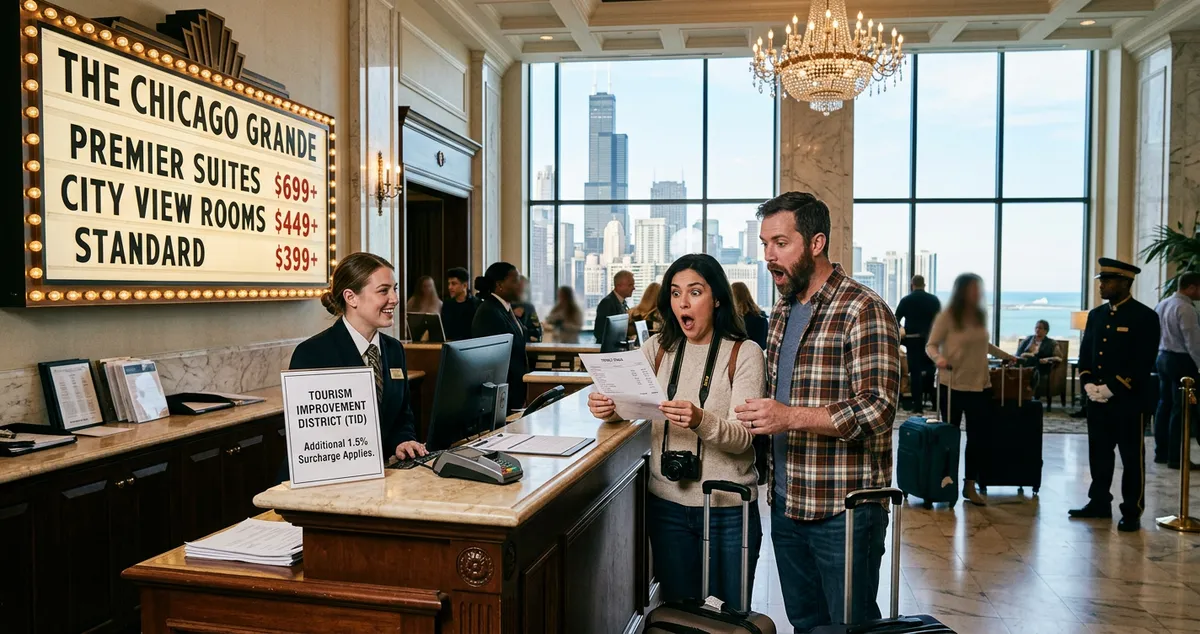
The Chicago City Council’s Finance Committee voted last month to advance an ordinance establishing a “Tourism Improvement District” that would impose a new 1.5% surcharge on overnight stays at hotels with more than 100 rooms, bringing the city’s total effective hotel tax rate to approximately 19% — a figure that would make Chicago’s hotel tax the highest of any major city in the United States. The stated purpose of the surcharge is to generate approximately $40 million annually to fund tourism promotion efforts, which is to say: the city intends to make it more expensive to stay in Chicago in order to fund advertising that tells people they should come stay in Chicago. I have read the ordinance twice and this is, in fact, what it says.
The district’s geographic boundaries would encompass downtown, the area around McCormick Place, the Illinois Medical District, Hyde Park, and portions of at least 14 wards extending into the West Loop, Bronzeville, and Bridgeport. The revenue would flow to Choose Chicago, the city’s tourism marketing organization, which currently operates on a budget of approximately $73 million and which would use the additional funds to — and I am quoting from the ordinance’s summary document — “attract events and conventions and advertise the city’s cultural riches.” The phrase “cultural riches” appears three times in the summary. The phrase “highest hotel tax in America” appears zero times, though it arguably deserves at least a mention in the interest of full disclosure.
The hotel and hospitality industry, somewhat counterintuitively, supports the measure. The Illinois Hotel & Lodging Association has endorsed it, as have several major downtown hotel operators who view the surcharge as a net positive because the additional marketing spend is expected to increase overall occupancy rates by enough to offset the per-room cost increase. This is the kind of math that makes perfect sense inside a conference room and inspires a specific kind of silence when you try to explain it to a person who just paid $47 in taxes on a $249 room. I ran the numbers on a hypothetical three-night downtown stay at current average rates: the total tax burden comes to roughly $142, which is more than the cost of a round-trip Megabus ticket from Indianapolis to Chicago, which is one of the cities whose residents Choose Chicago would presumably like to attract.
Critics of the plan — and there are several, though they have been quieter than one might expect given the magnitude of what is being proposed — have pointed out that Chicago already has one of the highest hotel tax burdens in the country, and that the new surcharge would push it past New York City, which has held the unofficial title of “most expensive place to sleep” for the better part of a century and which, one imagines, did not expect to be overtaken by a Midwestern city whose tourism pitch centers on affordability relative to the coasts. A spokesperson for a national hotel booking platform, who declined to be named because the company works with Choose Chicago on promotional campaigns, said simply: “Nineteen percent is a number that people notice.”
The full City Council vote is expected in the spring session, and passage is considered likely. Aldermen who spoke in favor during the Finance Committee hearing framed the surcharge as an investment, using the word “investment” an average of 3.2 times per statement, based on my count of the public record. One alderman compared the measure to “planting a seed,” then extended the metaphor for several minutes, describing the $40 million as “fertilizer” and tourism as “the harvest,” at which point the committee chair thanked him for his remarks and moved to the next speaker.
Choose Chicago, for its part, has projected that the additional funding will allow the organization to bid more aggressively for major conventions and sporting events, expand its international marketing presence, and launch new digital campaigns targeting what it calls “aspirational travelers” — a demographic category that, as far as I can determine, means “people who have not yet looked up the hotel tax rate.” The organization’s current marketing materials emphasize Chicago’s world-class dining, architecture, music, and lakefront. They do not mention the tax rate. When I asked a Choose Chicago spokesperson whether future campaigns would include the tax rate, she said the campaigns would “tell the full Chicago story.” I asked if the tax rate was part of the full Chicago story. She said she would follow up. She has not followed up.
The measure has also drawn attention from hospitality analysts nationally, several of whom have noted the irony of a tourism-promotion mechanism that functions, at the point of sale, as a tourism deterrent. Dr. Wendy Farrell, a hospitality economics researcher at Cornell, characterized the approach as “fiscally creative” and noted that similar districts exist in other cities, though typically at lower rates. “The question,” she said, “is whether the incremental marketing spend produces enough incremental demand to overcome the incremental cost. That’s three incrementals in one sentence, which tells you something about the complexity of the model.” She paused. “I would not want to be the person explaining this to a family of four checking into the Palmer House.”