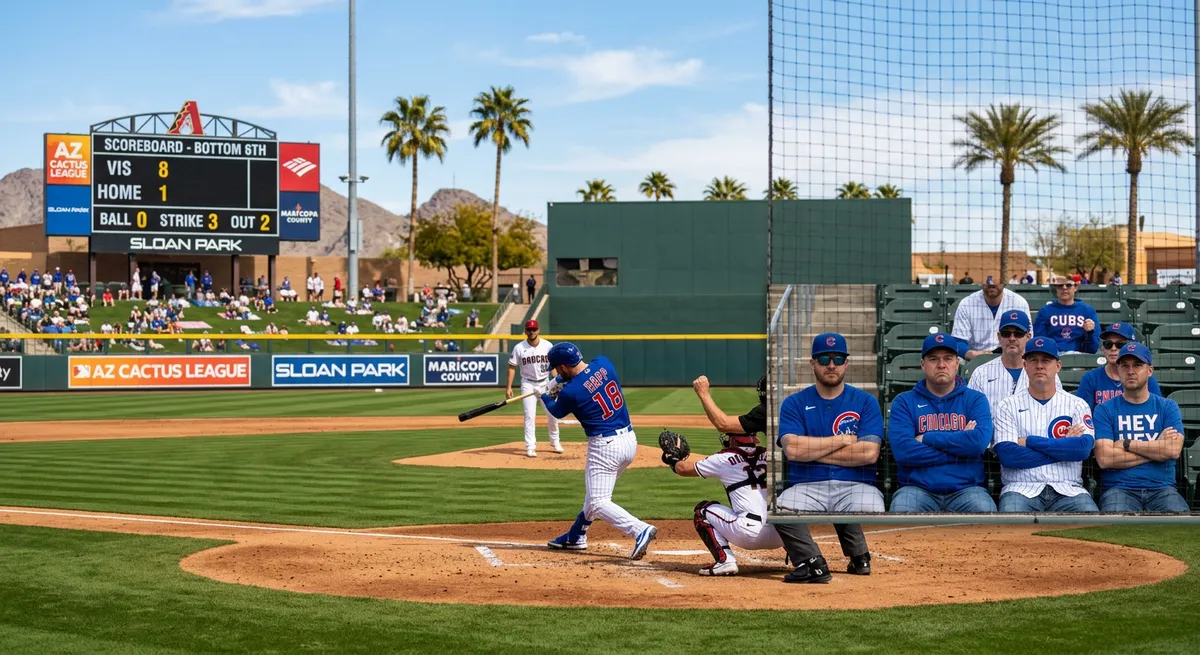
Cubs Lose Spring Training Game 9-5; Fans Activate Annual 'Doesn't Count' Protocol Right on Schedule
The Chicago Cubs lost to the San Francisco Giants 9-5 in Cactus League play on Sunday, and I want to be very clear about what this means: it means the Cubs lost to the Giants 9-5. That’s what it means. It does not mean they are a bad team. It does not mean they are a good team. It does not mean anything about the rotation or the bullpen or the lineup construction or the catching situation, which remains a thing that people have opinions about. What it means is that on a Sunday afternoon in Scottsdale, Arizona, where the weather is pleasant and the stakes are contractually zero, the Cubs allowed nine runs to a Giants team that is also not trying very hard, and now we all know this happened. That is the complete and total meaning of the event.
Cubs fans, who have been doing this for a very long time and have developed a rich and sophisticated relationship with hope, disappointment, and the calendar year as a unit of emotional processing, activated the “Doesn’t Count” protocol within approximately four innings. The protocol, which is informal but nearly universal among the fanbase, involves a specific mental gesture in which the result of a spring training game is held briefly in the mind and then set aside, gently, the way you might set aside a piece of mail that you’ll deal with later but that you also definitely won’t deal with later. The Cubs could have lost 17-0. The protocol still activates. The Cubs could have won 17-0. The protocol still activates, in a different direction. Spring training results exist in a state of managed irrelevance that the fanbase has refined over more than a century of needing to remain emotionally available in April.
The game itself featured several Cubs who are competing for roster spots, which means their performances actually do count for something — specifically, for whether they will be on the team — but this is a different kind of counting from the regular-season kind, and fans have a separate protocol for that, which involves watching the statistics with intense interest while simultaneously maintaining that the statistics are not meaningful. This is a coherent position if you live in it long enough. Cubs fans have lived in it long enough. They have built comfortable furniture inside it. They have friends over.
Shota Imanaga started and allowed three runs in two and a third innings, a line that a Cubs beat writer described as “an outing to evaluate further” and that a fan on the internet described as “fine, he’s just working on stuff, you don’t know what he’s working on.” Both descriptions are technically accurate. Imanaga is, by most measures, one of the better pitchers in baseball, and two innings of spring training work is approximately as informative about his 2026 prospects as the weather in Scottsdale is informative about the weather in April at Wrigley, which is to say that it tells you something and also that the something it tells you is subject to rapid revision. Cubs fans know this. They are comfortable with it. It is, in some ways, their native language.
The offense, for its part, had moments. Pete Crow-Armstrong went two-for-three. There were two Cubs homers in a game that was ultimately decided by the Giants scoring four runs in the fifth inning off a relief combination that the Cubs coaching staff is “still evaluating,” which is the baseball phrase for “we’re not sure about that either.” The Cubs’ own five runs were described in post-game coverage as “encouraging” by writers who cover the team, “not bad” by fans who watched the stream, and “a foundation to build on” by the Cubs’ official social media account, which exists in a state of permanent optimism that I sometimes envy.
I am sixty-three years old. I have watched the Cubs lose spring training games my entire life. I have watched them win spring training games my entire life. I have watched both kinds of games mean exactly nothing by June, and I have watched both kinds of games be cited in retrospect as “an early sign” by analysts doing retrospective analysis. The actual useful information that will emerge from spring training is information about which players are healthy, which players are improving, and which players are preparing to have a good year for some other team. That information will become clear over time, which is also a thing spring training shares with regular life: the useful information becomes clear over time, usually after it’s fully actionable. For now, it’s March. It’s 9-5. It doesn’t count. Go Cubs.