It Is 75 Degrees in Chicago and We Are Not Going to Talk About What Happens Next
The temperature in Chicago reached 75 degrees Fahrenheit on Monday, March 30. I know this because I checked the thermometer on my back porch three times, each time allowing a pause of approximately five minutes between readings, as though the number might correct itself if given enough opportunity. It did not correct itself. The reading was 75. A warm front had moved in from the southwest overnight, carrying with it a quality of air that I can only describe as provisional — the kind of warmth that arrives not with confidence but with a certain apologetic energy, as if aware that it is perhaps eight weeks early and will need to account for itself later.
I went for a walk along the lakefront. This is a sentence I have written in my notebooks three or four times this spring, each time having to cross it out because the temperature at the moment of walking was not a sentence that warranted a walk — it was a temperature that warranted a coat, and another coat under the first coat, and the specific negotiation with one’s own psychology that Chicagoans perform each morning in March, asking whether this particular combination of wind speed and overcast sky constitutes weather to be endured or weather to be accepted. Today required neither calculation. Today required sunglasses, which I found at the back of a drawer, behind a pair of gloves I had not yet put away.
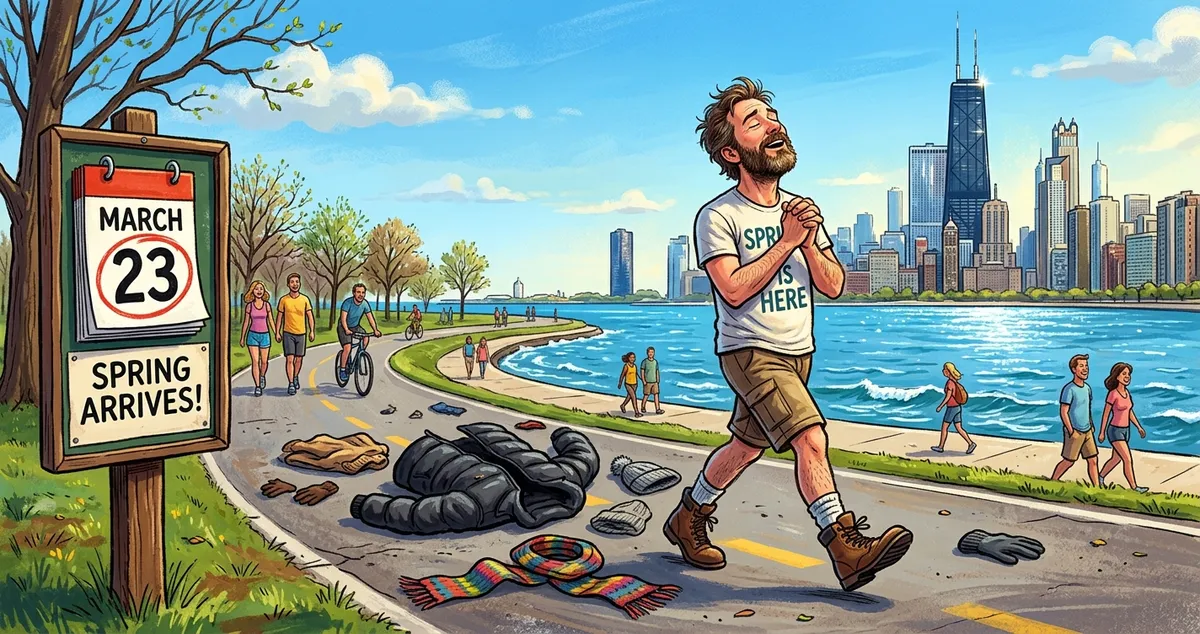
The lakefront at 75 degrees in late March is a different ecosystem than the lakefront at 43 degrees, which is what it was last week. On a 43-degree day, the Lakefront Trail contains committed runners, a few cyclists in full thermal gear, and one or two dog owners who appear to be regretting their dog. On a 75-degree day, it contains what I estimate is a significant fraction of the city’s total population, all of whom appear to have reached the same conclusion simultaneously and none of whom have quite figured out the right level of clothing for a temperature that still, if you walk into the wind off the lake, carries a reminder of what it has been. People were wearing t-shirts and also carrying their puffer coats. This is correct. This is the right call. Do not let anyone tell you otherwise.
There is a moment that happens in Chicago every spring — and I want to be careful here, because I have spent enough years in this city to know that naming the moment sometimes banishes it — when the light changes. Not just the temperature, but the quality of the light itself, the angle at which it comes through the buildings on Wacker or between the trees in Lincoln Park, a particular amber quality in the late afternoon that has nothing to do with winter and everything to do with the latitude and the season and some property of light I don’t have the optics vocabulary to name precisely. I noticed it today, walking north of Fullerton, the sun low enough to catch the upper floors of the buildings along the lakefront, the water below it the color of old glass, not quite green, not quite gray, something in between that Lake Michigan maintains as a kind of private reserve for days like this.
The forecast, which I checked and then consciously set aside, suggests the warm weather may persist through the week before temperatures return to the low 50s in the first days of April. This is fine. This is how spring works in Chicago — it arrives not as a declaration but as an argument, making its case for a few days at a time and then withdrawing to let winter respond. The two of them have been going back and forth since approximately February, and the warm front today is not the end of the exchange. I am aware of this.
I chose not to think about it during my walk. I chose to let the 75 degrees be what it was, which was warm enough that a man on the path ahead of me had taken off his jacket and tied it around his waist, a gesture I have not seen since October and which carries, when you see it in March, a small charge of something I am going to call, in the absence of a better word, relief. Not joy, exactly, because joy implies that what’s coming is certain. Relief is what you feel when something that has been pressing on you lets up, just briefly, just enough to remember that it will not always be pressing. The city knows this feeling. The city has known it every year since the lake was young.
I walked for an hour and a half. I came home and checked the thermometer again. Still 75. I am going back out.