Retired Crossing Guard Still Shows Up to His Corner Every Morning, Nobody Has the Heart to Tell Him
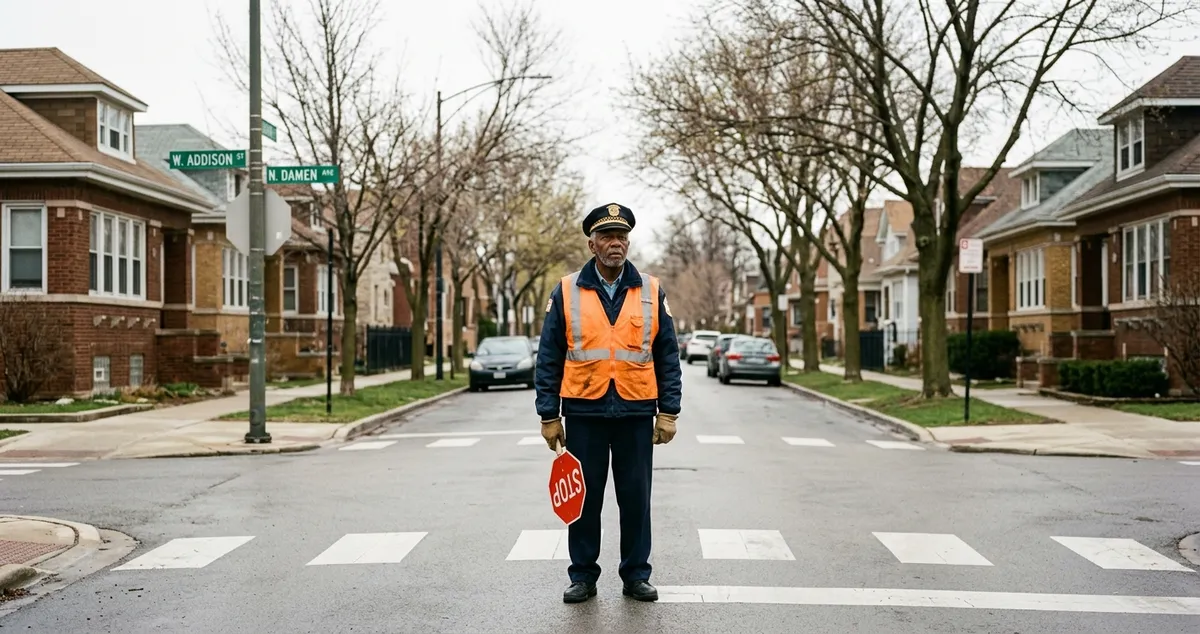
Earl Washington arrives at the corner of Addison and Damen at 7:15 every weekday morning, same as he has for twenty-three years. He wears the same orange vest. He carries the same handheld stop sign, its red faded to a dignified rose from decades of weather. He takes his position at the crosswalk, nods to the first parents rounding the corner with their children, and begins doing what he has always done: making sure every kid gets across the street safely. He retired in December.
The paperwork went through on December 20th. There was a small ceremony at Coonley Elementary — cake, a card signed by the staff, a gift card to Portillo’s that he called “very generous and completely unnecessary.” He shook hands, thanked the principal, told the children to always look both ways even when someone was holding a sign, and went home. He came back the next school day. He has not missed a morning since.
“I don’t know what else I’d do at 7:15,” Washington said, standing at his corner on a Tuesday morning in late March, breath visible in the cold air. A mother with a stroller approached the crosswalk. He raised his sign, stepped into the street, and waved her across with the practiced authority of a man who has been stopping traffic since before some of these parents were born. “I tried sleeping in. Got up at 7:12. Couldn’t do it.”
The school is aware. Principal Maria Esperanza confirmed that Washington’s retirement was processed and that a new crossing guard — Terrence, 28, who is fully trained and officially employed — was assigned to the Addison and Damen post in January. Terrence arrives each morning at 7:20 to find Washington already in position. He stands nearby, holding his own stop sign, and waits.
“Mr. Washington is… still here,” Terrence said, with the careful diplomacy of a man who has been navigating this situation for three months. “He’s very good at the job. He’s better than me, honestly. The kids listen to him. The cars listen to him. I mostly just stand next to him and learn things.” He paused. “I did stop a bike once. He gave me a thumbs up.”
The parents, for their part, seem untroubled by the redundancy. “I didn’t even know he retired,” said David Chen, who has been walking his daughter past Washington’s corner for four years. “He’s just… here. He’s always been here. I assumed he’d be here when my daughter graduated.” Another parent, who asked to be identified only as “the one who’s always running late,” said: “Honestly, having two crossing guards is the most protected I’ve ever felt at an intersection. I wish every corner had this.”
Washington does not consider what he is doing unusual. “People retire from jobs,” he said, stepping back onto the curb as the last cluster of students passed. “I retired from the job. I didn’t retire from the corner.” He said this with no irony, no wistfulness — just the plain certainty of a man stating a fact about himself. The corner is his. The morning is his. The children are, in a sense that transcends employment paperwork, his responsibility.
CPS’s human resources department confirmed that Washington is not on any active payroll and that his presence at the crosswalk is “voluntary.” When asked whether there were liability concerns about an unofficial, unpaid crossing guard directing traffic, a spokesperson said the department would “look into it” — a phrase that, in municipal parlance, means the question will be forwarded to someone who will forward it to someone who will lose the email.
Terrence has made his peace with the arrangement. He arrives at 7:20, stands to Washington’s left, and mirrors his movements — stop sign up when Washington’s goes up, down when it comes down. “It’s like being a co-pilot,” he said. “Except the pilot has no plans to land.” He smiled. “I figure one day he won’t show up and it’ll be my corner. But I’m not in a rush. The man’s earned it.”
Washington, asked if he had any plans to stop coming, looked at the question the way you might look at a cloud shaped like something you couldn’t quite name. “I’ll think about it,” he said. Then the 7:45 wave of students arrived, and he stepped into the street, raised his sign, and got back to work.