The Cubs Lost 10-4, Then Won 10-4, and Nobody Is Talking About This
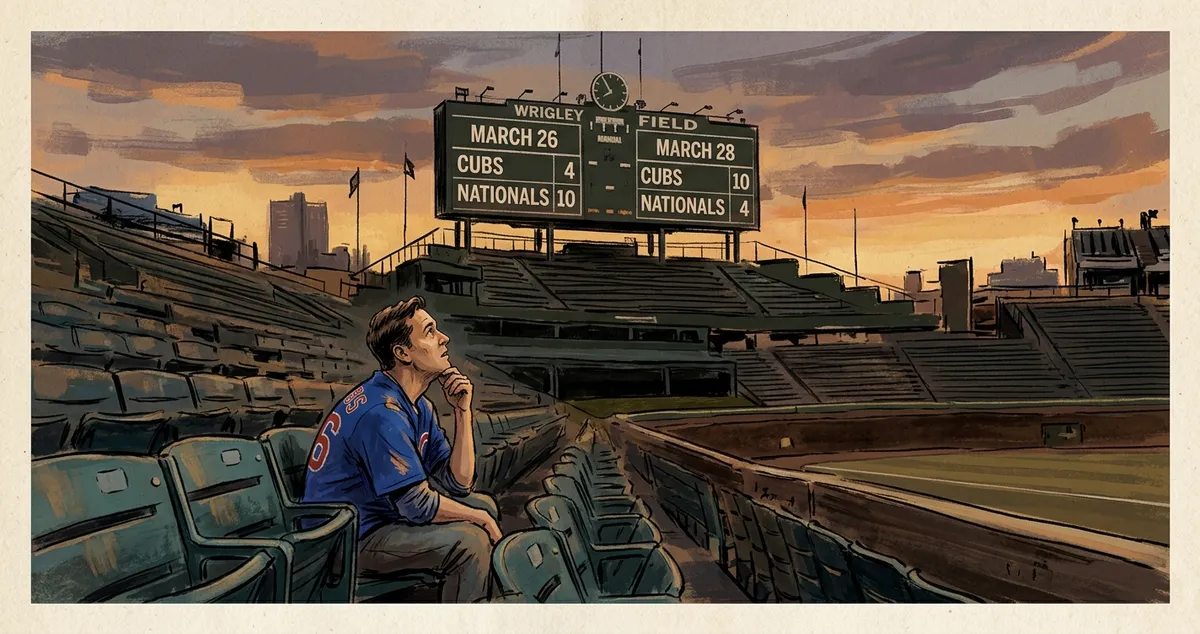
On the afternoon of March 26, the Washington Nationals scored ten runs against the Chicago Cubs at Wrigley Field. The Cubs scored four. It was Opening Day. The crowd of 40,413 filed out into the cold Addison Street air carrying the specific species of disappointment that comes not from surprise but from confirmation — a reminder that the world, however briefly, had arranged itself into a familiar shape.
Then, on the afternoon of March 28, the Cubs scored ten runs against the Washington Nationals. The Nationals scored four. It was the same teams. The same ballpark. The same two numbers. Only their positions had changed.
I have been thinking about this for thirty-six hours.
There is a concept in physics — and I use the term loosely, as I am a weather and environment reporter, not a physicist, and I am aware of how this column is going to sound — called time-reversal symmetry. It describes, in simplified terms, the mathematical property by which certain physical processes are indistinguishable whether run forward or backward. A pendulum swings. A ball bounces. The equations hold in either direction. Most real-world systems are not actually time-reversible, due to entropy and the general tendency of the universe to increase in disorder. This is why broken eggs do not reassemble. This is why you cannot un-have a bad Opening Day.
Unless, apparently, you play the same team again two days later and outscore them by the exact same margin in the exact same direction, which the Cubs did, raising questions I am not fully equipped to answer.
The statisticians will tell you this was not, technically, miraculous. The Cubs scored ten runs and allowed four on March 28, which is well within the range of outcomes for a major league baseball game. The probability of any specific scoreline is low, but the probability of some scoreline is one hundred percent, and the human tendency to find meaning in coincidence is not a property of the universe but of the people observing it. I understand this argument. I have made this argument. I do not find it entirely satisfying.
What I find more interesting is what it felt like to be a Cubs fan across those two days — to carry a 10-4 loss through a Chicago Friday that was 43 degrees and gray and smelled vaguely of lake, to wake up Saturday morning still somewhere inside that number, and then to watch it invert. The mathematician might call it a fluke. The Cubs fan sitting alone in the upper deck on Saturday evening, staring at a scoreboard that had returned a different answer to the same question, might call it something else. Something quieter. Something that doesn’t really have a name in standard meteorological or probability literature.
Seiya Suzuki, the Cubs’ right fielder, went on the injured list before the season started, having strained his knee during the World Baseball Classic in circumstances that were entirely foreseeable and that were, in fact, foreseen by several sports reporters who noted that playing competitive international baseball immediately before a major league season carries inherent physical risk. He will miss several weeks. The Cubs won 10-4 without him. This, too, feels like data, though I am not certain what kind.
The Cubs have 156 games remaining. The universe, as far as anyone can determine, is not obligated to continue providing symmetrical outcomes. The March cold will lift eventually. The lake will take on its spring color — that particular shade of gray-green that looks like it is deciding between two options and has not yet committed. Wrigley Field will fill and empty several hundred more times before October. Whether the numbers will fold back on themselves again, whether some other balance will be struck between loss and recovery, between the thing that happened and the thing that corrected it, I cannot say. I can only note that it happened once, in the first week of the season, before most of us were paying close attention. That seems worth writing down.