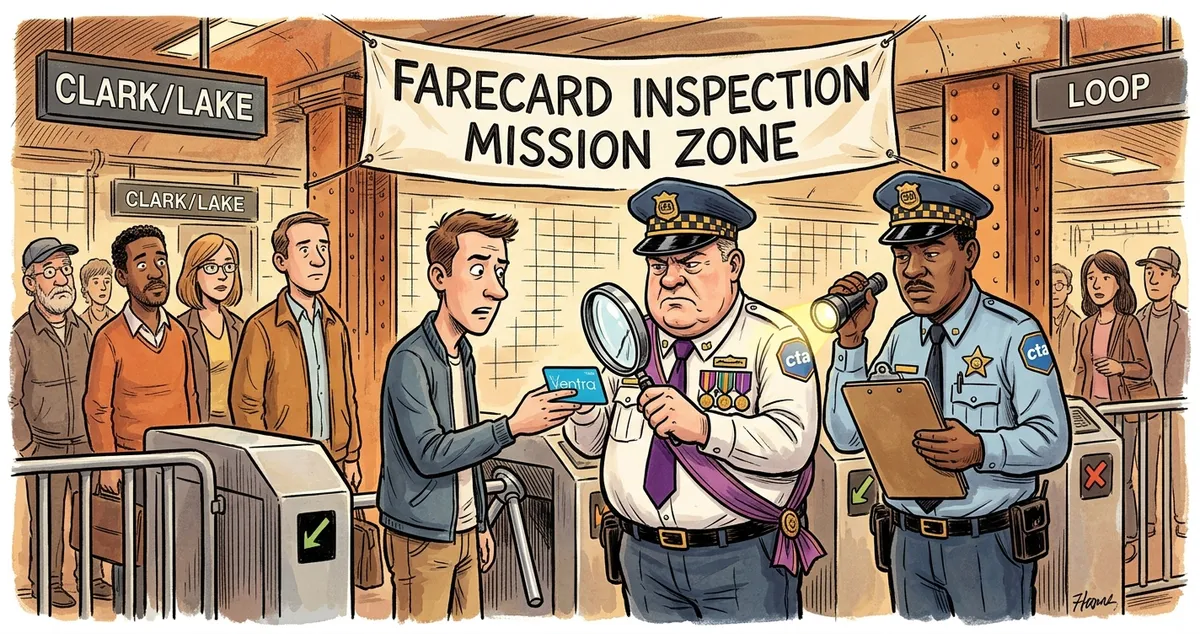
CTA Launches 'Farecard Inspection Missions,' Assures Riders the Name Was Not Arrived at Ironically
The Chicago Transit Authority unveiled its comprehensive new safety and security framework this month, and while the plan contains a number of substantive components — including Cook County Sheriff’s Office deputies assigned to ride trains on high-incident lines, a phased rollout of new high-barrier turnstile gates designed to reduce fare evasion, and a dedicated CTA Crime Task Force announced in coordination with Cook County State’s Attorney Eileen O’Neill Burke — it is the agency’s choice to describe one of its enforcement activities as “Farecard Inspection Missions” that has generated, among certain observers, a degree of unsolicited meditation.
A CTA spokesperson confirmed Thursday that “Farecard Inspection Missions” is the official terminology and that the agency selected it to convey “the targeted, coordinated nature of the compliance initiative.” When asked whether anyone in the communications department had flagged the word “mission” as carrying connotations somewhat larger than fare enforcement, the spokesperson said the term had “gone through the appropriate review channels” and declined to characterize those channels further.
The missions themselves — which are, in practice, roving teams of CTA personnel and, in some cases, sheriff’s deputies checking Ventra cards and fare receipts on platforms and trains — have been deployed primarily on the Red, Blue, and Green Lines since early March. The CTA says fare evasion costs the agency approximately $80 million annually, a figure that has appeared in every press release about the initiative and that, by this reporter’s count, is now the single most-cited statistic in CTA communications since 2019, when the agency briefly led all U.S. transit authorities in mentions of the phrase “state of good repair.”
The new high-barrier gates, which stand roughly chest-height and are designed to physically prevent fare jumpers from entering without tapping a card, are being installed at a pace the CTA described as “accelerated.” The agency did not specify what it was accelerated relative to, but a timeline presented at the March board meeting suggests full system deployment will take approximately four years, during which time the gates at any given station will exist in one of three states: fully installed, partially installed, or “in queue,” a designation that accounts for roughly sixty percent of current stations and that longtime CTA watchers will recognize as a category of significant flexibility.
The Cook County Sheriff’s deputies assigned to train lines under the new plan represent a meaningful shift in the agency’s approach to visible security presence. The CTA had previously relied on Chicago Police Department officers in a supplementary capacity, an arrangement that the department described, in a joint press release, as “an ongoing and valued partnership,” language that a CPD spokesperson declined to elaborate on when asked whether “ongoing” was doing a lot of work in that sentence. Under the new framework, Cook County deputies will ride assigned lines during peak hours and respond to incidents in coordination with CTA security staff, a model that several transit systems in other cities have piloted with what the CTA described as “encouraging preliminary outcomes.”
The CTA Crime Task Force, announced by State’s Attorney Burke on March 25, adds a prosecutorial layer to the framework, committing dedicated assistant state’s attorneys to CTA-related cases. The task force will focus on repeat offenders and what Burke described as “the small number of individuals responsible for a disproportionate share of incidents.” The agency noted that worker assaults — attacks on CTA bus and train operators — are down between 25 and 29 percent compared to the same period last year, a range that a CTA spokesperson described as “reflecting different measurement methodologies” when asked why it was a range rather than a number.
The full security plan, which runs to 34 pages in its public summary form and considerably more in its operational annexes, has been received with cautious optimism by riders, transit advocates, and union representatives, most of whom expressed support for the underlying goals while raising questions about implementation timelines, staffing levels, and whether the new high-barrier gates would interact gracefully with the accessibility accommodations required by federal law. The CTA said it was “committed to an inclusive rollout.” A subsequent question about what that meant was answered with a reference to the 34-page document.
Farecard Inspection Mission activity is expected to increase through spring and summer, with the agency planning to publish monthly compliance reports beginning in April. The reports will include number of missions conducted, fare compliance rates, and, presumably, a continued absence of any acknowledgment that “mission” is a word that typically implies a higher operational stakes than whether someone’s Ventra balance cleared. The CTA was asked about this one more time. The spokesperson said the name was final.