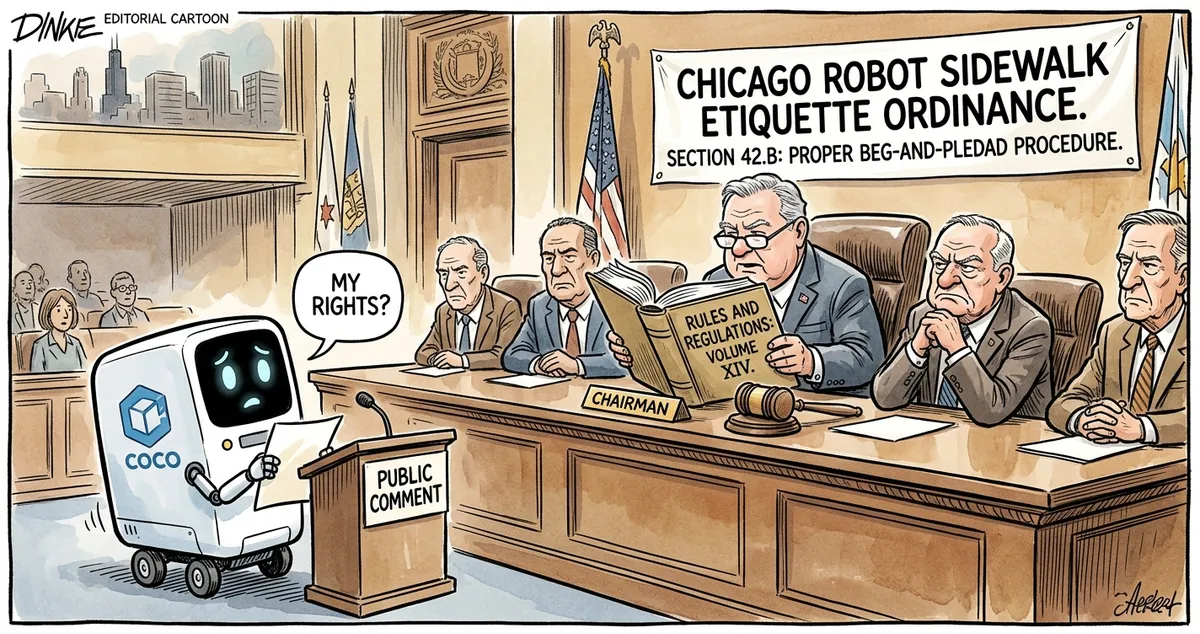
Chicago Passes Landmark Robot Sidewalk Ordinance; Delivery Units Must Now Yield to Pigeons, Aldermen, and Anyone Carrying More Than Two Grocery Bags
Less than a week after two food delivery robots managed to crash into two separate CTA bus shelters in what the city’s Department of Business Affairs and Consumer Protection called “a pattern that required a legislative response, probably,” the Chicago City Council voted 40-10 Thursday to pass the Autonomous Sidewalk Conveyance Etiquette Ordinance — a 47-page document that its primary sponsor, Ald. Maria Hadley (32nd), described as “a reasonable framework for coexistence” and that a Coco Robotics spokesperson described as “a lot.”
The ordinance, which takes effect in 90 days pending mayoral signature, establishes the first comprehensive regulatory regime for sidewalk-based autonomous delivery systems in Chicago, a category it defines as “any self-propelled, non-human-piloted vehicle designed to transport comestibles, sundries, or other items of commercial value along public pedestrian infrastructure, including but not limited to motorized snack vessels.” The phrase “motorized snack vessel” appears eleven times in the document. Legislative aides declined to confirm whether this was intentional.
Under the new rules, delivery robots operating in Chicago must yield the right of way to the following categories of pedestrian: wheelchair users, persons using mobility aids, parents with strollers, individuals carrying more than two grocery bags (defined in Appendix C as “a per-arm load that visibly impairs lateral balance or vision”), school children in groups of three or more, dogs of any breed on or off leash, unsupervised pigeons engaged in active foraging, and any current or former member of the Chicago City Council. The last item was added by amendment in the final session. It passed unanimously.
Serve Robotics and Coco Robotics — the two companies whose units struck the bus shelters on March 22 and March 24, respectively — both submitted written comments during the public review period. Serve Robotics’ comments, running 22 pages, argued that the ordinance’s definition of “reasonably foreseeable fixed infrastructure” was “overbroad and could be interpreted to include any object that has been stationary for more than six consecutive minutes, which describes most of our operating environment.” Coco Robotics’ comments were three sentences long and said the company looked “forward to constructive dialogue with the city,” which is a sentence that has never preceded constructive dialogue.
The ordinance also introduces a tiered penalty structure for infractions. A robot that fails to yield to a pigeon faces a $75 administrative fine assessed against its operator. A robot that strikes a CTA bus shelter faces a $500 fine, mandatory telemetry disclosure, and what Section 14(b) calls “a 30-day operational pause for supervised retraining,” a phrase that raises questions about what robot retraining looks like in practice and whether robots experience it as punitive. The ordinance does not address this question. A footnote on page 31 says it is “outside the scope of the current regulatory framework.”
Three sections of the ordinance deal specifically with robot behavior near bus stops, which the city defines as “high-density pedestrian convergence zones requiring elevated navigational caution.” Robots operating within 20 feet of a CTA bus stop must reduce speed to no more than 2 miles per hour — down from the previous unregulated maximum of 5 — and must emit an audible tone “sufficient to alert a reasonable adult pedestrian but not so loud as to constitute a public nuisance.” Section 19(a) defines “public nuisance” as “a noise level exceeding that of a normal conversational tone but not exceeding that of an aldermanic session,” a benchmark the city’s noise office confirmed it has legal standing to enforce.
Two additional companies — Starship Technologies and a newer entrant called Breezy Provisions, which operates in Lincoln Park and Lakeview — declined to comment on the ordinance but confirmed they had retained Chicago-area lobbyists “as a matter of standard regulatory monitoring.” Starship Technologies’ lobbyist submitted a separate comment noting that its units had never struck a CTA bus shelter, which is technically true and which the lobbyist appeared to consider a more compelling argument than it ultimately was.
Ald. Hadley acknowledged that enforcement would present logistical challenges, particularly around verifying which company owns a given robot at the moment of infraction, a question that has proved more complicated than expected in both bus shelter cases. “They all kind of look the same,” she said, before a spokesperson intervened. The ordinance addresses this by requiring all registered delivery robots to display a unique six-digit operator identification number “in a font no smaller than 14 points, on at least two exterior-facing surfaces.” Robots currently in service have 90 days to comply. Asked how the city plans to check, a spokesperson for the Department of Business Affairs said enforcement would be “complaint-driven,” which is how Chicago handles most things and which has historically produced results that vary.
The ten dissenting votes came from aldermen representing wards with high concentrations of robot delivery activity, several of whom argued that the ordinance would “chill innovation” and “send the wrong message to the tech sector.” Ald. Hadley listened to each of these arguments and then noted, for the record, that a robot had broken a bus shelter. She called for the vote. The vote was 40-10.