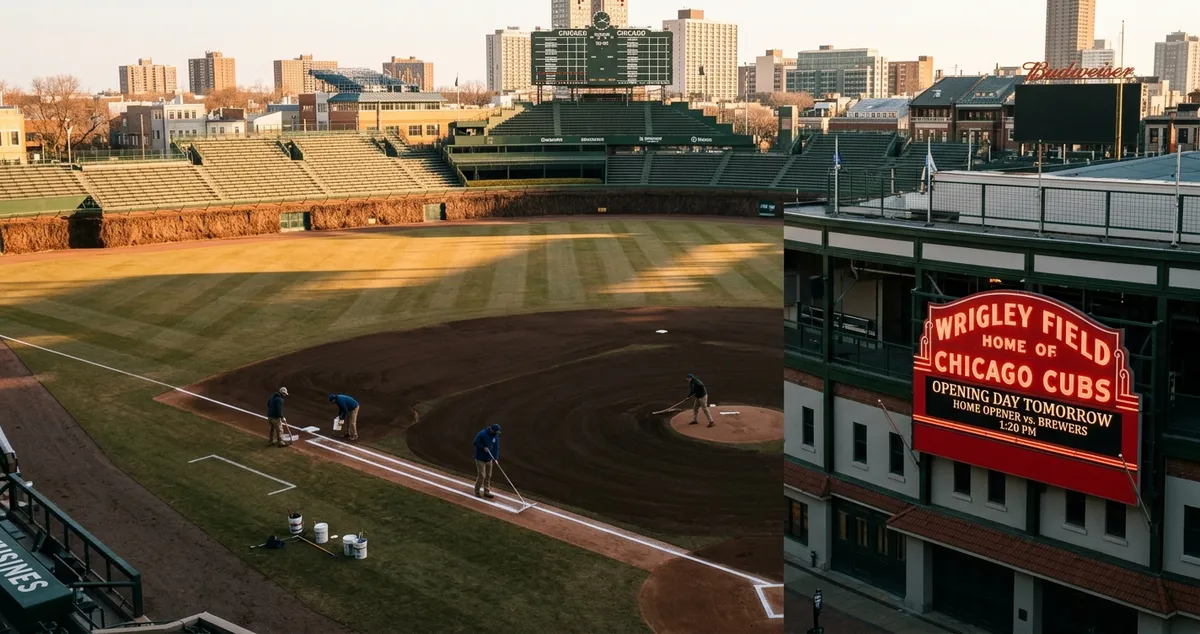
Wrigley Field Stays Up All Night Before Opening Day, as It Has Every Year Since 1914
Wrigley Field does not sleep the night before Opening Day. This is not a metaphor. The lights stay on — not the game lights, not the ones that didn’t arrive until 1988 and that the building still considers a recent addition, but the service lights, the ones that glow in the tunnels and concourses like a low-grade fever. Generators hum. Compressors cycle. The scoreboard, that magnificent hand-operated relic that has never once displayed a sponsored message, settles into its resting state: blank, patient, waiting for someone to climb inside it and start hanging numbers.
The grounds crew arrives before dawn. They have been here already, of course — they’ve been here for weeks, aerating and reseeding and coaxing the sod into the particular shade of green that looks natural on television but is, in reality, the product of horticultural decisions so precise they border on philosophy. But the day-before work is different. The day-before work is ceremonial. The baselines are painted with a whiteness that will not survive the second inning. The batter’s boxes are chalked with the care of a calligrapher. The pitcher’s mound is groomed to a regulation height of ten inches, a number that Wrigley has always found dignified, though it would never say so.
The ivy is still brown. This is the part that people forget, or choose not to see in the photographs — that on Opening Day in late March, the outfield walls are dressed in the skeletal remains of last season’s Boston ivy, dormant and bare, waiting for the warmth that won’t fully arrive until May. The ivy does not mind. The ivy has been doing this since 1937, when Bill Veeck planted 200 Japanese bittersweet vines and 350 Boston ivy plants along the brick, and every year since then the ivy has died and come back, died and come back, with the quiet persistence of something that has decided, once and for all, that this is where it lives.
By midafternoon the concession stands are being stocked. This is a logistical operation of considerable scale — 40,000 hot dogs, 30,000 beers, and this year’s additions: the Bao Wow Dog, the Double Diamond Waffle Fries, and whatever else the culinary team has devised to make a trip to the concourse feel like a restaurant opening. The stands themselves, with their steel counters and overhead menus, accept the new inventory without comment. They have served Vienna Beef since before any living vendor was born. They will serve bao buns if asked. They are, above all, professional.
The seats — all 41,649 of them, each one bolted to a framework that has been replaced and re-replaced and re-re-replaced over the decades until the only original component is the idea of a seat — face the field in concentric arcs of green and blue. They are, at this hour, empty, which is the only state in which you can truly see them: identical in structure, individual in wear, each one carrying the faint impression of every person who has ever sat in it and yelled at an umpire. Section 220, Row 12, Seat 7 has a scratch on its armrest that has been there since 1993. It does not remember how it got there. It remembers that it hurt.
Outside, on Addison Street, the bars are prepping. Murphy’s Bleachers is testing its taps. The Cubby Bear is adjusting its speaker levels. Wrigleyville, that strange and specific neighborhood that exists primarily as a function of a baseball team’s schedule, is transitioning from its winter dormancy — when the streets are quiet and the souvenir shops are shuttered and the only foot traffic comes from people who actually live here — to its summer identity, when every sidewalk becomes a parade route and every corner becomes a place where someone is asking if you have tickets.
The night before Opening Day is the longest night of Wrigley’s year. Not because the hours are longer, but because the building is aware of what comes next. Tomorrow there will be a national anthem and a first pitch and the sound — that specific, unreproducible sound — of 41,000 people exhaling at the same time when the first batter steps in. Tomorrow the scoreboard will fill with numbers that mean something. Tomorrow the ivy will feel the first vibrations of a crowd that has waited all winter to come back.
But that is tomorrow. Tonight, Wrigley stands in its own light, empty and immaculate, 112 years old and still, somehow, not finished becoming whatever it is becoming. The grounds crew finishes the baselines. The lights stay on. The building does what it has always done on the night before the season begins: it waits, with the patience of a thing that has learned that the waiting is part of the game.