NBC Chicago Spends $70 Million to Downsize Into Jerry Springer's Old Studio, Calls It 'the Future of Local News'
NBC 5 Chicago has completed a four-year, $70 million project to consolidate its newsroom, studios, and offices from five floors of NBC Tower into a single 70,000-square-foot space on the building’s second floor — a space that was, until relatively recently, the production home of “The Jerry Springer Show,” a detail that NBC’s press materials mention zero times and that every person who has ever watched television in Chicago will mention every single time.
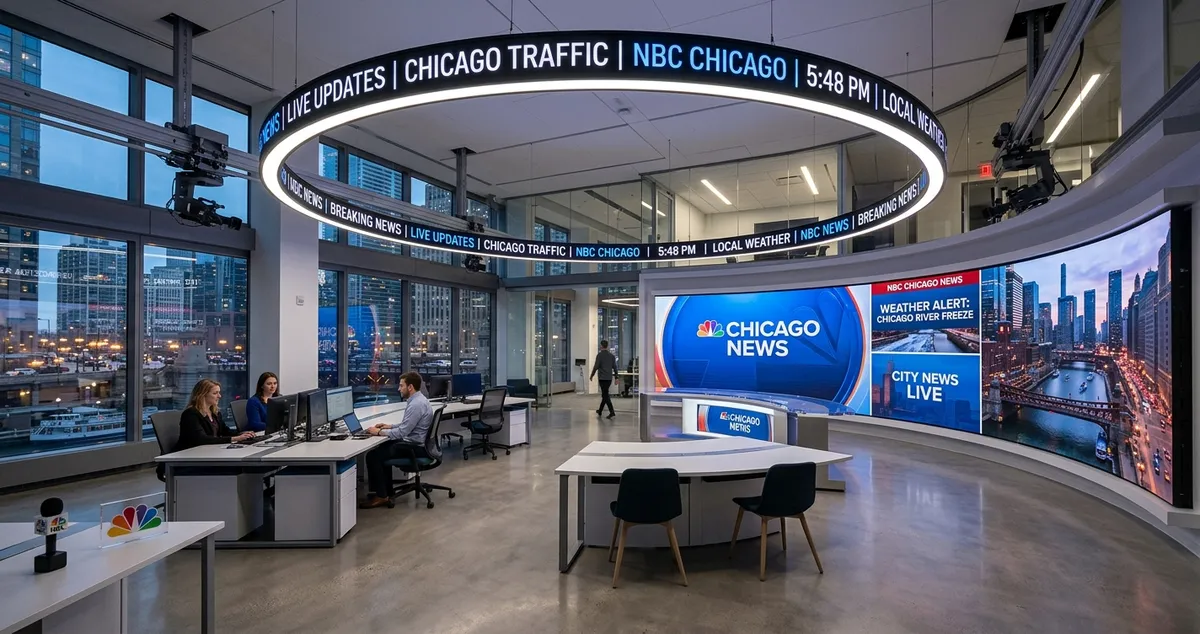
The new facility, which formally opened in January and was featured in an industry profile this week, houses more than 200 employees from NBC 5 Chicago, Telemundo Chicago, and the national NBC News Chicago bureau. It features wall-to-wall video screens, an illuminated ring with a digital news ticker orbiting the ceiling, robotic cameras that can be operated remotely, and panoramic windows overlooking Michigan Avenue and the Chicago River — all of which are impressive, and none of which quite dispel the lingering spiritual energy of a room where Steve Wilkos once threw a chair.
“This is the most advanced local newsroom in the country,” said station general manager Frank Whittaker, standing beneath the orbital ticker, which was at that moment scrolling weather alerts with the calm authority of a space station monitoring Earth’s vital signs. “We’ve reimagined what a newsroom can be.” The reimagining, it should be noted, includes a game room with a foosball table and a lounge area with couches, amenities that were not available to Jerry Springer’s studio audience but that are, evidently, considered essential infrastructure for the production of local news in 2026.
The project was driven by what NBC describes as “a convergence of factors” — remote work reducing the need for desk space, advances in broadcast technology eliminating the need for large dedicated studios, a smaller overall staff, and the expiration of the station’s lease on its upper floors. The five-to-one consolidation is, by any measure, a significant reduction in footprint. Whether it is a downsize or a right-size depends entirely on whether you are the person writing the press release or the person who remembers when the newsroom occupied an entire city block’s worth of office space.
The robotic cameras have drawn particular attention. Operated from a control room that can run multiple broadcasts simultaneously, the cameras move on ceiling-mounted tracks, pivot and zoom autonomously, and can be repositioned between shows without the involvement of a human operator — a technological achievement that the station’s remaining camera operators have reportedly received with the specific enthusiasm of people watching their jobs become software. “The robots supplement our team,” a spokesperson clarified. “They don’t replace anyone.” The spokesperson did not elaborate on whether the robots had been informed of this arrangement.
Industry observers have framed the move as a bellwether for local television. “Every major-market station is going to do some version of this within five years,” said Meredith Lau, a media analyst at Parkline Research. “The economics of maintaining large physical newsrooms are increasingly difficult to justify when most of your audience is watching on a phone screen and half your reporters are filing from the field.” Lau noted that the $70 million investment, while substantial, is partially offset by the lease savings from vacating four floors of premium Streeterville real estate, though she declined to estimate the exact offset because “NBC’s lease terms are not public and I prefer to deal in facts.”
For the employees who now work in the space, the transition has been an exercise in architectural cognitive dissonance. “It’s beautiful,” said one producer who spoke on condition of anonymity because they were not authorized to describe their workplace’s vibes. “The views are incredible, the technology is seamless, and every now and then I look at the floor and think, ‘a man in a diaper fought someone here in 2004.’” The producer added that the game room is “well-used” and that the foosball table “levels the playing field between anchors and interns in a way that feels symbolically important.”
NBC Tower, a 37-story postmodern skyscraper completed in 1989 and designed to echo the Tribune Tower across the street, now has four empty upper floors available for lease — a fact that commercial real estate brokers describe as “an exciting opportunity” and that the building’s other tenants describe as “quiet, finally.” The newsroom, meanwhile, hums along on the second floor, its orbital ticker spinning, its robotic cameras tracking, its walls echoing faintly with the ghosts of daytime television past. The future of local news, it turns out, is smaller, shinier, and haunted.