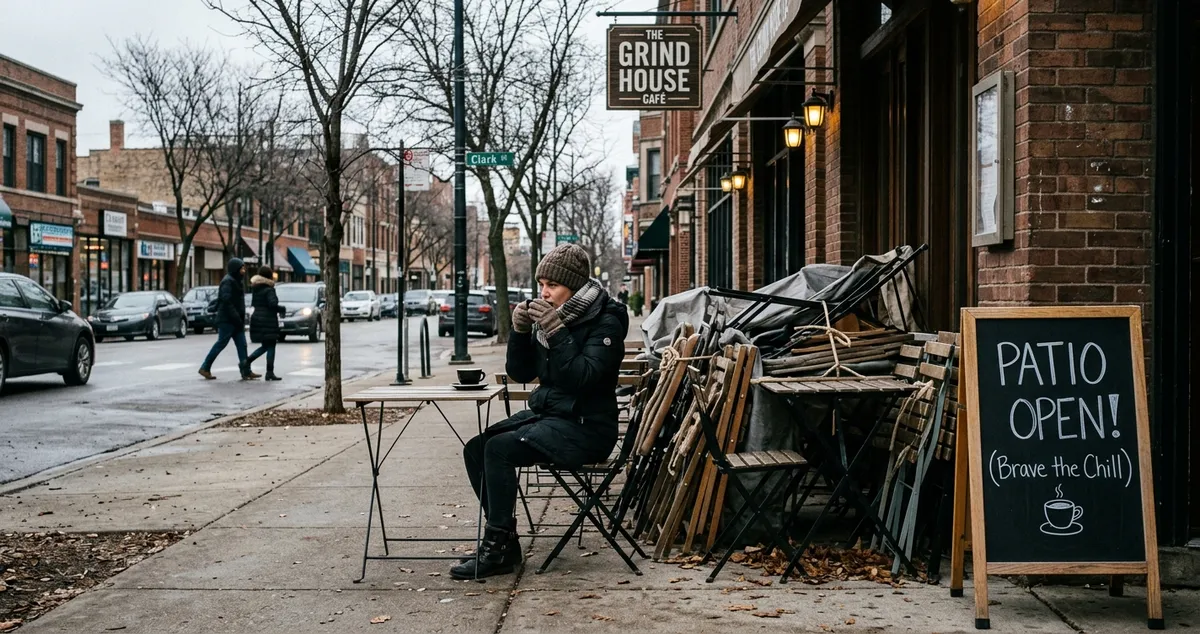
First Patio Season Sighting of 2026 Reported in Andersonville, Witnesses Describe Scene as 'Brave, if Medically Inadvisable'
The first confirmed patio sighting of the 2026 season occurred at approximately 11:40 a.m. on Tuesday at a cafe on North Clark Street in Andersonville, when a woman in a down jacket, knit hat, fingerless gloves, and what one witness described as “an expression of determined serenity” sat down at a small bistro table on the sidewalk and ordered a cortado. The ambient temperature was 48 degrees. The wind chill was 41. She did not go inside.
The sighting was reported independently by three passersby, two of whom posted photographs to social media and one of whom simply stopped walking, looked at the woman, looked at the sky, and continued on with what observers described as “a nod of recognition.” The cafe — which had placed exactly two tables on the sidewalk that morning, along with a chalkboard sign reading “PATIO OPEN (Brave the Chill)” — confirmed that the woman was its first outdoor customer of the year, though a manager declined to share her name, citing “customer privacy and, honestly, a reluctance to single anyone out for something that is technically a personal choice.”
There is a particular species of courage that exists only in the upper Midwest, and it expresses itself most clearly in the annual decision to eat or drink outdoors before the weather has formally consented to the arrangement. This is not recklessness. Recklessness is doing something dangerous without thinking about it. Patio season in March is doing something uncomfortable while thinking about it constantly — feeling the wind on your neck, watching your coffee cool at twice its normal rate, noting the goosebumps on your forearms — and deciding, deliberately, that the symbolic value of being outside outweighs the physical reality of what “outside” currently means.
The phenomenon has been documented by Dr. Renata Hollis, a behavioral psychologist at DePaul University who has studied seasonal outdoor dining habits in Chicago for six years. “What we see in late March is not weather-responsive behavior — if it were, no one would be outside until May,” Hollis said. “It’s identity-responsive behavior. Chicagoans begin sitting outside when they’ve decided that winter is over, regardless of whether winter has received the memo. The patio is a statement of intent.” Hollis’s research, published last year in the Journal of Environmental Psychology, found that the median “first patio” date in Chicago has moved earlier by approximately four days per decade since 2000, a trend she attributes partly to climate change and partly to “an increasing cultural premium on being perceived as someone who sits outside.”
The restaurateurs of Chicago approach the transition with a pragmatism born of experience. Patios begin appearing in mid-March, tentatively at first — a table here, a bench there, positioned against south-facing walls where the sun provides a few degrees of psychological warmth even when the thermometer does not cooperate. Heat lamps, once considered a luxury, are now a minimum requirement; a 2024 survey by the Illinois Restaurant Association found that 78% of Chicago restaurants with outdoor seating consider heat lamps “essential infrastructure,” up from 34% in 2018. Some establishments have gone further, installing wind screens, heated floors, and in one notable Fulton Market case, a retractable glass enclosure that technically qualifies as “outdoor” only in the sense that the roof opens, which it does not do in March.
The customer in Andersonville finished her cortado in approximately twenty minutes — longer than average for a cortado, shorter than average for a person making a point. She left a generous tip, according to the manager, and departed on foot, walking south on Clark with her hands in her pockets and her collar raised against a gust that arrived, with the comic timing of a city that knows exactly what it’s doing, the moment she stood up.
By Thursday, the forecast calls for 58 degrees and sunshine. More tables will appear. More customers will sit. The season will build slowly, then all at once, until by June the sidewalks of every commercial strip in the city are lined with diners who have forgotten that three months ago they were the strange ones, the early adopters, the people who looked at 48 degrees and saw not a temperature but a dare. The woman on Clark Street was the first. She will not be the last. Spring, like everything else in Chicago, arrives not when it’s ready but when someone decides to act as though it already has.