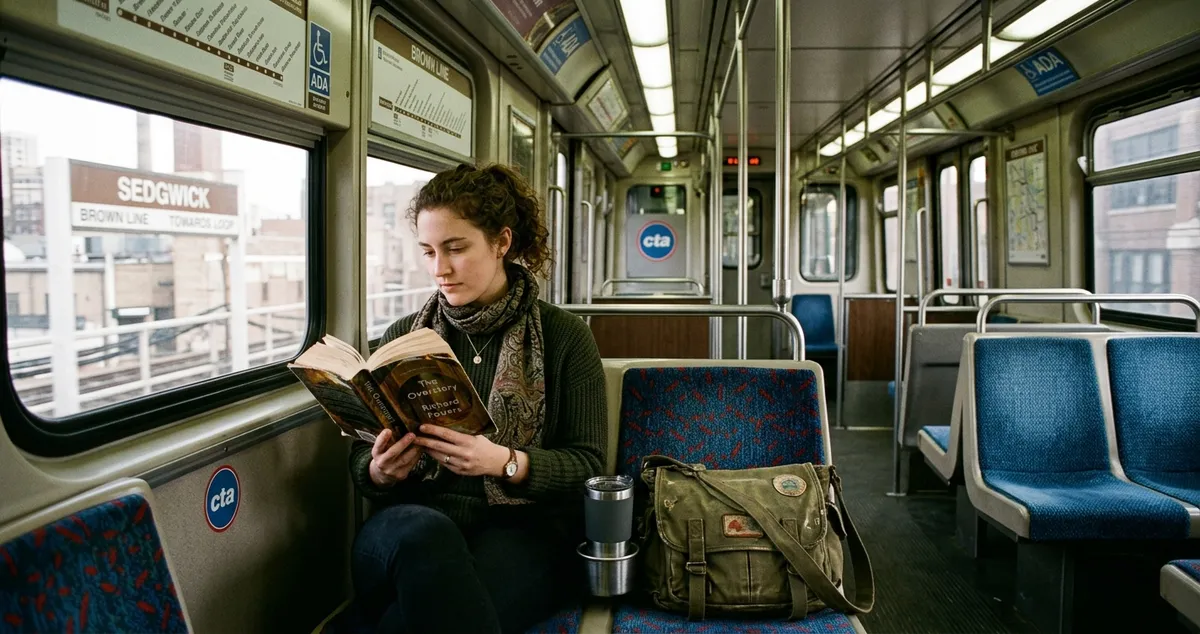
Woman Finishes Entire 900-Page Novel Using Nothing but CTA Brown Line Delays
There is a particular stillness that settles over a Brown Line train when it stops between stations. The lights flicker once, as if considering their options. The intercom crackles with a message that begins “attention passengers” and ends with a duration estimate that everyone on the train instinctively doubles. And then — nothing. The city outside the window holds still. The commuters inside adjust, shift, sigh. Most reach for their phones. Ellen Kowalczyk reaches for her book.
Kowalczyk, a 34-year-old data analyst who commutes from Ravenswood to the Loop five days a week, finished Richard Powers’ The Overstory — a 502-page novel that runs to 900 pages in the mass-market paperback she was reading — on a Tuesday morning somewhere between Sedgwick and Chicago. She had started it on January 6th. She read it exclusively on the Brown Line. She read it exclusively during delays.
“I have a rule,” she said, sitting at a coffee shop near her office with the book on the table between us, its spine so cracked it looked like it had been through a war. “If the train is moving, I don’t read. I look out the window, I listen to a podcast, whatever. But the second we stop — and we always stop — the book comes out.” She tapped the cover. “The CTA wrote this book as much as Richard Powers did.”
Her reading log, maintained in a spreadsheet she shared with undisguised pride, documents every session. Forty-seven delays over eleven weeks. Average delay duration: nine minutes and fourteen seconds. Longest delay: forty-one minutes on February 12th, caused by what the CTA described as “a signal issue at Fullerton” and what Kowalczyk described as “chapters 38 through 42.” Total reading time accumulated through delays alone: approximately seven hours and fourteen minutes.
The Brown Line, for the uninitiated, is the CTA’s scenic route — a meandering loop through the North Side that passes Victorian two-flats, church steeples, and the backs of restaurants close enough to identify what’s on the grill. It is also, by most metrics, among the slower and more delay-prone lines in the system. The CTA’s own performance data shows the Brown Line meeting its on-time threshold roughly 70 percent of the time, a figure that leaves considerable room for literature.
“I tried this on the Red Line once,” Kowalczyk said. “The delays are longer, but they’re more stressful. Someone’s always yelling. You can’t focus. The Brown Line delays have a meditative quality. You’re just… suspended. Between Southport and Belmont, looking at someone’s rooftop garden, reading about trees. It works.”
She is not, she noted, the only delay reader on her train. A loose community has formed in the second car — her preferred car, chosen for its proximity to the Merchandise Mart exit — where at least three other regulars pull out books the moment the train stops. “There’s a guy who’s been working through Dostoevsky since November,” she said. “I think he’s hoping for a system-wide shutdown so he can finish The Brothers Karamazov.”
Kowalczyk has already selected her next book: Hilary Mantel’s Wolf Hall, another brick of a novel that she estimates will take her through June, assuming the Brown Line cooperates. “And by ‘cooperates,’” she clarified, “I mean continues to not cooperate. That’s the whole system.” She tucked the book into her messenger bag, checked the CTA tracker on her phone, and noted with visible satisfaction that her train was running six minutes behind schedule. “Perfect,” she said. “That’s at least a chapter.”