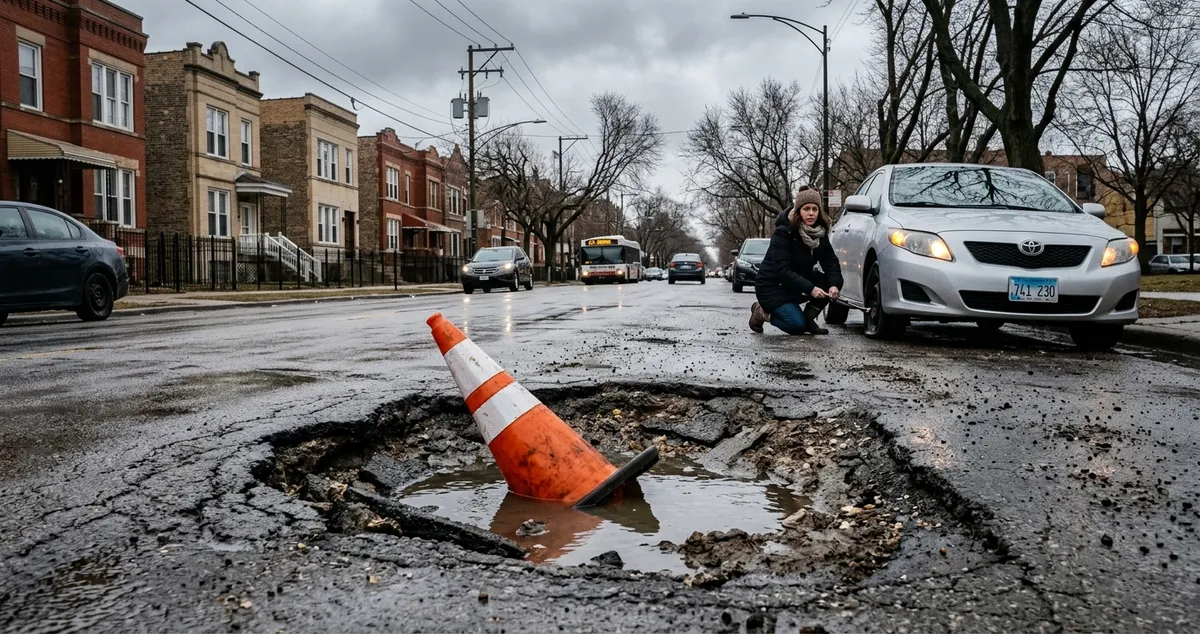
Annual Pothole Migration Arrives Two Weeks Early, CDOT Deploys 25 Crews to Manage What Scientists Are Calling 'an Inevitability'
There is a sound that every Chicagoan knows but no one talks about — a low, percussive thud followed by a metallic shudder that rises through the floorboard, through the seat, through the spine, and settles somewhere behind the eyes as a quiet, personal reckoning. It is the sound of a tire meeting a pothole, and it is, as of this week, the unofficial soundtrack of the city.
The 2026 pothole season has arrived approximately two weeks ahead of the historical average, an acceleration that meteorologists attribute to March’s unusually volatile freeze-thaw cycles. The mechanism is as old as asphalt itself: water seeps into cracks in the road surface, freezes and expands, then thaws and contracts, leaving behind voids that collapse under the weight of traffic. It is, in the language of materials science, “fatigue failure.” In the language of the woman whose tire I watched disintegrate on Western Avenue last Thursday, it is “a $400 catastrophe that the city should be ashamed of.”
CDOT has responded with what it describes as a “surge deployment” — up to 25 crews working seven days a week across all 50 wards, operating a fleet of patch trucks that fill reported potholes within a target window of three to six days from the first 311 complaint. The department reported filling over 48,000 potholes between January 1 and March 15, a number that sounds heroic until you consider that Chicago has approximately 4,000 miles of streets, each of which contains enough surface area to develop dozens of new voids every time the temperature crosses 32 degrees, which it has done 41 times since New Year’s Day.
The 311 system has become a kind of civic seismograph. As of March 20, pothole complaints represent the single largest category of service requests, surpassing streetlight outages for the first time since the polar vortex winter of 2019. The data, when mapped, reveals the expected arterial concentrations — Western, Ashland, Pulaski, and the perpetually beleaguered stretch of North Avenue between the Kennedy and Humboldt Park — but also an emerging pattern of residential side-street damage that residents attribute to increased delivery truck traffic and the city attributes to “normal seasonal degradation,” a phrase that does a remarkable amount of work for four words.
“You develop a mental map,” said Uber driver Claudia Reyes, 42, who estimates she navigates around 30 to 40 potholes per shift. “I know where every bad one is between here and O’Hare. I swerve before I even see them. My passengers think I’m a terrible driver. I’m actually the best driver. I’m protecting their suspension with my body memory.” Reyes noted that she has filed 17 pothole reports via the CHI311 app since February, seven of which have been marked “completed,” four of which she disputes. “They filled one of them with gravel that washed out in two days,” she said. “That’s not filling. That’s suggesting.”
The economics of pothole season are grimly predictable. Chicago-area auto repair shops report a 35% increase in suspension, alignment, and tire-related work orders between February and April, a seasonal surge that the Illinois AAA chapter has taken to calling “infrastructure tax.” Residents can file damage claims with the City Clerk’s office, a process that requires documentation of the pothole, proof of damage, and a receipt from a licensed repair shop — a bureaucratic gauntlet that one aldermanic aide, speaking anonymously, compared to “filing your taxes, except the government is the one who broke your car.”
There is, beneath the inconvenience, something almost geological about the process. The streets of Chicago crack and heal and crack again in a rhythm that predates every mayor, every budget, every 311 app. The asphalt is not failing; it is doing exactly what asphalt does when subjected to the specific cruelty of a Midwestern winter followed by the false promise of a Midwestern spring. Each pothole is a small negotiation between the road and the climate, a place where the surface admits that it cannot hold, that something underneath has shifted, that the ground itself is tired of pretending.
CDOT commissioner Thomas Kazmierczak said in a statement that the department “remains committed to addressing road surface conditions as quickly and efficiently as possible” and encouraged residents to continue reporting potholes through 311. He did not address the philosophical dimensions of the problem, which is understandable. He has 48,000 holes to fill, and March is not over yet.