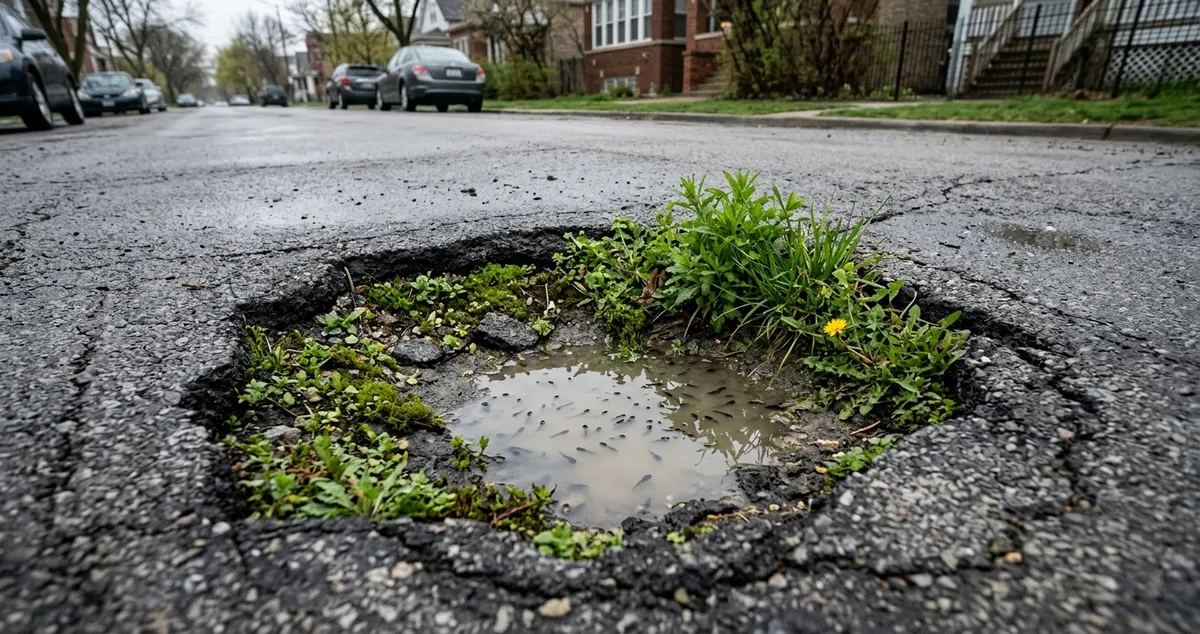
Bridgeport Pothole Develops Thriving Ecosystem, Applies for Wetland Protection
The pothole at 3147 South Halsted Street did not ask to become a habitat. It started, as all potholes do, with modest ambitions — a crack in the asphalt, a winter’s worth of freeze-thaw cycles, a quiet surrender to gravity. But somewhere between its first report to 311 in October and its continued existence in late March, the pothole stopped being a nuisance and started being a neighborhood.
It began with water. Rainwater pooled in the depression, which by February had widened to roughly four feet across and eight inches deep — dimensions that, in real estate terms, would qualify it as a studio apartment in certain parts of Lincoln Park. The water attracted sediment. The sediment attracted seeds. And the seeds, unbothered by the fact that they were germinating in the middle of a city street, did what seeds do.
“There’s clover in there,” said Dr. Patricia Huang, an urban ecologist at UIC who has been visiting the pothole weekly since a colleague texted her a photo in early March. “Dandelion, some chickweed, and what I’m fairly certain is a volunteer tomato plant, which means someone’s compost situation is more interesting than they realize.” She knelt at the pothole’s edge and pointed to the water with a pen. “And those are tadpoles. American toad, probably. At least a dozen.”
The pothole — which neighbors have taken to calling “the pond,” and which one Reddit user christened “Lake Halsted” — has become something of a local attraction. Dog walkers pause to inspect it. Children have been observed lying on their stomachs at its rim, watching the tadpoles with the intensity of doctoral candidates. A hand-painted sign reading “WILDLIFE AREA — DO NOT FILL” appeared last week, staked into the gravel shoulder by an unknown conservationist.
City records show the pothole has been reported to 311 four separate times since October, each report generating a service request that remains listed as “open.” A spokesperson for the Department of Transportation acknowledged the reports and said the pothole is “in the queue for repair,” adding that the department “does not comment on the biological contents of individual potholes.” When informed that a UIC ecologist had described the site as “a functioning vernal pool,” the spokesperson asked to be transferred to voicemail.
The question of whether Lake Halsted qualifies for any form of environmental protection is, according to Dr. Huang, “technically interesting and practically absurd.” Vernal pools — seasonal wetlands that support amphibian breeding — are protected in several states, though Illinois is not among them. “If this were downstate, near a forest preserve, you could make a case,” she said. “In the middle of Halsted Street, you’re mostly making a point.” She paused. “But it’s a good point.”
Alderman Patrick Daley Thompson’s office released a brief statement noting that “the city is committed to maintaining safe and passable roadways” and that “pothole repair remains a priority.” The statement did not address the tadpoles. A follow-up inquiry about the tadpoles was met with silence.
As of press time, the tomato plant is four inches tall. Dr. Huang has given it a name — Gerald — but insists this is “purely for data-tracking purposes.” The tadpoles, she estimates, will metamorphose into toadlets within six to eight weeks, at which point they will leave the pothole and disperse into the surrounding neighborhood. Whether the pothole itself will still be there to see them off is, like most things in Chicago infrastructure, a matter of patience and managed expectations.