Griffin Museum Staff Spend Eight Hours Spring-Cleaning a Castle That Hasn't Had a Resident Since 1949
The chandeliers are the hardest part. Not because they’re heavy — each one weighs less than a paper clip — but because they remember everything. Every set of eyes that has peered through the glass at them since 1949. Every child’s breath that has fogged the display case. Every shift in barometric pressure that has settled a new layer of invisible dust onto crystals smaller than grains of rice. The chandeliers carry it all, and on the third Monday of March, someone has to take it away.
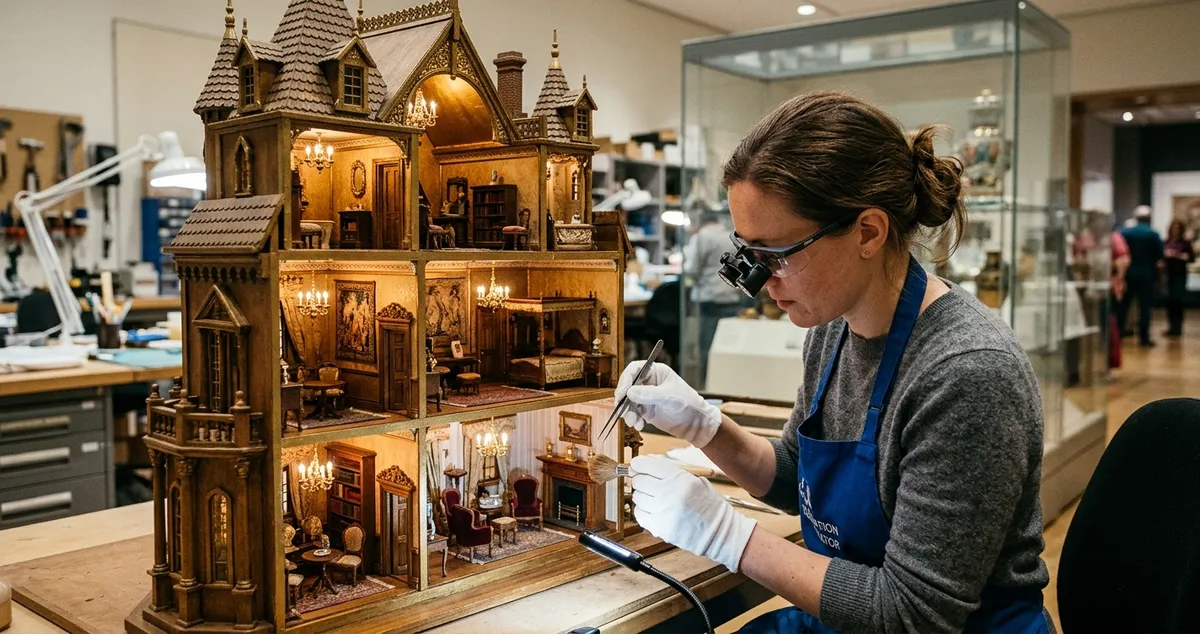
That someone, this year, was conservator Beth Takahashi, who arrived at the Griffin Museum of Science and Industry at 6:30 a.m. with a toolkit that would make a watchmaker envious: sable-hair brushes no wider than eyelashes, vacuum nozzles fitted with mesh screens to prevent accidental artifact ingestion, and a pair of surgical-grade tweezers that she refers to, without irony, as “the good ones.” Her assignment: the biannual deep clean of Colleen Moore’s Fairy Castle, a miniature palace that has been on continuous display at the museum for 76 years and has never, in all that time, asked to be left alone.
The castle was built between 1928 and 1935 by silent film star Colleen Moore, whose father reportedly suggested she construct “the dollhouse of her dreams.” Moore took this suggestion with a literalness that borders on the heroic. The result is a nine-square-foot, twelve-room structure containing over 1,500 miniature objects, including a tiny Bible rumored to be the smallest in the world, a grand piano with strings made from spider silk, and floor coverings woven on custom looms that produced fabric at a scale of approximately one inch per hour. The total value of the castle’s contents has been estimated at several million dollars, a figure that does not account for whatever it is worth to have been loved this carefully for this long.
“You develop a relationship with the rooms,” Takahashi said, working a brush the size of a matchstick across the ballroom floor while her colleague, conservation technician Darnell Harris, documented each cleaned section with a macro lens. “I always start with the kitchen because it feels the most practical. Like, if this were a real house, you’d start with the kitchen. Then I work my way up to the throne room.” She paused. “The throne room is always last. It likes the anticipation.”
The cleaning process takes approximately eight hours and is performed two to three times a year, depending on conditions. Each room is addressed individually. Surfaces are brushed, not wiped, to avoid displacing fragile elements. The team uses LED headlamps and jeweler’s loupes to inspect crevices that are, in a very real sense, too small for the human gaze. Harris noted that the most common contaminant is not dust but “micro-fibers from visitor clothing,” which drift through the display case’s ventilation seams like tiny, uninvited guests. “The castle is technically airtight,” he said, “but Chicago finds a way.”
Visitors who happened to arrive during the cleaning were redirected to the U-505 submarine exhibit, though a small crowd gathered at the conservation window to watch. One woman, a retired teacher from Naperville who gave her name only as Dolores, said she had been visiting the Fairy Castle since she was seven years old. “I used to think fairies lived in it,” she said. “Now I think something better does. I think patience lives in it. I think that’s what you’re looking at when you look in there — seventy-six years of someone deciding, every single day, that this small, beautiful thing is worth taking care of.”
By 2:30 p.m., Takahashi had reached the throne room. The miniature crown, which sits on a cushion the size of a pea, had accumulated a film of particulate matter that she removed with three passes of a brush and a single, controlled exhale. The chandelier above the throne — the smallest in the castle, holding twelve candles each the size of a pin head — took twenty minutes. She held each crystal between the tips of her tweezers, brushed it, and returned it to its setting with the focus of someone performing the most important surgery in the world on the smallest patient imaginable.
“People ask me if it’s tedious,” Takahashi said, packing her tools into a velvet-lined case as Harris powered down the documentation lights. “It’s not. It’s the opposite. When everything is this small, nothing is insignificant. Every speck matters. Every surface has a story.” She clicked the case shut. “I think that’s the lesson of the castle, honestly. That the tiniest things deserve the most attention.” She looked back at it through the glass — twelve rooms, 1,500 objects, seventy-six years of breath and dust and light — and nodded once, satisfied. The castle, for its part, said nothing. It simply gleamed.