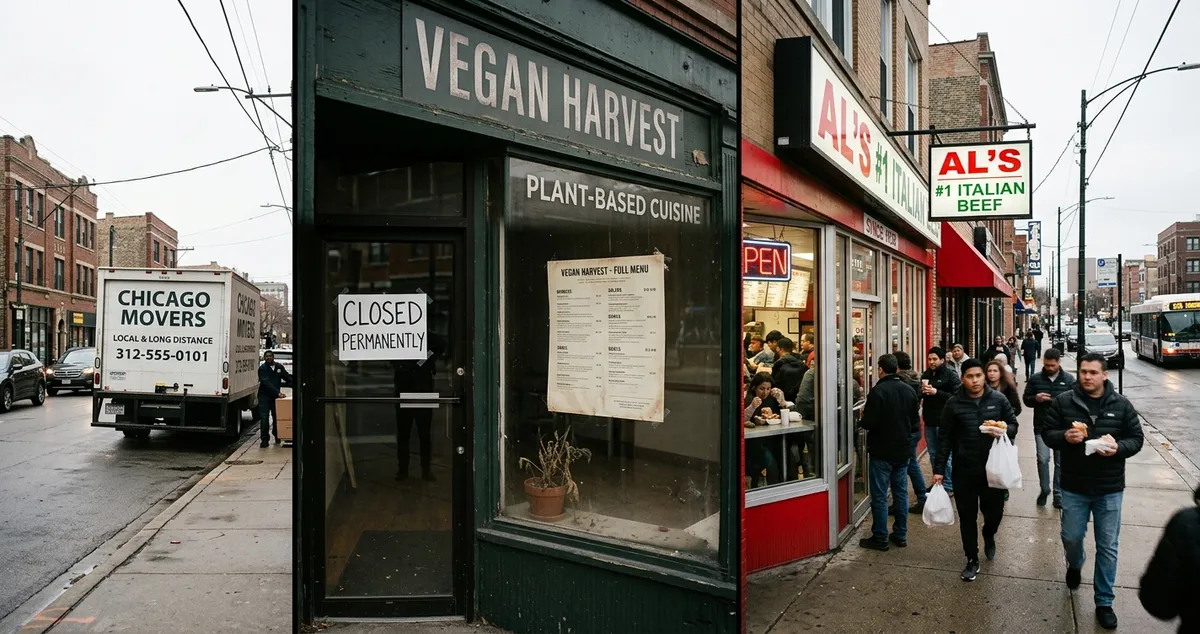
Six Vegan Restaurants Close in Chicago in Under Three Months, City's Italian Beef Shops Decline to Comment
The city that invented the Italian beef sandwich, perfected the encased meat, and once hosted a ketchup-on-hot-dogs debate so heated that it required aldermanic mediation has, in the span of approximately eleven weeks, lost six plant-based restaurants — a casualty rate that industry observers are calling “unprecedented” and that at least one Bridgeport diner owner described, off the record, as “the market correcting.”
The closures began in January with Kitchen 17, the Lakeview institution that created Chicago’s first vegan deep-dish pizza and had scaled to shipping 20,000 frozen pies annually to all 50 states. It was followed in rapid succession by Native Foods, Chicago Raw, the Chicago Diner’s Logan Square location, Bloom Plant Based Kitchen in Wicker Park, and Cinnaholic. Six restaurants. Three neighborhoods. One shared cause of death that the owners have politely framed as “unsustainable operating costs” and that the numbers suggest was something closer to arithmetic.
“The margins in plant-based dining were never comfortable, but they were viable when downtown foot traffic was at pre-2020 levels,” said Eleanor Marsh, a restaurant industry consultant with Lakeview Hospitality Group. “What changed isn’t that people stopped wanting vegan food. It’s that the people who want vegan food also want to work from home three days a week, and you can’t sell a $19 grain bowl to someone’s living room couch.” Marsh estimated that Loop and near-Loop lunch traffic remains 31% below 2019 levels, a figure that affects all restaurants but hits hardest at establishments whose customer base skews toward the kind of worker who has a standing desk and strong opinions about oat milk.
The closure of Kitchen 17 has drawn particular mourning. Founded in 2017 by chef and owner Andrea Pappas, the restaurant became an unlikely ambassador for a city not traditionally associated with vegetables, proving that Chicago could produce a vegan deep-dish that was, by most accounts, genuinely good. Its frozen pizza operation had reached national distribution. “We were in Whole Foods in 38 states,” Pappas said in a statement. “But the retail side couldn’t subsidize the restaurant side anymore. The math just stopped working.”
The response from Chicago’s carnivorous establishment has been, publicly, one of measured sympathy. Al’s #1 Italian Beef on Taylor Street issued a statement expressing “solidarity with all Chicago restaurants during a challenging time” and noting that “the restaurant industry is a family, regardless of menu.” Privately, sources say, business at Al’s has been up 12% since January, a coincidence that no one at the counter seemed interested in interrogating.
Ald. Patricia Navarro (32nd), whose ward includes the former Bloom location, said her office has received inquiries from three prospective tenants for the space, two of which are “fast-casual meat-forward concepts” and one of which is, somewhat poetically, a jerky shop. “I want to be clear that we welcome all types of dining in the 32nd Ward,” Navarro said. “But I also represent the people of this ward, and the people of this ward have spoken, and what they’ve said is ‘Italian sausage with peppers.’”
Not everyone is ready to write the obituary. Bloom’s owners announced plans to return with “a new vegan concept” later this year, though details remain vague and the phrase “new concept” in the restaurant industry typically means “the same food in a smaller space with fewer employees.” Several surviving plant-based establishments, including Kale My Name in Pilsen and the Chicago Diner’s original Boystown location, report stable business and no plans to close. “We’ve been here since 1983,” said a Chicago Diner spokesperson. “We survived the Atkins diet. We’ll survive this.”
The broader question — whether Chicago is simply not a vegan city, or whether six closures in eleven weeks is a statistical blip in a market that will eventually rebalance — remains the subject of vigorous debate. What is not debatable is the scene outside Al’s on a recent Saturday afternoon: a line of 40 people, none of whom appeared to be in crisis about the state of plant-based dining, waiting patiently in the March wind for a sandwich made of beef, giardiniera, and the quiet confidence of a city that knows exactly what it is.