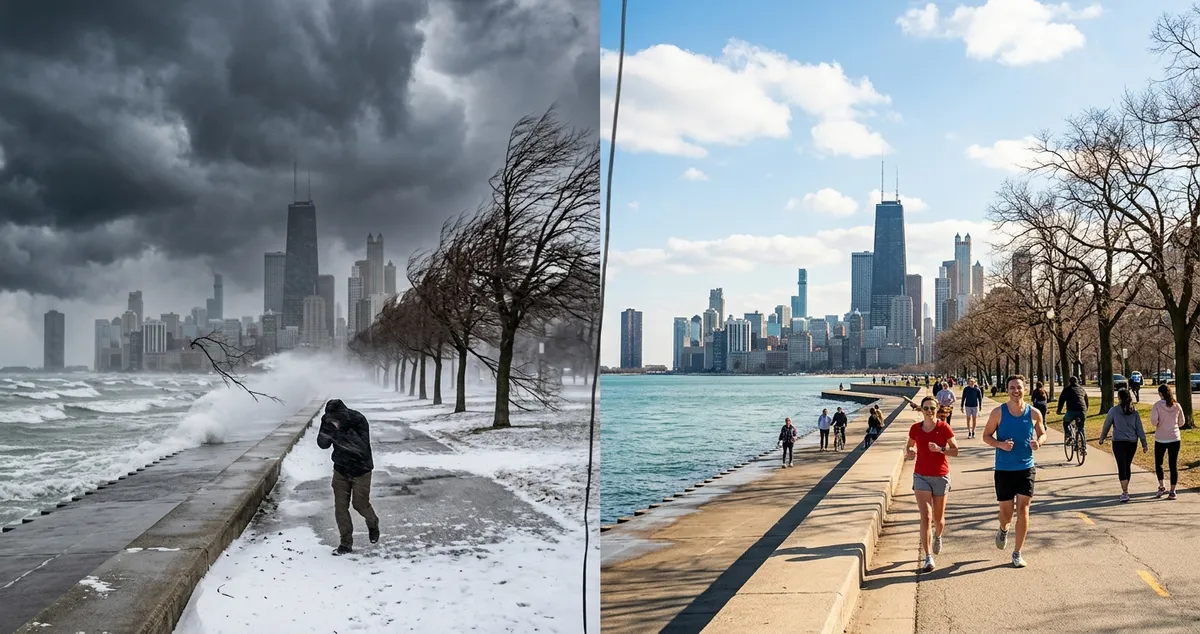
Chicago Experiences All Four Seasons in Single Week, Residents Unmoved
There is a particular kind of silence that settles over a city that has simply stopped being surprised by the sky. It is not the silence of shock, nor of awe, nor even of resignation. It is the silence of a population that has looked at a forecast calling for 60 mile-per-hour winds followed by record rainfall followed by springtime sunshine and thought, collectively, yeah, that tracks.
March 2026 opened with temperatures running ten degrees below normal — a sullen, gray cold that sat on the city like a grudge. Highs in the mid-20s. Wind chills that made the lakefront feel like a personal insult. The kind of cold that doesn’t just chill you but seems to have opinions about your coat. Meteorologists at the National Weather Service’s Romeoville office described it as “a persistent Arctic intrusion,” which is the scientific way of saying winter had not yet been informed that it was over.
Then came March 13.
The system that moved through that Thursday brought sustained winds above 50 mph and gusts exceeding 60 — enough to topple trees in Lincoln Park, shear branches across power lines in Evanston, and rearrange the patio furniture of every restaurant in Wicker Park that had optimistically set up for spring. ComEd reported 87,000 outages across the metropolitan area. A trampoline in Berwyn traveled four blocks and came to rest in a Walgreens parking lot. No one was injured. The trampoline was not recovered.
Two days later, on March 15, Chicago received 1.76 inches of rain in a single day — breaking a record that had stood since 1943, when the world had other things on its mind. The Chicago River rose visibly along the Riverwalk. Basement sump pumps across the North Side entered what one plumber described as “a crisis of purpose.” Lower Wacker Drive, that subterranean passage that exists in a state of permanent philosophical ambiguity, flooded in three separate locations, stranding a delivery truck carrying, according to its driver, “a lot of ranch dressing.”
And then — because March in Chicago is not a month so much as a mood disorder — the sun came out.
By March 18, temperatures had climbed to 62 degrees. By Thursday, 65. Joggers appeared on the lakefront in shorts and tank tops, as if the previous two weeks had been a shared hallucination. Patios reopened. Dogs were walked with visible enthusiasm rather than grim obligation. A man in Uptown was observed eating ice cream on a bench at 10 a.m., and no one questioned his choices, because after what the sky had put this city through, ice cream at 10 a.m. was an act of radical self-care.
“What we experienced was a compressed seasonal transition that is becoming more characteristic of Great Lakes spring patterns,” said Dr. Nina Alvarez, a climatologist at the University of Illinois Chicago. “Essentially, the jet stream oscillated rapidly between a meridional and zonal configuration, producing an accelerated weather cycle.” She paused. “In layman’s terms, March did a speedrun.”
The question of whether Chicagoans are adequately preparing for these whiplash transitions appears to have been answered by the city’s collective wardrobe. A survey of the Damen Blue Line platform on any given March morning reveals parkas beside windbreakers beside fleece vests beside one person in a T-shirt who has simply decided that temperature is a suggestion. “I own one coat,” said Ravenswood resident Derek Shull, 34. “If it’s wrong for the weather, that’s the weather’s problem.”
There is something almost meditative about a city that has internalized chaos as climate. Chicago does not rage against the dying of the light, because the light will be back on Tuesday, along with 40-degree temperature swings and a chance of hail. The forecast for the coming week calls for partly cloudy skies and highs near 55 — normal, unremarkable, the kind of weather that barely registers. After the month we’ve had, normal feels like its own kind of miracle. Or maybe just a pause. March, after all, is not over yet.