Seventy Thousand Chicagoans Discovered the Primary Existed Between 4 and 7 PM; Board of Elections Calls It 'Peak Civic Engagement'
The Illinois primary election concluded Tuesday night with an unofficial Chicago turnout of roughly 25 percent — a figure that the Board of Elections characterized as “robust” and that a reasonable person might characterize as “one in four.” But the real story was not the final number. The real story was the shape of the day, which resembled less a steady exercise in democratic participation and more a citywide game of chicken between voters and the 7 PM poll-closing deadline.
At 2 PM, turnout stood at 16 percent. By 3:30, it had crawled to 19. Election judges across the city reported long stretches of empty polling places, silent gymnasiums, and the particular loneliness of a person sitting behind a folding table with 400 unclaimed “I Voted” stickers and a copy of the Chicago Reader they’d already finished twice. “I reorganized the ballot supply three times,” said Maria Delgado, an election judge at a West Town precinct. “I alphabetized the poll book. I texted my daughter. I considered quitting.”
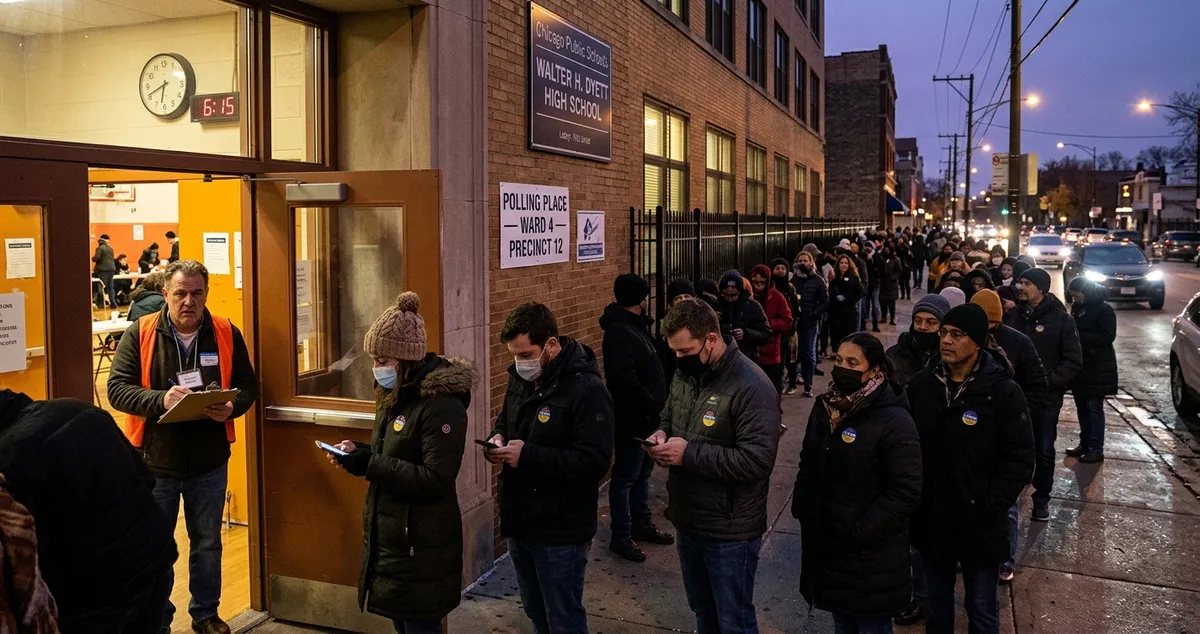
Then, at approximately 4 PM, something happened. The Board of Elections’ live tracker, which had been flatlined for hours, began climbing. Between 4 and 7 PM, over 70,000 ballots were cast across the city — more than one-third of the entire day’s total, compressed into three hours that transformed placid polling places into scenes of controlled chaos. Lines appeared at precincts that had not seen a line since the morning rush. One South Side location reported a queue stretching to the sidewalk at 6:40 PM, twenty minutes before close, with voters still clutching sample ballots they appeared to have printed in their cars.

“This is a phenomenon we’ve observed before, but the magnitude was unusual,” said Max Benson, a spokesperson for the Chicago Board of Elections, choosing his words with the care of a man who has been asked to explain why democracy looks like a last-minute homework submission. “Chicagoans are engaged voters. They are also, historically, evening voters.” When pressed on whether “evening voter” is a polite way of saying “procrastinator,” Benson said the Board does not editorialize on voter motivation.
The irony, as several civic engagement groups noted Wednesday morning, is that the early voting period preceding the primary was record-breaking. The Board received 188,057 early and mail-in ballots — smashing the previous gubernatorial primary record of 106,252 set in 2018. In other words, the voters who planned ahead did so in historic numbers, and the voters who did not also showed up in historic numbers, just much later and all at once, like a restaurant that takes no reservations and wonders why there’s a rush at 7:45.
The late surge produced its own micro-dramas. At a Lincoln Park precinct, a voter arrived at 6:52 PM and asked the election judge to “explain the assessor race real quick.” The judge, who had been on duty since 5:30 AM, reportedly stared for several seconds before providing what witnesses described as “a very concise summary.” In Pilsen, a man who had come straight from work attempted to vote while still wearing a hard hat and reflective vest, prompting a brief discussion about whether construction PPE constituted campaign signage. It did not.
The results themselves were decisive in several races — Lt. Gov. Juliana Stratton claimed the Democratic Senate nomination, Pat Hynes unseated Cook County Assessor Fritz Kaegi, and a 13-candidate field in the 7th Congressional District was won with just over a quarter of the vote — but the day’s most lasting image may be the turnout curve itself: a flat line that suddenly, urgently, almost desperately spikes in the final hours, like a city that collectively remembered it had somewhere to be. “We’re already looking at ways to smooth participation across the full day,” Benson said. He did not sound optimistic.