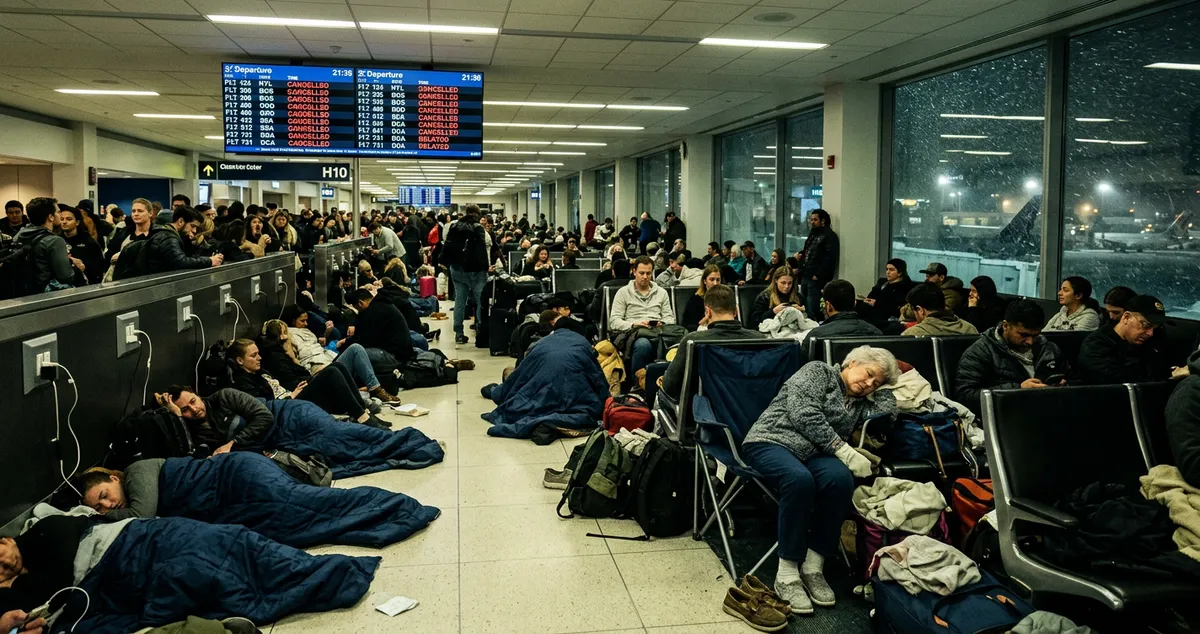
O'Hare Cancels 384 Flights, Stranded Passengers Form What Sociologists Are Calling 'A Small Society'
O’Hare International Airport canceled 384 flights and delayed another 233 in the 24 hours following the arrival of a bomb cyclone that swept through the Chicago area Sunday night and Monday morning, stranding an estimated several thousand passengers across Terminals 1, 2, 3, and 5 in what the Chicago Department of Aviation described as “a weather-related operational disruption” and what the passengers themselves described using language that cannot be reprinted in a family publication.
By 9 AM Monday, Terminal 3’s B Concourse — home to American Airlines’ domestic operations and the airport’s largest concentration of delayed passengers — had developed what Dr. Elena Marsh, a sociologist at UIC who was herself stranded on a canceled 6:15 AM flight to Dallas, described as “the early indicators of emergent social organization.” Dr. Marsh, who studies group behavior in confined spaces, said she had observed the formation of at least three distinct passenger clusters: “the Informed,” a group near Gate B18 who had downloaded the FlightAware app and were providing real-time updates to surrounding travelers with the quiet authority of wartime radio operators; “the Resigned,” a larger group distributed across the concourse floor who had accepted their situation and were watching movies on their phones with the glassy serenity of people who had moved past anger into something deeper; and a third group she called “the Seekers,” who were walking the terminal in continuous loops, checking departure boards that had not changed in two hours, stopping at every gate agent’s desk to ask the same question, and receiving the same answer, which was “we don’t have any updates at this time.”
The concourse’s electrical infrastructure came under immediate strain. Passengers identified every available outlet within the first 90 minutes, and by 7 AM, a charging hierarchy had informally established itself. A man near B22 who had secured a three-outlet power strip described his position as “non-negotiable” and said he was willing to share one of the three outlets with a mother traveling with a toddler but “not with the guy who already had 43% battery and just wants to watch YouTube.” When asked how he knew the man’s battery percentage, he said, “He showed me. He showed me his 43% like it was supposed to make me feel something. It did not.”
The airport’s food court experienced what an O’Hare concessions manager called “demand patterns outside our modeling.” The McDonald’s in Terminal 3 sold out of Egg McMuffins by 8:15 AM, a full hour ahead of the breakfast-to-lunch transition, prompting a line of approximately 60 people that extended past the Starbucks, whose own line had merged with the McDonald’s line in a way that created what one traveler called “a superline” and what a Starbucks barista called “my nightmare.” A Garrett Popcorn location remained fully stocked throughout the morning, apparently because airport-stranded passengers, despite being hungry, draw a psychological line at popcorn for breakfast. “We’ve had four customers since six AM,” said the employee behind the counter, who asked not to be named because she was not authorized to speak to media but who was, she said, “not doing anything else.”
The Chicago Department of Aviation activated its emergency operations center at 11 PM Sunday, approximately five hours before the worst of the snow arrived, and deployed additional staff to terminals to assist with rebooking and passenger management. A spokesperson for the department said the response was “consistent with our Severe Weather Operations Plan” and that the airport had distributed 200 cots to terminals for passengers expecting overnight delays. A follow-up question about whether 200 cots was sufficient for several thousand passengers was met with the response that “additional resources are being evaluated on a rolling basis,” a phrase that has the structural properties of an answer without being one.
Airlines offered varying levels of communication. American Airlines posted gate-by-gate updates to its app roughly every 40 minutes. United, whose operations are based in Terminal 1, sent a single push notification at 5:22 AM reading “Your flight has been impacted by weather” — a sentence that one passenger, a management consultant from Naperville, described as “the most passively constructed piece of English I have ever received, and I write passively constructed English for a living.” Southwest, operating out of Midway, was reportedly experiencing similar disruptions, but Midway passengers were not available for comment because, as one Southwest gate agent explained, “they left.”
By late Monday morning, as the snow began tapering and the wind chills settled into single digits, the first rebookings began processing. Dr. Marsh, the sociologist, noted that the social structures of Terminal 3 were already beginning to dissolve. The Informed near B18 had lost their audience. The Resigned were standing up and checking bags. The Seekers had stopped seeking. The man with the power strip was packing it into his carry-on with the careful movements of someone storing a weapon after a battle that had, in the end, not come. “This is the part most people don’t study,” Dr. Marsh said, pulling her own bag toward the rebooking desk. “The dissolution. How fast it all goes back to strangers.” She paused. “Anyway, I need to get to Dallas.”
The Department of Aviation said in a Monday afternoon statement that operations were “returning to normal,” a characterization that did not specify what normal means at O’Hare, where 384 cancellations was the crisis but where a normal day still involves 50 to 70 cancellations, several hundred delays, and a permanent, low-grade condition of managed chaos that the city has been navigating since the airport opened in 1944. By Tuesday, the department said, all terminals would be “fully operational.” The popcorn, presumably, would still be available.