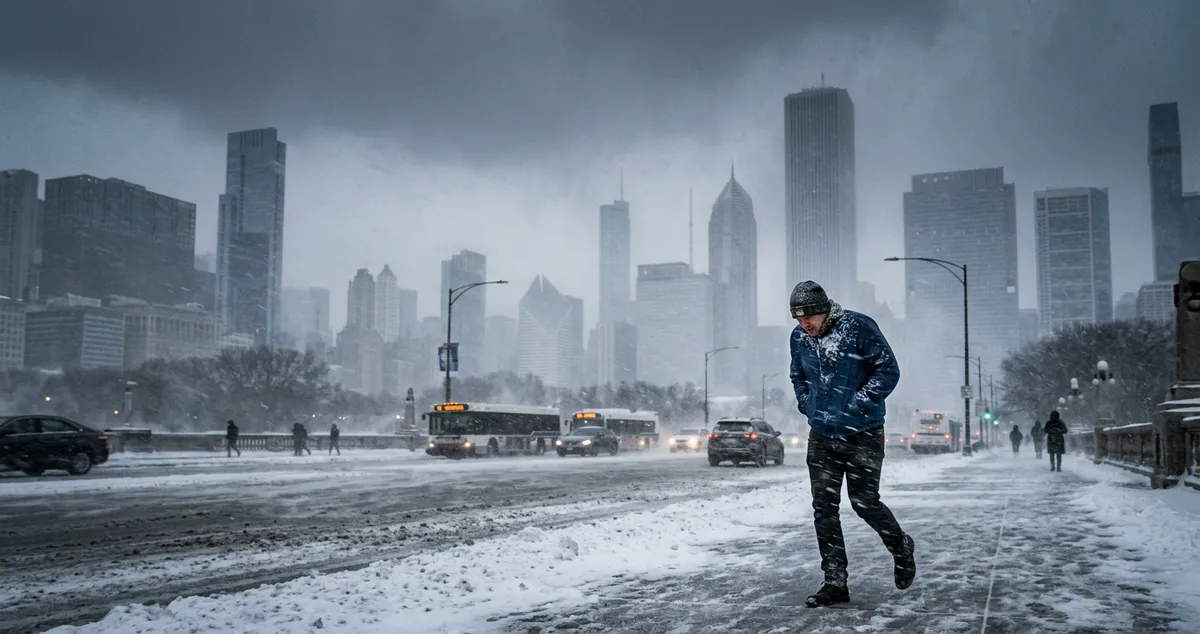
Meteorologists Confirm March 16 Blizzard Is Winter's Way of Having the Last Word
The snow began falling on Chicago at approximately 4:17 AM on Monday, March 16th — forty hours after half a million people stood along Columbus Drive in shirtsleeves watching the St. Patrick’s Day parade, thirty-six hours after the Chicago River ran green under a sky that could charitably be described as “almost warm,” and exactly zero hours after the National Weather Service issued a Winter Weather Advisory that most of the city had already decided not to believe. The storm arrived anyway. Storms are indifferent to belief.
The system responsible — a rapidly intensifying low-pressure area that meteorologists have taken to calling a “bomb cyclone,” a term that sounds dramatic until you experience one and realize the drama is entirely earned — swept across the Great Plains on Sunday evening, spawning severe thunderstorms to its south and wrapping bitter arctic air around its northern flank directly into the Chicago metropolitan area. By midnight, the thunder had given way to horizontal snow. By dawn, the city had accumulated between one and four inches, depending on elevation, exposure, and how recently your neighbor had shoveled. Wind gusts reached 45 miles per hour. The temperature, which had been 54 degrees on Saturday afternoon, was 23 degrees by Monday’s sunrise. This is a drop of 31 degrees in 38 hours, which is not unusual for March in Chicago but which feels, each time it happens, like a personal affront.
There is a particular quality to late-March snow that distinguishes it from the November or January varieties. January snow is expected. It arrives as part of an understood contract between the city and the season: winter will be long, and cold, and heavy, and the city will endure it because endurance is what the city does. November snow is a warning — a preliminary statement from the atmosphere that the contract is about to take effect. But March snow, especially mid-March snow, especially mid-March snow that follows a weekend of 50-degree weather and green rivers and outdoor dining and the collective municipal fantasy that spring has arrived — March snow is something else entirely. March snow is an argument. It is winter making a point. The point is: you were premature.
The National Weather Service’s Chicago office posted its advisory at 6:42 PM Sunday, approximately four hours before the snow began. The advisory warned of “1 to 3 inches of accumulation with locally higher amounts, reduced visibility in blowing snow, and hazardous travel conditions through early Monday afternoon.” It was a clear, accurate, well-communicated forecast. It was also, according to informal surveys of social media conducted by this reporter, almost universally ignored by residents who had spent the weekend wearing light jackets and who were not emotionally prepared to re-engage with the concept of winter. “I saw the advisory,” said a man waiting for a bus on Michigan Avenue at 7:30 AM Monday, snow collecting on the shoulders of a windbreaker he had chosen, he admitted, “on principle.” The principle appeared to be that it was mid-March and he should not have to own a coat anymore.
O’Hare International Airport reported 384 flight cancellations and 233 delays within 24 hours of the storm’s onset. Midway saw proportional disruptions. The CTA issued a system-wide cold weather advisory and deployed “scratcher” trains along elevated lines to prevent ice buildup on the third rail — a precaution that is technically routine but that carries, in March, a particular melancholy, as though the transit system is admitting something the rest of us are not yet willing to say. The Illinois Department of Transportation deployed 350 plows across the Chicago district. The plows had been, as of the previous Friday, repositioned to maintenance yards for pre-spring servicing. They were repositioned back.
What strikes me about this storm — what strikes me about every late-season storm, if I am honest — is not the snow itself but the silence that follows. By Monday afternoon, the advisory will expire. The snow will taper. The wind will remain, scouring the city with single-digit wind chills that will make the morning’s accumulation feel like a memory. And then, by Wednesday or Thursday, the temperatures will climb back into the 40s, and the snow will melt, and the cycle will reset, and the city will once again begin the cautious, hopeful, inevitably premature process of believing in spring. This is the Midwestern condition. Not optimism, exactly. Something more stubborn. Something that looks at a forecast for 23 degrees and blowing snow in the third week of March and says, not unreasonably, yes, but next week.
The storm will pass. It always does. The question it leaves behind — the question every March storm leaves behind, carried on a wind that has traveled a thousand miles across frozen plains to arrive at the lakefront with nothing to show for itself but cold — is not whether winter is over. Winter is always almost over in March. The question is whether we were wrong to think it was already gone, or whether thinking it was gone is the thing that makes its return survivable. I do not know the answer. I do know that the man at the bus stop, the one in the windbreaker, got on the bus when it came. He did not go home for a heavier coat. He rode the bus into the city, into the snow, into a morning that was not the morning he had planned for but was the morning he had. This is Chicago in March. The forecast is always wrong, except when it isn’t, and either way, you go to work.