Illinois Votes Tomorrow. The City Is Getting Quiet in a Way That Means Something.
There is a particular quality to the city the night before an election — not a hush, exactly, but a held breath. Something that moves differently through the streets. You can feel it if you walk late enough, past the bars still lit from the weekend, past the polling place signs taped to school doors with a care that suggests someone thought about where to put them, past the people moving home from wherever they’ve been with the slightly purposeful gait of people who have something to do tomorrow.
Tomorrow is the March 17 primary, the one with the Senate race and the ten-person congressional free-for-all and the Cook County Board contests that will determine, in ways that are specific and granular and difficult to explain briefly, who controls what in this city for the next several years. There will also be a river full of green dye, because this year St. Patrick’s Day and Election Day share a Tuesday, and Chicago is a city that sees nothing strange in this — that holds its civic and its festive impulses in the same hands and does not require them to be kept separate.
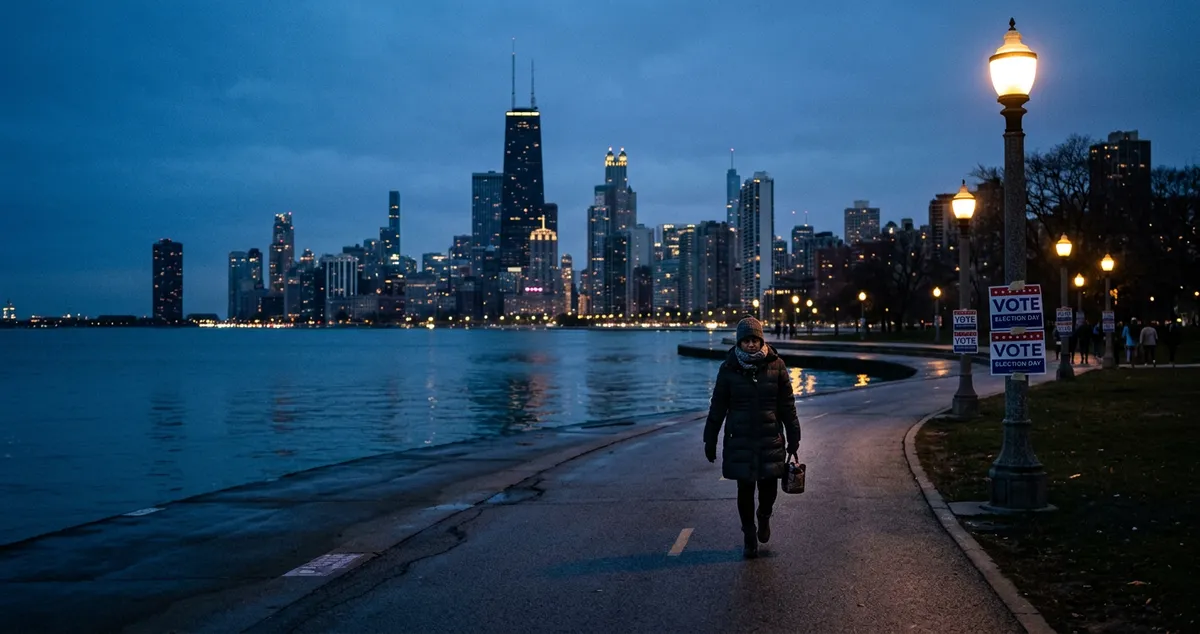
I walked the lakefront this evening, south from Hyde Park toward the Museum Campus and back. The lake is gray-dark, still cold, the ice along the shore mostly gone now but the water not yet willing to be anything other than serious. There were a few joggers. A couple walking a dog that seemed aggrieved by the wind. A man sitting on a bench facing the water who may have been thinking about the election or may have been thinking about something else entirely, which is his right.
What does it mean to vote in a city like this? Not in the procedural sense — the Board of Elections has a website for that, and it is functional more than 60% of the time, which I understand is better than it was in January — but in the ambient sense. In the sense of: this is a city of 2.7 million people who arrived from everywhere, through every kind of door, with every kind of story, and tomorrow they will walk into a school gymnasium or a church basement or a firehouse and make a mark next to a name, and the marks will be counted, and from the counting will emerge something that is technically a result and is also, if you look at it a certain way, a photograph of where the city stands at this particular moment in its long and argumentative life.
Chicago is a city that has a relationship with its own history that I find unusual, compared to other places I’ve been. It carries its history the way the river carries water — constantly, in the direction of whatever comes next, without making a performance of it. The river flows south now because men with engineering degrees decided in 1900 that it should, and it has flowed south ever since, and this fact is known and sometimes mentioned but rarely dwelt on, because there is always something more current to attend to. That is also how the city handles its elections. Something happened here once; something is happening now; something will happen again; keep moving.
The Senate race, from where I sit, feels like a genuine question mark, which is rarer than it should be. Three candidates who have each earned their candidacy in ways that are specific and real. The congressional race feels like an experiment in what happens when a democratic process has more options than a reasonable person can evaluate, which is also a fair description of most democracies operating at scale. Neither of these is a crisis. They are the ordinary texture of a complicated civic life in a city that has never resolved the tension between its neighborhoods and its institutions, its ethnic loyalties and its class interests, its ambition and its deep, abiding preference for things to stay the way they are.
Tomorrow the precincts will open at six in the morning, when it will still be dark and cold, and some people will vote then — the ones who believe in voting before the day accumulates its complications, who find a particular satisfaction in the act of going first. The precincts will stay open until seven at night, when the city will be several hours into its St. Patrick’s Day, when the bars will be full and the river will have been green and then returned to its usual color and the parade will be a memory and the voting will still be happening, the way voting happens — steadily, unhurriedly, with a weight that it is easy to underestimate because it is distributed across so many ordinary doors.
I will vote in the morning. I have my precinct card. I know where to go. This, I think, is the thing about elections that doesn’t get written about enough: not the drama of close margins or the machinery of campaigns, but the simple, unremarkable fact of showing up somewhere specific on a Tuesday and doing the quiet thing that the city requires. It doesn’t feel like history when you’re doing it. It feels like running an errand.
The lake at night is very still. The polls open at six.