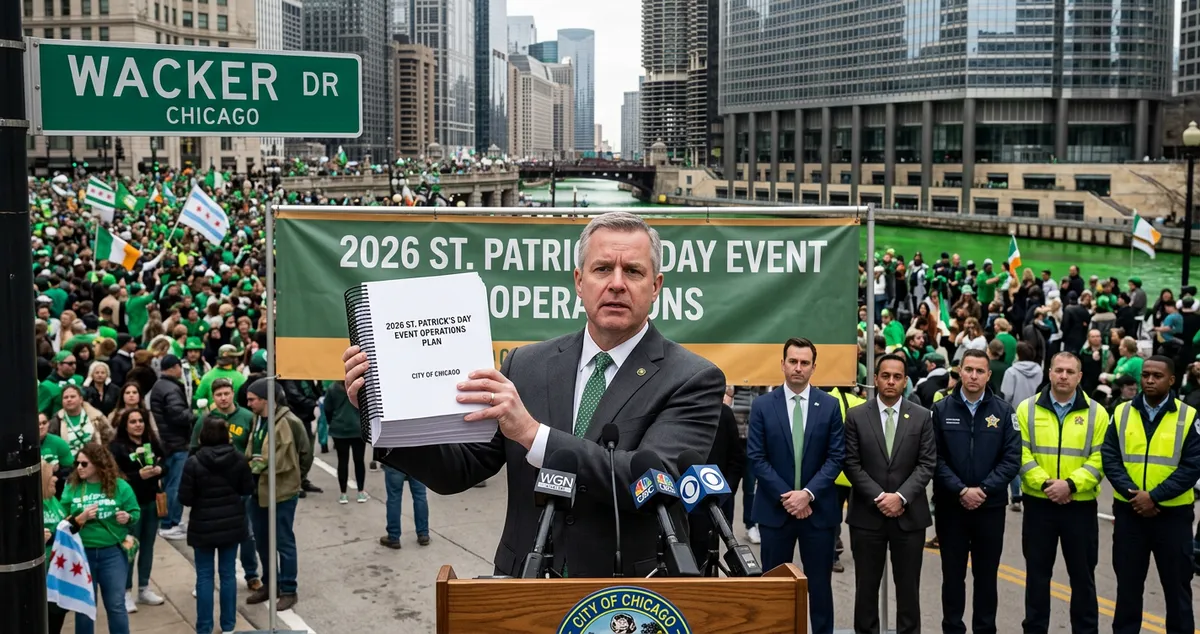
City Releases 47-Page St. Patrick's Day Crowd Management Plan; Page 46 Notes the Plan Will Not Be Read
The City of Chicago’s Department of Special Events released its 2026 St. Patrick’s Day Crowd Management and Event Logistics Plan on Thursday, a 47-page document covering parade routing, river access protocols, police zone designations, permitted vendor locations, restricted airspace, and, on page 38, a four-paragraph section titled “Equine Incident Response,” the existence of which a department spokesperson declined to explain beyond saying it was “added after 2023.”
The plan, which represents a 12-page expansion from last year’s 35-page plan, was developed over six months by a cross-departmental working group that included representatives from the Office of Special Events, the Chicago Police Department, the Chicago Fire Department, CDOT, the Chicago Park District, Plumbers Union Local 130, the Chicago Transit Authority, and what the document’s appendix identifies as “the Ad Hoc River Staging Subcommittee,” a body whose official status the city clerk’s office confirmed it could not locate in any existing municipal charter.
“This is our most comprehensive operational framework to date,” said Margaret Holton, Director of Special Events, at a press conference Thursday morning where she stood next to a large printed version of the plan’s cover page. “We have planned for 214 distinct operational contingencies.” She was asked to name five. She named three, then said the fourth was “situational,” then said she’d have her office follow up on the fifth. Her office has not yet followed up.
Among the plan’s highlights: a revised “Green Zone” along Wacker Drive that expands the crowd-restricted corridor by 30 feet compared to 2025, reflecting what the document calls “observed pedestrian pressure data” and what a CPD sergeant quoted anonymously calls “the year everyone tried to get onto the same corner.” The plan also introduces a new color-coded wristband system for river-adjacent standing zones — platinum, gold, and silver — that is explained across seven pages with a flowchart that, the document notes in a footer, “is intended to be read before arrival and not consulted on-site while in motion.”
The CTA section of the plan — pages 19 through 24 — outlines enhanced service on the Red, Green, and Brown Lines, a 90-second headway target during peak loading windows, and a protocol for “crowd saturation events” at Roosevelt and Grand stations that essentially amounts to stopping everyone from entering until capacity decreases. The plan acknowledges this will create a line on the street. The plan does not specify how long that line may become or what to do with it. A CTA spokesperson said the agency was “confident in its operational posture” and noted that the Brown Line had been “given a full briefing,” a phrase she used without apparent irony and which I did not ask her to clarify because I was afraid she would.
The alcohol compliance section — pages 25 through 31 — establishes enforcement windows for the city’s special event liquor license extensions, which allow bars along the parade route to open as early as 6 AM. The section notes that the Department of Business Affairs and Consumer Protection will conduct “targeted compliance walks” between 6 and 8 AM, adding that these walks are “advisory in nature during the first hour.” It does not define what “advisory in nature” means in a compliance context. A BACP spokesperson said it meant “we’re looking, not yet citing,” and then said she’d like to clarify that quote, and then did not clarify it in a way that changed its meaning.
On page 43, the plan introduces what it calls a “Bystander Communication Matrix” — a chart showing who is supposed to tell whom what, in what order, when a situation escalates from a Level 1 (minor crowd density) to a Level 5 (what the chart labels “full operational activation,” which it declines to define further). The matrix has 34 cells. Seven of them contain the instruction “notify supervisor.” Eleven of them are blank, which a department official said indicated “context-dependent discretion.” When I noted that 11 blank cells out of 34 represented roughly 32% of the matrix, the official said that was “a fair read of the numbers.”
Page 46, the second-to-last page before the appendices, contains a single paragraph that reads: “The Department of Special Events acknowledges that comprehensive pre-event planning documents are most effective when reviewed in advance by all operational staff. Distribution of this plan occurred on March 12, 2026. The event is March 14, 2026.” It then says nothing further. There is no follow-up paragraph. The next page is the appendix, which contains, as noted, the equine incident protocols.
The plan is available on the city’s website. As of Thursday afternoon, the PDF had been downloaded 847 times, a figure a spokesperson called “strong engagement.” Of those 847 downloads, it is not possible to determine how many were read in full. Page 46 does not seem to expect an answer to that question.