Illinois Lawmakers Introduce Bill to Ban Eating Pie on Pi Day, Citing 'Fundamental Misunderstanding of Mathematics'
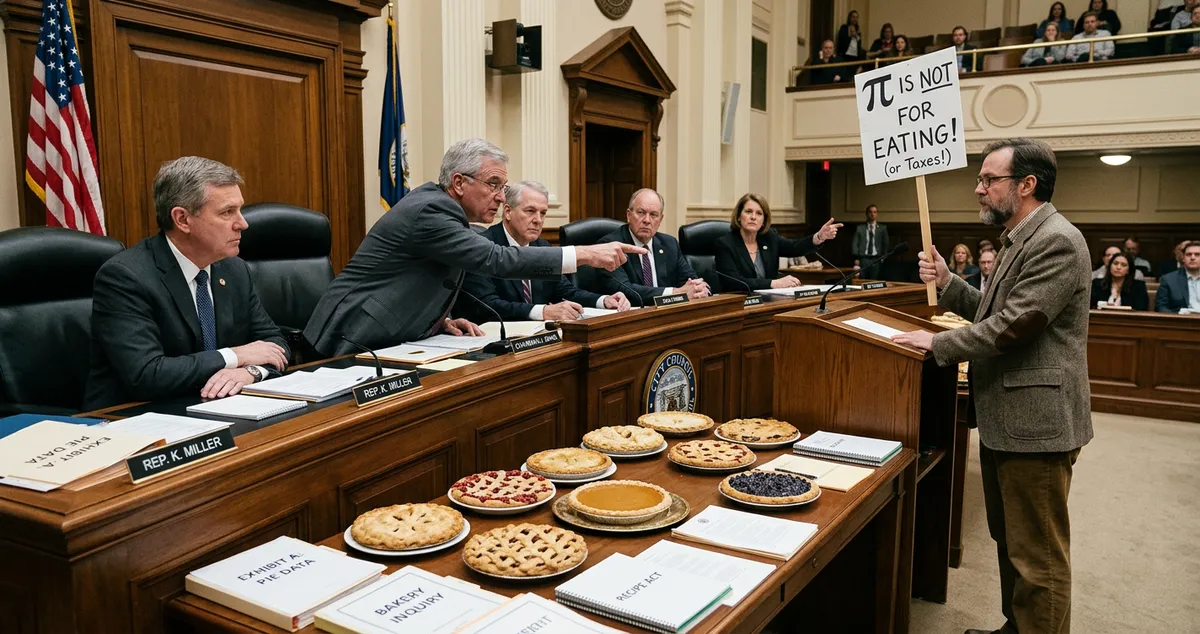
A group of Illinois state legislators held a press conference Saturday morning at the James R. Thompson Center to announce the introduction of a bill that would make it a Class C misdemeanor to purchase, distribute, or consume pie — the baked good — in observance of Pi Day, the mathematical holiday celebrated annually on March 14th in recognition of the ratio of a circle’s circumference to its diameter. The bill, which the sponsors acknowledged was unlikely to pass but which they characterized as “an important conversation starter,” would impose fines of up to $75 for first-time offenders and require repeat violators to complete a four-hour online course in Euclidean geometry.
“Pi Day is about mathematics,” said the bill’s lead sponsor, a state representative who asked that his remarks be attributed to “the bipartisan Pi Integrity Caucus” rather than any individual member. “It is about the transcendental number 3.14159 and so on. It is not about crust. It is not about filling. It is not about à la mode.” He paused to hold up a laminated chart showing national Pi Day spending data, which indicated that Americans purchased approximately $580 million worth of pie on March 14th last year. “This is a chart about pie,” he said, pointing at the chart. “This should be a chart about pi.” He then held up a second chart that was simply the pi symbol printed very large on a piece of posterboard, and said, “This is what the day is for.”
The press conference lasted 34 minutes and included testimony from Dr. Helen Tsai, a mathematics professor at the University of Illinois at Chicago, who had been invited to provide expert context and who appeared to regret accepting. “The number pi is one of the most important constants in mathematics,” she said, reading from prepared remarks. “Its applications span geometry, trigonometry, calculus, and physics. It is irrational, transcendental, and has been computed to over 105 trillion digits.” She then looked up from her notes, said “I do not have an opinion on pie,” and did not take questions.
The proposal has drawn immediate and vigorous opposition from the Illinois Restaurant Association, the American Pie Council, and an online petition titled “Don’t Let Springfield Take Our Pie” that had gathered 11,400 signatures by Saturday afternoon. Critics have pointed out that pie already has its own dedicated holiday — National Pie Day, celebrated on January 23rd, which has been observed since 1975 and is overseen by the American Pie Council, which also hosts the annual National Pie Championships. In fact, not only does pie as a category have its own day, but individual flavors of pie have their own nationally recognized holidays as well: National Cherry Pie Day falls on February 20th, National Blueberry Pie Day on April 28th, National Apple Pie Day on May 13th, National Pecan Pie Day on July 12th, and National Pumpkin Pie Day on December 25th, which it shares with Christmas. There is also a second, unexplained National Pie Day on December 1st, whose origins no food historian has been able to definitively trace.
“Pie has more holidays than most federal agencies,” said Deborah Lam, a spokesperson for the Illinois Restaurant Association, during a phone interview. “It has a dedicated advocacy organization. It has a championship. The idea that pie somehow needs to colonize a math holiday to remain culturally relevant is, frankly, not supported by the data.” She said the IRA estimated that Chicago-area restaurants and bakeries generate approximately $2.3 million in pie-related revenue on March 14th alone, and that the proposed ban would constitute “a direct attack on small business under the guise of mathematical purity.” She was asked if she had a favorite pi fact. She said she did not.
The bill’s sponsors appeared unfazed by the backlash and, during the question-and-answer portion of the press conference, grew increasingly specific in their grievances. One co-sponsor produced a printout from a national pizza chain’s website advertising a “Pi Day Special: $3.14 for any large pie” and held it at arm’s length as though it were evidence in a criminal proceeding. “This is a pizza,” he said. “They are calling it a pie. On Pi Day. This is three layers of misunderstanding stacked on top of each other.” Another co-sponsor noted that several bakeries in the Chicago area had begun selling pies with the first 50 digits of pi written in icing on the top crust, a practice she described as “a conceptual contradiction that I find personally distressing.”
The mathematical community itself appears largely uninterested in the dispute. A spokesperson for the Mathematical Association of America said the organization “celebrates Pi Day as an opportunity to engage the public with mathematics in all its forms” and that “we have no official position on pie as a food item.” Separately, a post in the University of Chicago mathematics department’s internal Slack channel — shared with the Dispatch by a source who requested anonymity — read, in its entirety: “Let them eat pie. We have tenure.” The post received four emoji reactions, all of which were the pi symbol.
The bill, if it advances, would face committee review in the spring session. Legal scholars contacted by the Dispatch expressed skepticism about its constitutionality, with one professor of food law at Northwestern noting that “the First Amendment implications of banning a specific food on a specific day are, to put it mildly, non-trivial.” The Pi Integrity Caucus, for its part, said it was prepared for a long fight. “We are not going away,” said the caucus spokesperson. “Pi is infinite. Our resolve is also infinite. Pie is finite. It gets eaten. That is the fundamental difference, and we believe the law should reflect it.”