The First Patio Chairs Have Appeared on Chicago Sidewalks, and They Are Not Ready
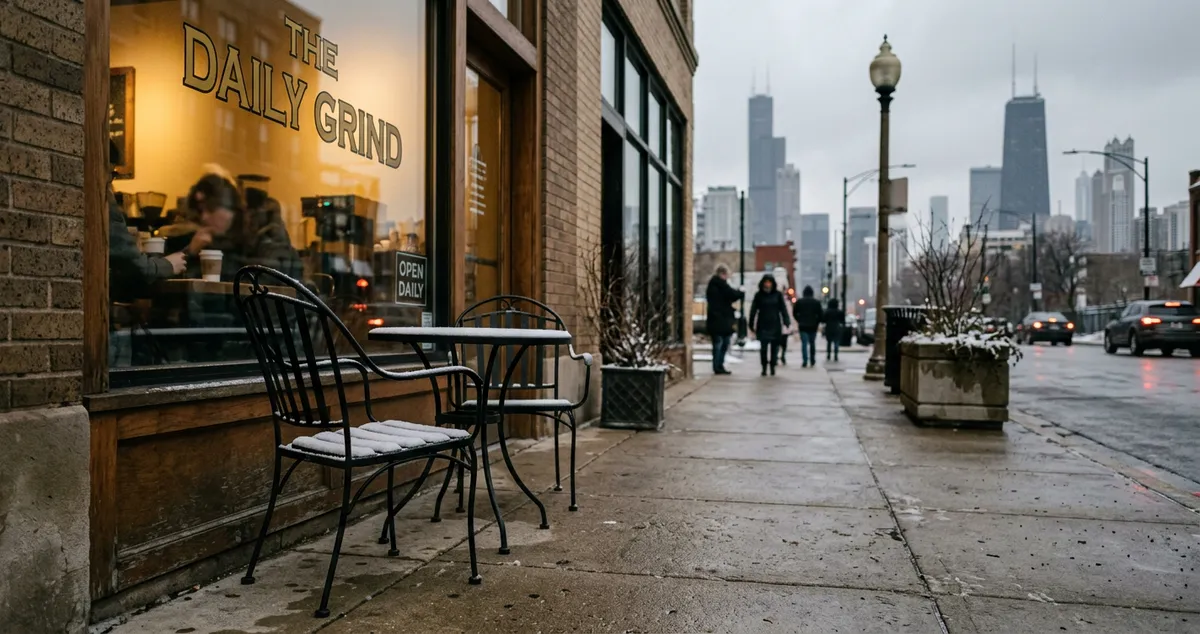
They appear every year around this time, as certain as the equinox and as premature as the crocuses that push through the last of the frozen mulch along the lakefront — the first patio chairs of spring, set out on the sidewalks of Chicago by restaurant owners who know, with the specific knowledge that comes from having lived through many Marches in this city, that it is too early. It is 36 degrees. There is a dusting of snow on the seat cushions where seat cushions exist, and a thin film of ice on the metal where they don’t. No one is sitting in these chairs. No one will sit in these chairs today, or likely tomorrow, or possibly for several weeks. And yet there they are, two or four at a time, arranged around small tables outside cafés in Lincoln Park and wine bars in Andersonville and taco joints in Pilsen, facing the street with the quiet, unoccupied patience of things that have been placed with intention and then left to wait.
The annual emergence of the patio chair is not, strictly speaking, a rational act. The National Weather Service forecast for the weekend calls for highs in the upper 30s, wind gusts of 20 miles per hour, and a chance of snow — conditions that are, by any objective measure, inhospitable to the act of sitting outside and consuming food or beverages. The wind alone would present structural challenges to a napkin. And yet the chairs come out, because the chairs coming out is not about the weather that exists. It is about the weather that is coming, or the weather that could come, or the weather that the person dragging a wrought-iron bistro set through a doorframe at 7 AM has decided to believe in despite all available evidence. The patio chair in March is an act of faith, and like all acts of faith, it does not require conditions to be favorable. It requires only the willingness to begin.
I walked three miles of the North Side this morning, cataloging the early deployments. A café on Clark Street in Lakeview had set out a single two-top with a small vase of artificial flowers, the petals of which were visibly damp. A restaurant on Damen in Bucktown had arranged four chairs around a table and placed a laminated menu on top, held down by a salt shaker, a configuration that suggested not just optimism but operational readiness — as though a customer might materialize at any moment, sit down in the 36-degree wind, and order a salad. In Wicker Park, a bar had deployed its full sidewalk patio setup, eight tables, complete with umbrellas that were closed and lashed to their poles like sails in a harbor, waiting for a warmth that the atmosphere has not yet agreed to provide.
There is a meteorological concept called “apparent temperature,” which accounts for the combined effect of air temperature, wind speed, and humidity on the human body — what it actually feels like, as opposed to what the thermometer says. In Chicago in mid-March, the apparent temperature is almost always lower than the actual temperature, sometimes significantly so. Today’s air temperature of 36 degrees, combined with a northwest wind of 15 miles per hour, produces an apparent temperature of approximately 26 degrees, which is the temperature at which exposed skin begins to lose heat faster than the body can produce it, and which is, by any clinical standard, not patio weather. But the patio chairs do not know this. The patio chairs know only that they have been placed outside, and that outside is where they are meant to be when the season turns, and that the season is turning even if the thermometer has not been informed.
The restaurant owners I spoke to were uniformly aware that the timing was aggressive. “We know,” said a woman behind the counter of a breakfast spot on Southport, gesturing toward two chairs visible through the window, both lightly frosted. “It’s a statement.” She did not elaborate on what the statement was, but she didn’t need to. The statement is the same every year: we are still here, and it is almost warm, and when it is warm, we will be ready. A bartender on Division Street, who had set out four high-tops on the sidewalk at approximately 6:30 AM, said he does it every year on the first weekend that the temperature hits 35. “Thirty-five is the threshold,” he said, with the conviction of someone who has thought about this number a great deal. “At 35, people start thinking about sitting outside. They don’t do it. But they think about it. And I want the chairs to be there when they’re thinking about it.”
This is, I think, the essential quality of the March patio chair: it is furniture for the imagination. It is not meant to be sat in, not yet. It is meant to be seen — from the window of a passing car, from the opposite sidewalk, from the warm interior of the very restaurant that placed it outside — and to trigger, in the person who sees it, the memory or the anticipation of what it feels like to sit outside in Chicago when the weather is actually good. When the lake light comes in long and gold across the tables. When the trees on the parkway have leaves and the wind is warm and the city opens itself up in that way it does for exactly four months a year before it closes again. The chair is a placeholder for that feeling. It sits in the cold because someone must, and because the alternative — leaving the sidewalk bare, admitting that winter is still here, conceding that March in Chicago is a month of false starts — is a concession that no restaurant owner and no Chicagoan is willing to make.
By late afternoon, the snow had stopped and the temperature had risen to 39 degrees, which is still not patio weather by any reasonable definition but which represents a three-degree improvement and which, in the specific calculus of Chicago in March, counts as progress. I passed the café on Clark Street again on my way home. The artificial flowers were still there. The chairs were still empty. But the laminated specials board had been updated, and someone had added, in blue dry-erase marker, the words “PATIO OPEN.” It was, in the most technical sense, true. The patio was open. The patio is always open, in the hearts of the people who put the chairs out, long before anyone is brave enough to sit down.