Chicago Survives Longest Freeze in 19 Years, Emerges Unsure of Itself
The freeze lifted sometime around the second week of March, as freezes in this city tend to do — not with ceremony, not with announcement, but with a kind of atmospheric shrug, a few degrees of warmth arriving like a guest who shows up late and doesn’t mention it. And the city, which had endured its longest sustained below-zero stretch since 2007, looked out its windows and tried to remember what it did before all of this.
The National Weather Service confirmed Tuesday that Chicago had recorded its longest winter freeze in nineteen years, a stretch of days during which temperatures at O’Hare never climbed above freezing, during which the lakefront became something other than a place for walking, during which the city contracted inward the way all cold things do — into buses, into buildings, into the practiced stoicism of people who have made their peace with January and find it less easy, every year, to make their peace with February.
“We’ve had cold snaps before,” said Anjali Shetty, a meteorologist with the National Weather Service’s Chicago office, pulling up a chart that resembled a long, flat argument. “What made this one unusual was duration. It wasn’t the depth of cold so much as its persistence. It didn’t want to leave.”
By late February, certain behaviors that had been provisional had become habitual. The man on the Blue Line who wears his parka even after boarding, who does not remove it for the entire ride — he became, for a season, the norm rather than the outlier. Restaurants that had installed outdoor heaters for winter seating removed them and then, faced with their continued absence, forgot why they’d ever been there. A woman in Logan Square told me she had stopped checking the forecast sometime in January and simply assumed it was bad, a coping strategy she described as “philosophically efficient.”
The freeze also imposed a certain clarity. When the world outside is hostile, the world inside clarifies itself. You learn which friendships are worth the logistics of winter, which routines survive the cold and which were only ever fair-weather habits. A kind of pruning, seasonal and unsentimental.
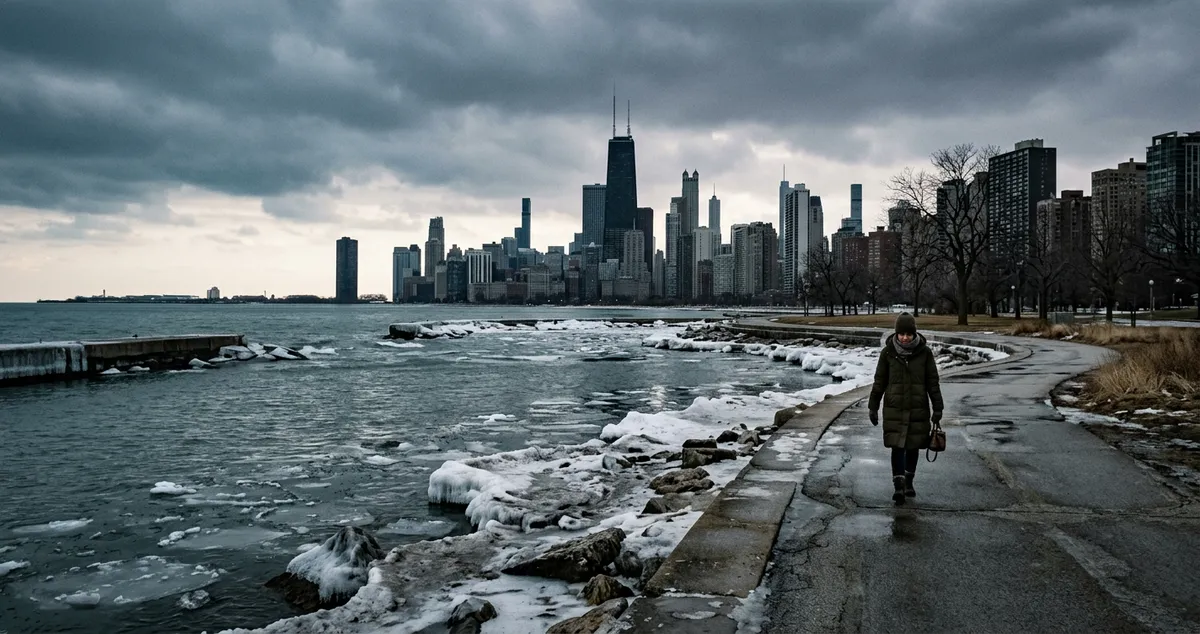
Lake Michigan, for its part, developed significant ice coverage along the Chicago shoreline — a rarity in recent decades, and a sight that stopped people on the lakefront path in the way that unusual beauty tends to stop people: suddenly, briefly, with a slight feeling of not deserving it. The ice made sounds, mornings especially, a low cracking that carried across the water and meant nothing specific and somehow meant everything you wanted it to.
What does it mean that Chicago thaws? The question sounds rhetorical but is not, quite. There is something in the thaw that requires renegotiation — with the outdoors, with the body’s willingness to move through space again, with the city as a physical place rather than a series of heated interiors connected by brief, unpleasant transitions. Residents report a kind of re-entry confusion, a need to remember why the lakefront is worth walking, before the muscles remember for the brain.
“I went outside yesterday,” said Ivan Petrov, a Hyde Park resident who works from home. “Just to go outside. I don’t think I’ve done that since October. It was fine. I didn’t know what to do, exactly. I just walked around the block and came back.” He paused. “But I’m going to do it again today.”
By Sunday, forecasters are calling for temperatures in the mid-40s. By late March, possibly 50. The ice on the lake is already retreating, leaving behind that particular shade of cold-water gray that Lake Michigan holds in early spring — not inviting, not warm, but no longer hostile. Present, instead. Available, in the way that things are available when the worst of something has passed.
The city is not new. It has done this before, will do it again, has its own logic about seasons that does not require our approval. But there is something, every spring, that feels briefly like permission. Like the city saying: alright. Come back out. See what’s still here.