Chicago Teachers Union Clarifies $3.1 Million Political Budget Is for 'Civic Awareness,' Not Politics
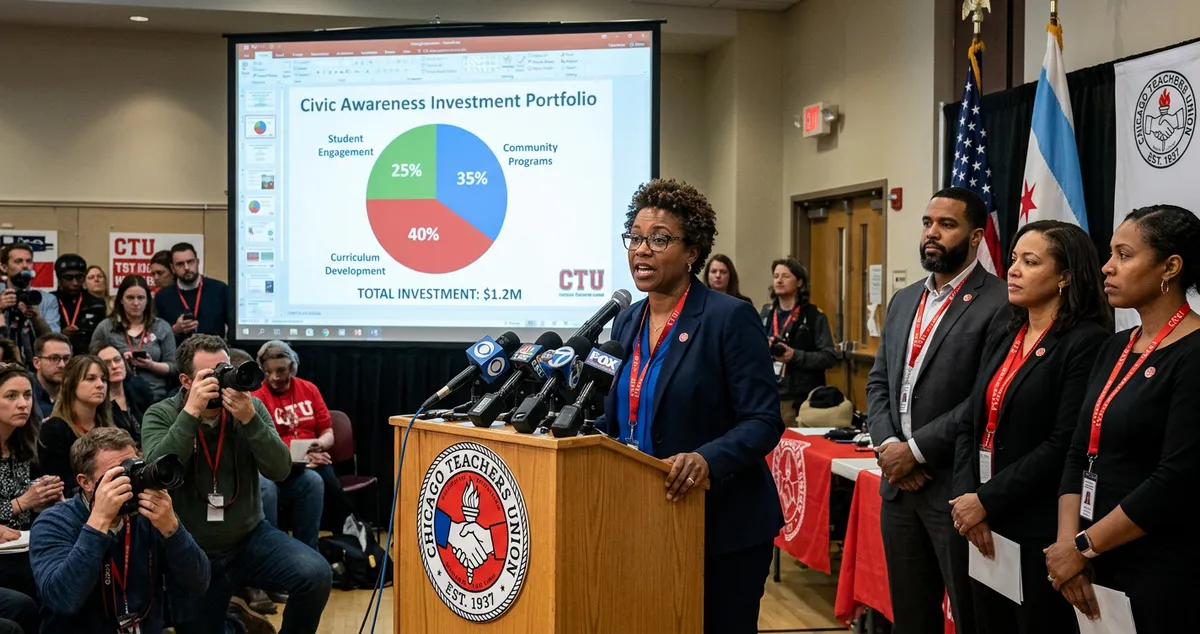
The Chicago Teachers Union moved swiftly Thursday to contextualize a fiscal report showing $3.1 million budgeted for political activities through June 2026, releasing a statement clarifying that the expenditures were not, in fact, political — but rather “a robust investment in the civic awareness infrastructure that supports the democratic participation of educators as community stakeholders.”
The statement, which ran to eleven pages and included a glossary, did not specify what “civic awareness infrastructure” costs $3.1 million, nor how it differed from the political action committee expenditures listed directly beneath it in the same report.
“We want to be very clear: the CTU is an educational organization,” said CTU President Stacy Davis Gates at a press conference that opened with a ten-minute video montage of children learning to read. “Everything we do is in service of students. Including, obviously, the voter mobilization contracts, the precinct-level field operations, and the media consultancy we retained to help educators understand how to talk about the March 17 primary in an educational way.”
The March 17 date, she noted, was “just a coincidence.”
The fiscal report, filed with the Illinois Educational Labor Relations Board, lists several line items that have attracted scrutiny, including $480,000 for “electoral education programming,” $215,000 for a “civic landscape assessment” conducted entirely in competitive districts, and $62,000 for what is described only as “door-related community outreach.” A CTU spokesperson confirmed the last item referred to canvassing but said calling it canvassing was “reductive.”
Alderman Anthony Napolitano, whose ward includes several schools represented by the CTU, called the spending “breathtaking in its audacity” and said he intended to file a formal inquiry with the city clerk. The city clerk’s office said it had received the inquiry and would “respond in due course,” which, based on the office’s current processing timeline, a spokesperson estimated at 14 to 18 months.
The Illinois Policy Institute, which first surfaced the fiscal figures, published a 4,000-word analysis calling the budget “a masterclass in the laundering of political intent through educational branding.” The CTU responded by calling the Institute “a politically motivated organization” and, when pressed on the irony, said the situations were “categorically different for reasons we will explain at a later date.”
Three aldermanic candidates who received endorsements backed by CTU political expenditures said they had not received any political support from the CTU, only “a great deal of encouragement from educators in their communities who happened to show up with matching T-shirts and clipboards.”
The union’s internal communications, obtained by this reporter through a public records request that the CTU contested, was overruled, re-contested, and eventually released with 40% of the text redacted, suggest that leadership anticipated the budget figures would draw attention. One memo from November reads: “Let’s get ahead of the narrative on the civic stuff before someone calls it what it is.” The next line is redacted.
CTU’s legislative director, when asked to define the difference between political spending and civic awareness spending, said the question “showed a fundamental misunderstanding of the labor movement” and handed this reporter a 60-page booklet on union history, which did not answer the question but was, he acknowledged, very thorough.
The union’s next fiscal report is due in July. A CTU spokesperson said it would reflect “continued investment in the educational mission of Chicago’s public school educators,” and when asked whether that would include additional political expenditures, said she didn’t have that information “in front of her right now.”