A Six-Inch Hailstone Fell on Kankakee and Scientists Are Asking What It Wants
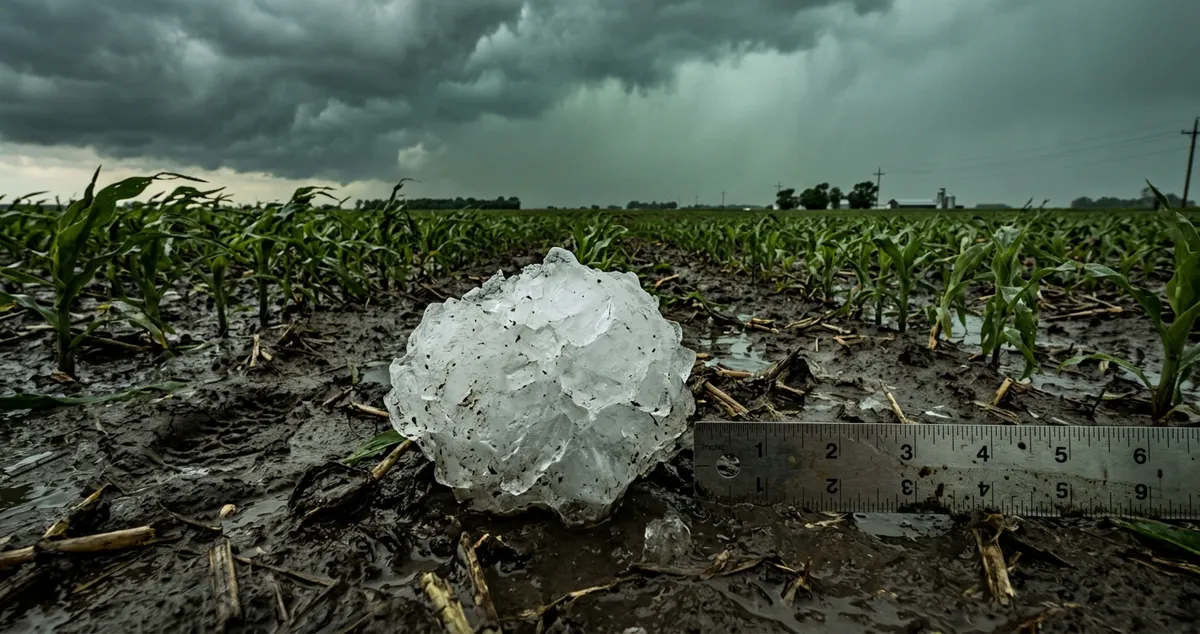
On Tuesday afternoon, at 3:17 PM, a hailstone measuring approximately six inches in diameter fell from a supercell thunderstorm rotating over Kankakee County and came to rest in the mud of a cornfield on the south side of town. It was approximately the size of a softball. It was larger than many people’s heads. It sat in the field for eleven minutes before a retired farmer named Gerald Bauer walked out to photograph it next to a ruler, an act that Gerald later described as “just seemed like the right thing to do,” and which I consider one of the more instinctively correct responses to the inexplicable that I have encountered in seven years of environmental reporting.
The National Weather Service in Romeoville confirmed Tuesday evening that the Kankakee specimen — if verified — would represent a new Illinois state record for hailstone diameter, surpassing the previous record of 4.5 inches set in 2015. Meteorologists noted that the stone required “an extraordinary combination of updraft velocity, moisture, and thermal instability” to reach its recorded size. They offered this observation in a professional tone, the tone of people who understand the mechanism but have perhaps not fully reckoned with the fact that the sky produced a six-inch ball of ice and dropped it on Kankakee. Mechanisms do not always explain what a thing means.
I want to say something careful here, something I do not want misread as alarmism or as a lapse in scientific rigor. But there is a question that follows an event like this — a question that sits just outside the margins of the meteorological data, in the place where the data ends and the staring-out-the-window begins — and the question is: what are we to make of it? Not mechanistically. We understand the mechanism. We have understood the mechanism for decades. The question I am asking is older than meteorology. It is the question that Gerald Bauer, retired farmer of Kankakee County, was asking without knowing he was asking it when he walked out into that muddy field with a ruler and felt, in the pit of his stomach, that he was in the presence of something that wanted to be measured.
The rest of Tuesday’s storm system was, by any reasonable assessment, extraordinary. At least four tornadoes touched down in Livingston and Kankakee counties. Baseball-to-softball-sized hail pelted Bolingbrook and Downers Grove, breaking car windows and denting aluminum siding and causing what one insurance adjustor described to me on the phone as “a situation.” The Storm Prediction Center had issued a Moderate Risk — a Level 4 on the five-point scale — for the Chicagoland region Tuesday morning, which means the professional hail forecasters were not surprised by any of this. They had the numbers. They had the models. They had issued the appropriate advisories. Somewhere in a Romeoville office, a meteorologist had looked at a computer screen Monday night and seen, in the swirling contours of atmospheric instability, the general shape of Tuesday. The six-inch hailstone was not in that shape. Or rather: it was implied by that shape, which is not quite the same thing.
Dr. Priya Mehta, an atmospheric scientist at the University of Illinois, told me by phone that the Kankakee stone was the product of what she called “multiple recycling cycles through the updraft column.” She explained that as a hailstone rises and falls within a supercell, it accumulates new layers of ice each time it passes through regions of supercooled water droplets. A large stone indicates many such cycles — a kind of long, slow, impossible violence carried out at altitude. “The stone was probably in the air for twenty to forty minutes,” she said, “before it fell.” I thought about this for a while after we spoke. Twenty to forty minutes is a long time to be somewhere you are not supposed to be. I found myself wondering whether it was patient or urgent, and then I reminded myself that hailstones do not have interiority, and then I thought about it some more anyway.
Gerald Bauer, whose photograph of the specimen has been circulated widely since Tuesday evening, said in a brief phone interview that he had been farming in Kankakee County for thirty-eight years and had never seen anything like it. “It was just sitting there,” he said. “Looked like it was waiting.” He paused. “I know that sounds funny.” I told him it did not sound funny. He said he still hadn’t fully figured out why he’d felt the need to get a ruler. “It just seemed important,” he said, “to know how big it was. Like it mattered.” I asked if he still had the stone. He said it had melted by the time he got back with the ruler. There was a long pause. “About three minutes,” he said. “That’s how long it took me. It was gone by then.” He said he still had the ruler, the photograph, and the impression of something he couldn’t quite name.
Verification of the record requires submission of photographs, weather service confirmation, and a chain of atmospheric custody that I find both completely reasonable and, in the context of Gerald’s three minutes, slightly beside the point. The stone is gone. The record stands or does not stand on the evidence of a retired farmer’s photograph and the meteorological data that surrounded the moment. The atmosphere does not keep records of itself. It has already moved on to the next pressure system, already repositioned for Thursday’s warm front, already forgotten whatever it was expressing on Tuesday afternoon when it assembled six inches of ice, dropped it on a cornfield, and waited for Gerald Bauer to come outside.
What I will say — and I mean this in the most scientifically defensible sense I can manage — is that the atmosphere is not neutral. It is a system, and systems have states, and the states of this particular system have been shifting in measurable, documented, peer-reviewed ways for decades. Tuesday was a data point. The six-inch hailstone was a data point. Gerald Bauer’s three minutes was not a data point; it was a human being standing at the edge of something that had come and gone and left only a ruler and a photograph and a question he will probably think about for the rest of his farming life. That is not nothing. It is, in fact, the part I keep coming back to.
This article has been updated to reflect NWS Romeoville confirmation that the Kankakee hailstone is under review for potential state record status. Verification is expected within 30 days.