Ten Democrats Are Running for One House Seat and the Debate Stage Rental Was Not Cheap
The Illinois 2nd Congressional District primary, scheduled for March 17, currently features ten Democratic candidates seeking to succeed Rep. Robin Kelly, who announced last year she would not seek reelection in order to run for the Senate seat being vacated by Dick Durbin, a decision that set in motion a cascade of political repositioning that one Cook County Democratic Party official described to me last week as “a chain of dominoes, except each domino is a person who has been waiting for an opening and the chain is longer than we anticipated.” The field of ten — which includes former officeholders, current aldermen, nonprofit executives, a small business owner, and at least one candidate whose campaign website bio describes him as “a lifelong 2nd District resident and community champion,” a phrase that means something specific to those who wrote it — represents, by any reasonable assessment, a number of candidates that is larger than the number of answers most voters can name when asked, unprompted, who the candidates are.
The Illinois Primary Project, a nonpartisan civic education organization based in Evanston, released a poll last week in which 61% of 2nd District Democratic primary voters reported being “aware that a primary is occurring” and 23% could name more than two candidates when asked without prompting. The remaining 54% — the gap between awareness and recall is explained by what the poll’s methodology notes call “mixed certainty responses” — named candidates that either do not exist or are running in different races. The poll’s margin of error was plus or minus 4 points, which the Project’s director noted “does not fully account for the possibility that voters are thinking of the Senate race, the House race, the county race, or some race they saw on television from a different state.” She said the polling environment for this primary was “challenging,” and then she paused, and then she said “exceptionally challenging,” and then she said she needed to take a call.
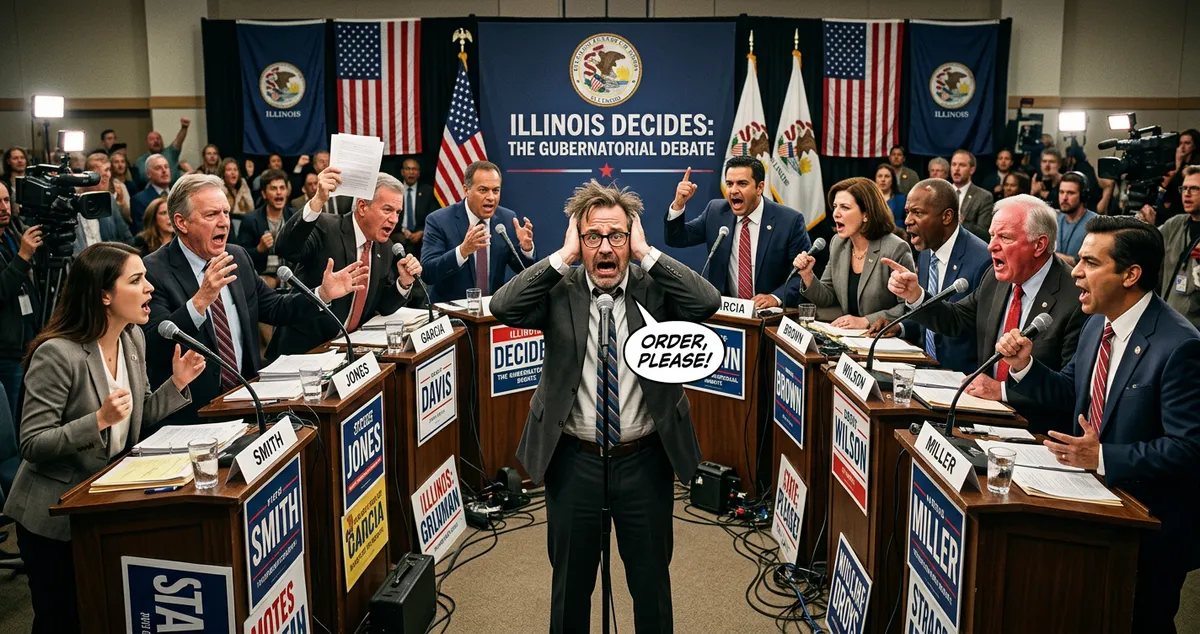
The debate, held last Thursday at a community center in Matteson, required a venue adjustment when organizers realized the standard configuration of six podiums was insufficient. A second row of four podiums was added, creating what the event coordinator described in an email to staff as “a split-level format” and what several attendees described as “a situation.” The moderator, WTTW political reporter Brandis Friedman, opened the debate by noting that she would be enforcing a strict thirty-second response limit for the opening round and a sixty-second limit for rebuttals, which produced an immediate protest from three candidates in the back row who said they could not hear the thirty-second bell from their position. The bell was subsequently struck louder. Two candidates in the front row said this was startling. The event coordinator ordered a bell of intermediate loudness, which arrived eleven minutes into the debate and satisfied no one.
Policy differences among the ten candidates are, in the characterization of multiple political analysts, “present but granular.” All ten candidates support expanded healthcare access. All ten oppose cuts to social services. Nine of the ten have issued statements on gun violence prevention, and the tenth has issued a statement on “community safety infrastructure,” which his campaign manager confirmed covers essentially the same policy ground but was “framed more accessibly for 2nd District constituents.” Seven candidates have specifically cited their connection to the South Side and south suburbs as central to their candidacy. Four have mentioned Pullman. Two have mentioned the same Pullman community meeting from 2018, which I am looking into.
One candidate, Victor Reyes — former head of the Hispanic Democratic Organization and current private sector consultant — entered the race in December and has since accumulated the endorsements of three ward committeemen, two union locals, and an alderman who described his support in a press release as “strong and unequivocal,” adding in a separate interview that the race was “still very fluid” and that he was “watching developments carefully.” He endorsed Reyes again when I called to clarify. He said it was still his preferred outcome. He said the word “preferred” in a tone that suggested “preferred” was doing a great deal of work in that sentence.
The campaign finance landscape, as of the most recent filing deadline, shows the field clustered around a range of totals that Illinois political consultant Matt Fricker — who is not affiliated with any campaign in this race, a disclosure he made twice during our conversation — described as “competitive.” When I asked if “competitive” meant the race was genuinely open or if it meant no one had yet separated from the field, he said those were not mutually exclusive characterizations. He said he expected the race to tighten in the final week. He said this was historically true of all races with ten candidates, then corrected himself and said he wasn’t certain he had data on races with exactly ten candidates, but that the general principle held. He said he would follow up with data. He has not yet followed up.
The Cook County Democratic Party, which has declined to make an endorsement in the race, released a statement Tuesday reminding voters that the primary is March 17, that polls are open from 6 AM to 7 PM, and that sample ballots are available at cookcountyclerk.com. The statement did not mention that March 17 is St. Patrick’s Day, a fact that the party’s communications director confirmed was “not an oversight” and that she “did not wish to editorialize about.” Early voting is available through March 16. As of Tuesday, the Board of Elections reported early vote totals for the 2nd District that it described as “tracking normally for a competitive primary,” a characterization I found both informative and almost completely uninformative. I asked a spokesperson to clarify. She sent me the statement again.
Correction: An earlier version of this article stated that five candidates had mentioned Pullman. The correct number is four. Two of the four mentioned the same Pullman community meeting.