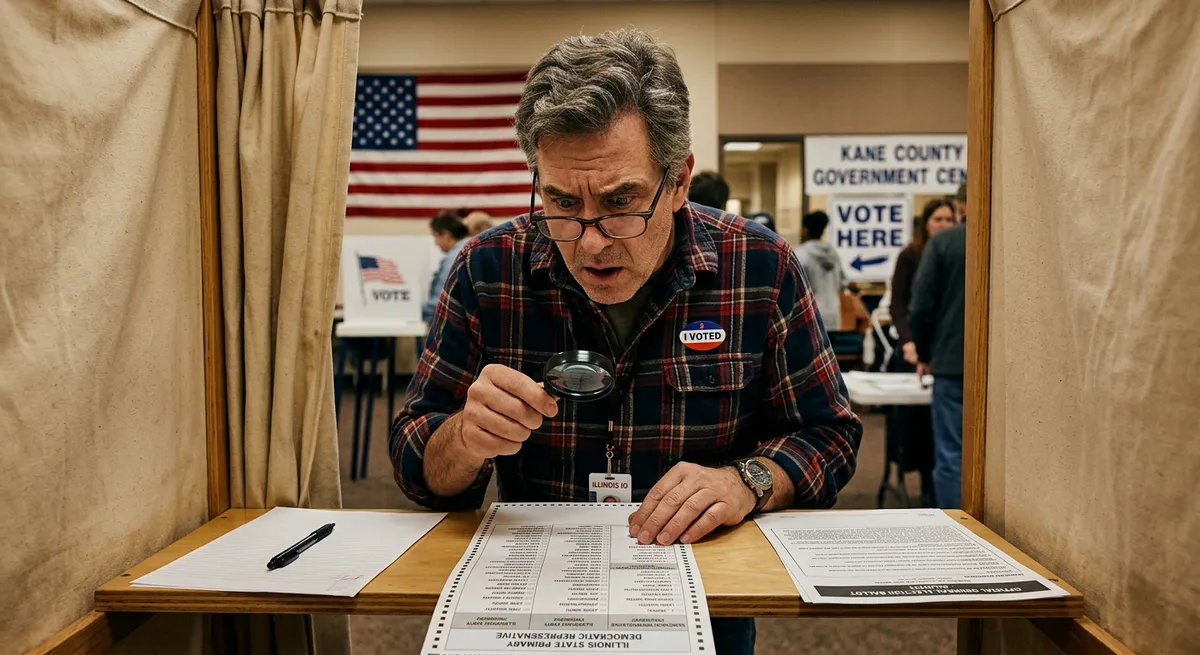
Illinois Voters Unsettled by Senate Primary Featuring No Obviously Bad Options
The Democratic primary for the Illinois U.S. Senate seat being vacated by five-term incumbent Dick Durbin — scheduled for March 17, which is one week from today, which means early voting ends tomorrow — has entered its final stretch with the field still featuring multiple candidates that political scientists describe, in tones of mild professional bewilderment, as “broadly qualified.” Rep. Raja Krishnamoorthi of Schaumburg, Lt. Gov. Juliana Stratton, and Rep. Robin Kelly of Matteson have all run substantive campaigns, issued detailed policy platforms, and conducted themselves in public with a consistency of message that has, according to a survey conducted by the Illinois Civic Engagement Project, left approximately 38% of likely Democratic primary voters experiencing what the survey instrument termed “decision paralysis adjacent uncertainty” — a phrase the Project’s research director admitted was coined at 11:45 PM the night before the survey launched but which, she said, “really captured the vibe.”
The discomfort runs deeper than polls suggest. Focus groups convened last week by the nonpartisan Illinois Voter Education Collaborative produced several exchanges that facilitators described in their notes as “striking.” One participant, a retired school administrator from Evanston, was recorded saying, “I know all three of them are fine. I know that. But usually there’s at least one who’s obviously wrong and I just vote against that one, and here I can’t find it.” A second participant, a union electrician from Cicero, said he’d been “Googling for scandals for two weeks and everything I found was basically mid-level policy disagreements, which doesn’t help.” A third participant, unprompted, asked if there was still time for someone new to enter the race. There was not. She was informed of this. She nodded for a long time.
The campaigns, for their part, have done their best. Krishnamoorthi’s team deployed a direct mail piece last month contrasting his foreign affairs committee experience with the other candidates’ committee assignments, a distinction that one political consultant who reviewed it described as “very real and meaningful within the relevant policy context and almost certainly invisible to anyone who has not served on a foreign affairs subcommittee.” Stratton’s campaign leaned into her executive experience as Lieutenant Governor, a role whose responsibilities she summarized in a candidate forum as “comprehensive statewide leadership engagement,” which is technically accurate and which prompted an audience member to ask what she did on a Tuesday. Kelly’s team focused on healthcare and gun violence prevention — concrete, popular issues — which resulted in the other two campaigns promptly issuing statements emphasizing their own healthcare and gun violence prevention records, creating what one journalist covering the race called “a convergence event” and what another called “a mess.”
The Illinois State Board of Elections — which does not typically involve itself in the interpretive dimensions of democratic choice — has, nonetheless, received what a spokesperson described as “an unusual volume” of calls from voters in the final two weeks. The most common inquiry, per the spokesperson, has been some variation of: “Is there a cheat sheet?” There is not. The Board has a Voter Information Portal, accessible at vote.illinois.gov, which provides candidate information in a format the spokesperson called “objective and comprehensive.” When I asked if the Portal helped with “lateral competence fatigue” — a phrase I introduced into the conversation — the spokesperson said he didn’t know what that was and was going to send me to the communications office. He sent me to the communications office. The communications office was out.
The candidate forums, of which there have been five, have been described in the political press as “substantive” and “policy-rich” and “the kind of debates that make you feel good about democracy and bad about Twitter.” At the most recent forum, held in Springfield, a moderator asked each candidate what distinguishes them from the other two. Krishnamoorthi spoke for two minutes about foreign policy depth. Stratton spoke for two minutes about executive experience. Kelly spoke for two minutes about community-based healthcare advocacy. Then all three nodded at each other in a way that three University of Chicago professors watching from the front row described, separately, as “collegial,” “weirdly collegial,” and “look, it’s genuinely great but I understand why it’s confusing to voters who came in expecting a food fight.” After the forum, two of the candidates’ campaign managers were observed chatting near the refreshment table and laughing about something, which a Tribune reporter photographed but decided not to publish because it didn’t make anyone look bad.
Alderman Denise Rowland of the 44th Ward — who has endorsed Krishnamoorthi, and therefore has a position in this race, which she is happy to explain — said at a ward meeting Tuesday that the primary’s civility was “in some ways a problem we should be grateful for.” She paused. “I’ve never said that out loud before. It sounds weird.” She acknowledged it sounded weird. She said Chicago voters were sophisticated and would make the right choice. When asked which choice that was, she said Krishnamoorthi’s, for the foreign policy reasons. When asked what foreign policy reasons were most salient, she said, “the recent ones,” and moved on to a parking meter variance on Roscoe Street.
Early voting runs through March 16. Election Day is March 17 — which is also St. Patrick’s Day, meaning the Chicago electorate will, in some portion, be casting their ballots in a state of festive patriotic feeling that political scientists have studied and found to have no measurable effect on outcomes, though one researcher noted it does appear to increase the frequency of the phrase “I’m doing my civic duty” at polling places located within four blocks of a bar. The Board of Elections has been asked whether St. Patrick’s Day creates unique administrative challenges. The spokesperson who fielded this question said: “Every primary is unique.” He said this with the particular tone of a man who has answered a lot of calls about cheat sheets.