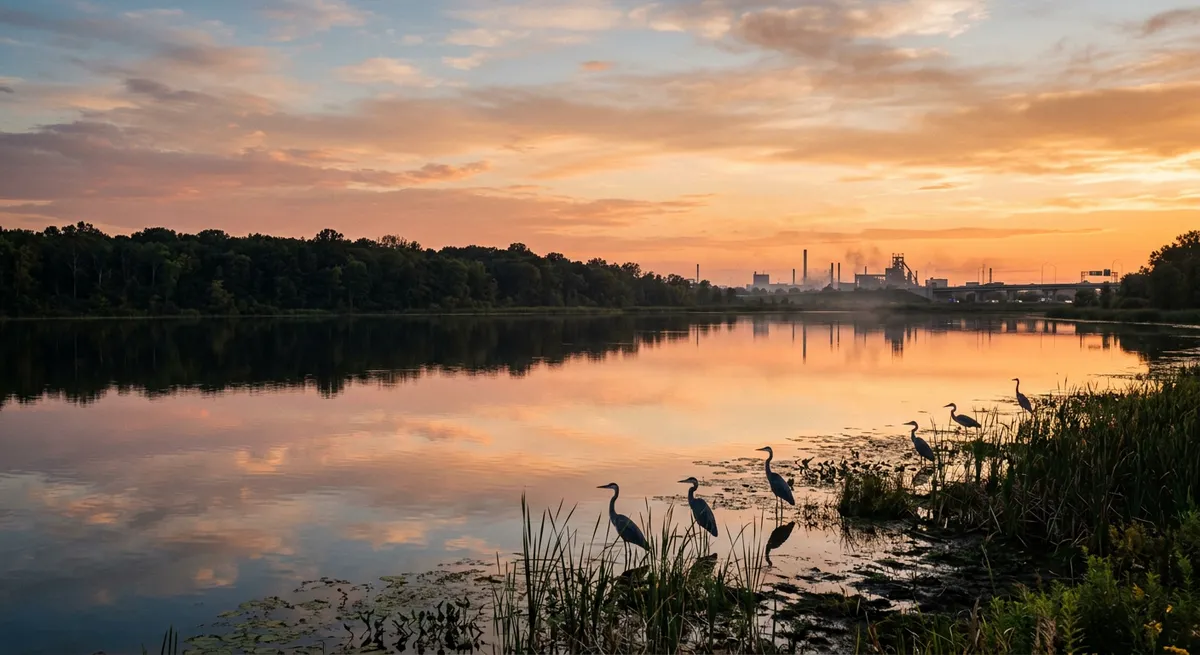
Wolf Lake Has Some Questions About the Bears Stadium Proposal and Would Like to Speak With Someone
Wolf Lake has been here since the last Ice Age. This is not a figure of speech — the lake was formed roughly 12,000 years ago by glacial activity that carved out the terrain along what is now the Illinois-Indiana state line, leaving behind a 765-acre body of water that sits in a position that could charitably be described as “between things.” It is between Chicago and Hammond. It is between Illinois and Indiana. It is between the industrial legacy of the southern lakefront and the parks that replaced parts of that legacy. It has been between things for 12,000 years. It is good at being between things. What it is not good at — what no lake has had sufficient time to develop expertise in — is being between two different visions for a very large football stadium.
The Chicago Bears, in their ongoing search for a new home, have been exploring a site in Hammond, Indiana, approximately two miles from Wolf Lake, which would require significant development of the surrounding area and which has, depending on which planning document you read, various implications for the lake and the wetlands adjacent to it. Hammond’s municipal government is engaged. The Indiana Economic Development Corporation has expressed interest. The Bears have not committed to anything. In this context, Wolf Lake has been informed that its future is “uncertain,” which is a word that lakes encounter very rarely, because lakes have generally been future-stable for millennia and do not typically receive memos about their long-term outlook.
The lake, to its credit, is processing this with more equanimity than you might expect from a glacial remnant. It has seen things. The steel mills that once lined the southern lakefront have come and gone. The neighborhoods around it have changed in ways that would be unrecognizable to anyone who lived here in 1950. The lake itself has been the subject of conservation efforts, invasive species remediation, and at least two Illinois state reports on improving public access to its shores — reports that have been received, acknowledged, and placed into the category of things that would be nice to do when there’s time. The lake is accustomed to plans. Plans come and go. The water remains.
What concerns the lake — insofar as a lake can be said to concern itself — is not the Bears specifically. The Bears are a football team and have their own needs, and a stadium is a building, and buildings have been built near lakes before without catastrophic results. What concerns the lake is the specificity of “uncertain.” Certain lakes have dealt with uncertainty before and come out fine. The Chicago River was reversed in 1900 and has been managing the existential implications ever since. But the Chicago River is in a city, surrounded by institutions that have strong opinions about it. Wolf Lake is in Hammond, on the state line, adjacent to a wildlife preserve, and it has fewer advocates per square acre than your average downtown waterway. It has herons. It has carp. It has a boat launch that locals use on weekends. These are not powerful stakeholders.
The Indiana Department of Natural Resources has indicated it will review any development proposals that affect the area. The Illinois Department of Natural Resources has a similar process, because the lake crosses the state line and therefore has two sets of regulators who will each need to be satisfied before anything happens near its shores. This is the kind of situation that could, in theory, be protective — two states, two agencies, many forms to fill out. It is also the kind of situation that tends to resolve in favor of whoever has the most patient attorneys. Wolf Lake does not have attorneys. It has a sedimentation rate and a measured phosphorus level and approximately 24 species of fish, which is a strong showing for a lake of its size but which does not translate directly into leverage at a planning hearing.
What the lake would like, if it could like things, is a conversation with someone who has read the relevant environmental assessments and is not primarily motivated by either stopping the stadium or building it, but who is specifically focused on what happens to a 12,000-year-old glacial lake that finds itself between the two. Such a person may exist. They may even be working on it. The lake will be here when they figure it out. That is the one thing about which there is no uncertainty. Wolf Lake has been here since the last Ice Age. It has been between things the entire time. It will be between things when this is resolved, whatever resolved turns out to mean. It is patient in the way that only geography can be patient — not calmly, not serenely, but simply because time, for a lake, is a different kind of thing than it is for a stadium.