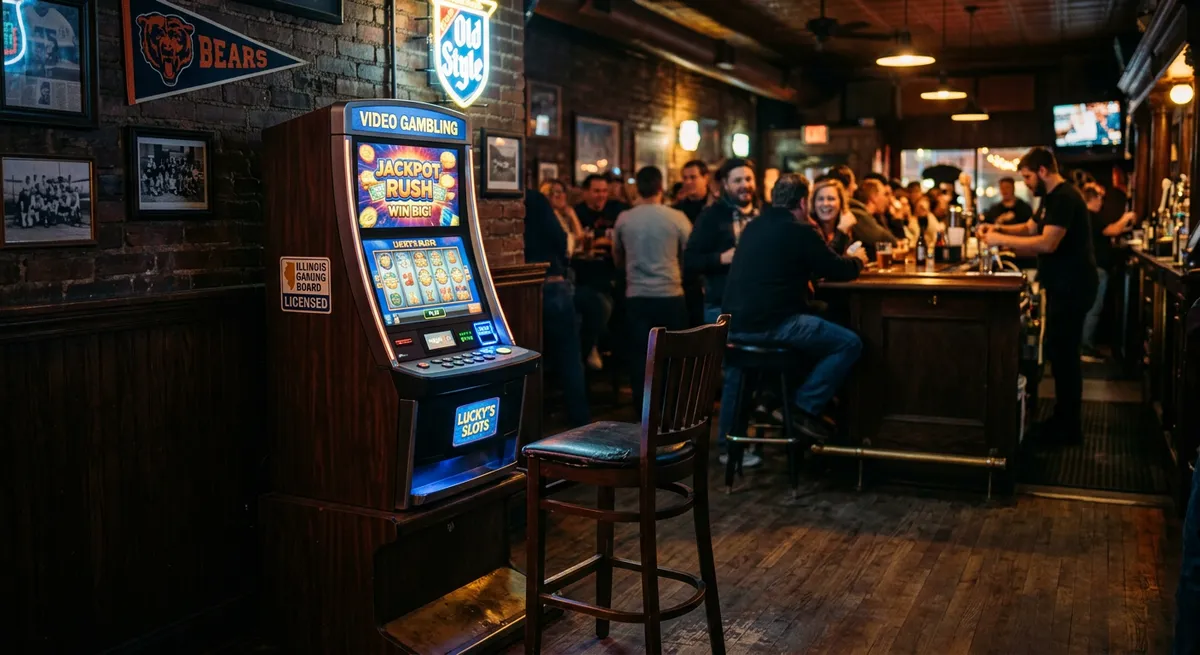
Chicago One Step Closer to Video Gambling in Bars; The Machines Are Being Briefed
The Chicago City Council’s Committee on Finance approved an ordinance Wednesday that would legalize video gambling terminals at bars, restaurants, and truck stops across the city, advancing a measure that has been before the Council in various forms since Illinois first legalized the machines in 2009. Chicago has spent seventeen years watching the rest of the state generate revenue from small glowing screens while declining to participate on the grounds of various objections that have shifted over time and are now sufficiently diminished that a committee has voted to move forward. The ordinance still requires a full Council vote, and the full Council moves at a speed that would test the patience of the video gambling machines themselves, but the direction of travel is now clearer than it has been in nearly two decades of not traveling anywhere.
Video gambling terminals, for those who have spent the past seventeen years in Chicago rather than downstate, are small touchscreen devices installed near bars that allow patrons to play poker, slots, and other games for real money, with a portion of each terminal’s take split between the operator, the establishment, and the state. Illinois currently has more than 52,000 licensed terminals at locations outside Chicago, generating the $2.4 billion in cumulative state revenue since 2012, which is a number the Committee on Finance has been looking at for a while. Chicago, which accounts for roughly one-fifth of Illinois’ population and a much larger fraction of its bars, has been absent from this arrangement, which bar owners have noted with the specific frustration of people watching their suburban counterparts make money from something that is sitting right there.
The ordinance would allow terminals at establishments with a liquor license and at least 1,000 square feet of space, a threshold that eliminates some of the city’s smaller and more beloved spots while including the bulk of the full-service bar and restaurant market. City officials estimate the terminals could generate between $40 million and $80 million annually for the city, a range that is wide enough to suggest that nobody is completely sure but that is also wide enough to make the lower bound seem acceptable. A portion of the terminal revenue would be directed toward mental health services and gambling addiction resources, which is the part of the ordinance that allows the Council to describe it as harm-reduction infrastructure rather than simply a policy change that makes it easier to lose money on a touchscreen at 11 p.m. on a Wednesday.
Bar owners who appeared before the committee were, by nearly all accounts, in favor. A representative from the Illinois Licensed Beverage Association said the terminals would “complement the existing bar experience” and help establishments “compete with suburban venues,” which is a sentence that contains an argument about the nature of competition that the suburban venues in question were not invited to respond to. A Logan Square tavern owner said she had “watched customers drive to Norridge to use the machines and then come back for a drink,” which is a supply chain dynamic that the City of Chicago has apparently been fine with for seventeen years and has now decided is fine with in a different direction. The machines are expected to arrive within six to twelve months of final approval, though this timeline is subject to the permitting process, which is its own kind of gambling.
The opposition, which exists but is quieter than in prior years, centers on concerns about gambling addiction, neighborhood character, and the proximity of terminals to schools and places of worship — the latter addressed in the ordinance through minimum distance requirements that were negotiated in committee and that Alderman Daniel La Spata, who represents Logan Square and Wicker Park and has historically been skeptical, described as “improved but still a concern.” La Spata did not vote to advance the ordinance and indicated he would be watching the full Council vote carefully, which is the aldermanic formulation for “I have not fully committed to losing this fight.” His constituents, for their part, are divided in approximately the ratio that divides all Chicago constituencies on all things: a third enthusiastic, a third opposed, and a third who want to know more about the permitting timeline.
The video gambling terminals themselves, reached through their trade association, expressed no opinion, because they are machines. But they have been briefed on Chicago, and they understand the market. They have been waiting in Rosemont and Melrose Park and Lyons and North Riverside, and they are familiar with the people who come in from the city to use them. The machines know what they are for. They know what they do. They know that late on a Wednesday, in a bar where the Bulls game has become unwatchable, there is a particular kind of person who is going to sit down at the terminal and press the button and see what happens. That person is everywhere in Chicago. They just currently have to drive to Bridgeview to do it. The ordinance would fix this, at least geographically. Whether it fixes anything else is not the ordinance’s concern.