CTA Brown Line Loses an Hour Overnight, Finds the Experience 'Disorienting but Familiar'
The Brown Line lost an hour last night. So did everything else — the Red Line, the Blue Line, the buses, the city, the clock on the microwave that nobody has updated since the last time this happened — but I want to talk specifically about the Brown Line, because the Brown Line has been doing this for a long time and I think it has earned a more nuanced response to the experience than “spring forward.” The Brown Line was built in 1907. It has sprung forward 119 times. It has lost, in aggregate, roughly five days of its life to daylight saving time, which is five days the Brown Line will never get back, and which it accepts with the specific equanimity of something very old that has learned to accept the things it cannot change and keep moving through Ravenswood.
The transition happened at 2 a.m. Sunday, at which point 2 a.m. became 3 a.m. and a Brown Line train sitting at Damen station — running late already, as Brown Line trains sometimes do, for reasons the CTA would describe as “operational” and that regular riders would describe as “the usual” — found itself not late at all, technically, because the standard by which lateness is measured had shifted by sixty minutes in its favor. This happens every spring and the CTA does not issue a statement about it. The Brown Line does not issue statements. But if it could, I think the statement would be something like: “We are running on time, in the sense that time has been rearranged to accommodate our current position, which is one of the few times that has ever happened.”
Riders who take the Brown Line early on Sunday mornings — a thin, hardy group united mainly by the fact that they have somewhere to be before the rest of the city has accepted consciousness — arrived at platforms in the 6 o’clock hour and stood in the cold with their hands in their pockets, waiting for trains that were running on the new schedule, which was the old schedule shifted forward, which meant that the gap between trains felt exactly the same as it always does on a Sunday morning, which was fine. The Brown Line Sunday service runs every twelve minutes in the off-peak hours, and twelve minutes is twelve minutes regardless of what the clock says. This is perhaps the Brown Line’s most consistent quality: its indifference to the arbitrary. It runs when it runs. The hour is a construct. The Brown Line is a train.
The stations took the transition with varying degrees of adjustment. The Merchandise Mart station, which sits at the bottom of the loop and handles the largest midday crowds, did not seem especially affected — it is accustomed to confusion as a baseline condition and processes time largely through the volume of people rather than through any internal sense of the hour. The Kimball terminal, at the northern end, had a driver who had been on the first northbound run of the morning and who finished his shift aware that he had been driving for what felt like four hours but was officially clocking as three, which is the spring-forward driver experience and which he described, to no one in particular, as “I’d rather lose it in spring than gain it back in November, personally. November’s bad enough.” This is a reasonable position.
The platforms themselves, which are largely wood — the Brown Line’s elevated structure along the Ravenswood corridor is one of the older segments of the CTA system and its platforms retain a material memory of the city as it was when the line was new — did not, in any way I could detect, react to the time change at all. Platforms are stoic. They accept what comes. They have held, across 119 years, passengers going to jobs that no longer exist, toward neighborhoods that have changed character three times over, through winters that seemed unsurvivable and springs that followed anyway. One hour, given or taken, doesn’t move them. The platforms have seen the whole thing. They are not impressed by the clocks.
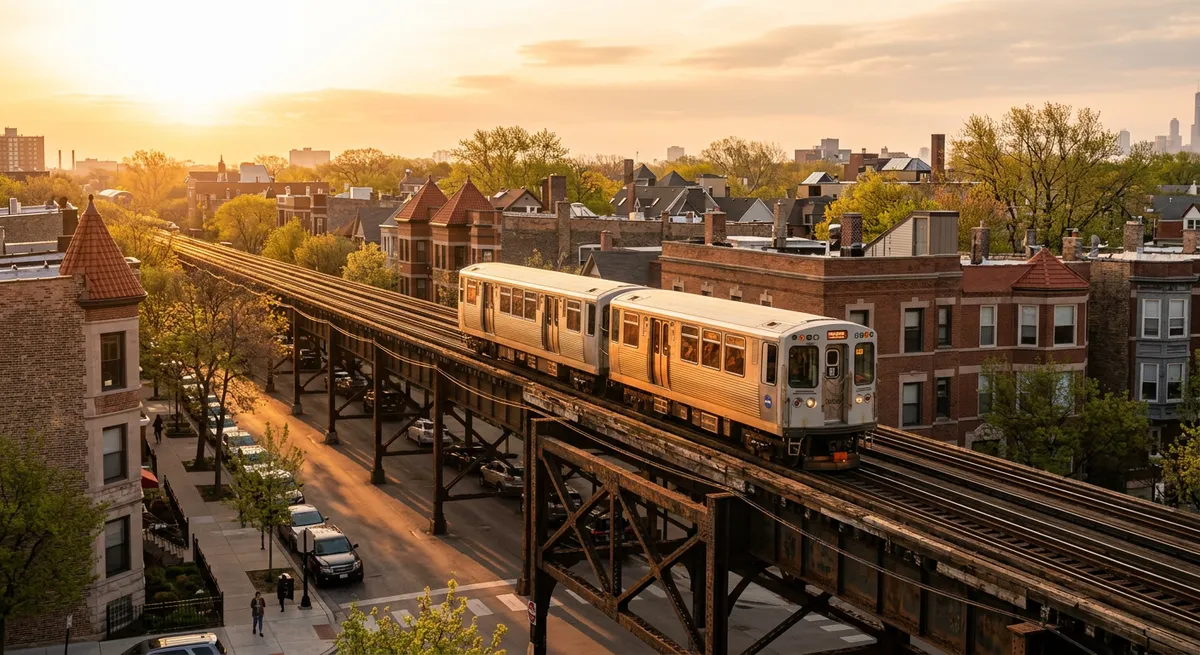
What daylight saving does give the Brown Line — and this is the part that makes the whole disorienting exercise worthwhile, if you take the long view — is the light. By 5:30 p.m. on Sunday, the sun had not yet set on Chicago for the first time since late October. Riders on the elevated sections north of Belmont, which run above ground and look out over the rooftops of Lakeview and Ravenswood and Lincoln Square, watched the day from their seats in a light that felt new. The shadows were long and the sky was pale gold and the city beneath the tracks looked like it was being seen for the first time, which it wasn’t, but which is what late-afternoon March light does when it comes back after a long absence. The Brown Line moved through it at the speed it always moves, neither faster nor slower. The hour was gone. The light had returned. Somewhere behind a Roscoe Village two-flat, a dog was running in a yard that was still, technically, winter, in a light that was, unmistakably, something else.