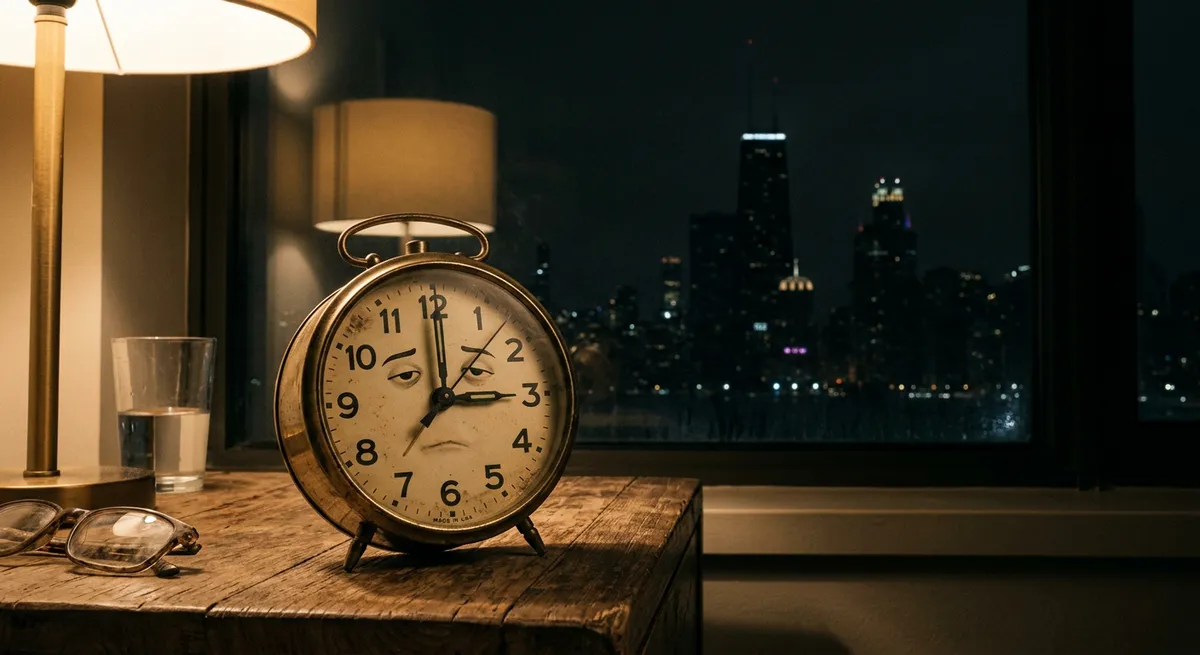
City of Chicago Springs Forward, Loses Hour; OEMC Confirms the Hour Was Not Recoverable and Has Opened a Ticket
At 2:00 a.m. Sunday, the City of Chicago officially lost an hour. This is not a figure of speech. One hour — sixty minutes, 3,600 seconds, the time it takes to watch two episodes of a prestige drama or cook a proper Sunday sauce or complete a transfer at O’Hare — was removed from the city’s operational calendar by the Uniform Time Act of 1966, which requires participating states to advance their clocks by one hour on the second Sunday of March, and which Illinois has been participating in since 1967, except for a brief and complicated period in 1974 that municipal attorneys have asked not to be quoted on. The hour in question was the hour between 2 and 3 a.m. It is gone. It will not be returned until November 1st, at which point it will be given back under circumstances that feel worse than the taking ever did.
The Office of Emergency Management and Communications issued a brief advisory at 11:45 p.m. Saturday reminding residents to set their clocks forward one hour before sleep, check smoke and carbon monoxide detector batteries, and “allow additional time for adjustment in the morning,” which is the most genuinely compassionate official communication the OEMC has issued in recent memory. A spokesperson confirmed Sunday morning that the transition had gone smoothly and that no incidents had been reported that were “directly attributable to the time change,” a qualifier that was inserted deliberately and that the spokesperson declined to elaborate on. The OEMC has opened a standard-issue transition ticket in its tracking system, which will remain open through March 22nd, at which point it will be closed as resolved on the grounds that everyone has more or less adjusted.
Alderman Carlos Ramirez-Rosa, whose 35th Ward constituents include a significant number of people who work early-morning shifts and are therefore acutely affected by the subtraction of an hour from their Sunday sleep, issued a statement calling daylight saving time “an anachronistic federal imposition that continues to fall hardest on working families,” which is a statement he issues every March with minor variations and which the federal government continues not to respond to. He included a link to the Sunshine Protection Act, a federal bill that has been introduced in Congress repeatedly since 2018 and that would make daylight saving time permanent, eliminating the twice-annual adjustment. The bill has passed the Senate once, in 2022, and failed to come to a vote in the House, and is currently in its latest reintroduction, where it sits alongside approximately 14,000 other bills in various stages of not becoming law.
Several constituents filed 311 complaints Sunday morning related to the time change, which 311 does not technically have a category for, but which operators routed to the General Inquiry queue with notes. One complaint, filed at 8:12 a.m. by a resident of the Near North Side who identified himself as having “lost approximately 47 minutes of effective sleep due to my body’s non-compliance with the mandated adjustment,” requested that the city “look into this.” The city’s 311 system logged the complaint, assigned it a reference number, and sent an automated confirmation email. The complaint is currently unresolved. The system’s projected resolution date is listed as “ongoing,” which is the 311 system’s way of communicating that some problems are larger than any single ticket.
The Department of Transportation noted that traffic signal timing does not change with daylight saving time, because traffic signals operate on their own internal systems and are not, in a meaningful sense, aware of what hour it is. This is either reassuring or philosophically interesting, depending on how your Sunday is going. The Chicago Department of Public Health issued a reminder that disrupted sleep patterns in the days following the spring transition have been associated with increased rates of workplace injuries, cardiovascular events, and Monday-morning errors — a reminder it issues annually, always on the Sunday of the change, when the information is accurate but also slightly too late to be actionable. A spokesperson said the reminder was “informational rather than prescriptive” and that residents should “be gentle with themselves this week,” which may be the most emotionally attuned thing any City of Chicago agency has ever put in writing.
Mayor Brandon Johnson, asked at a Sunday afternoon press appearance whether he supported making daylight saving time permanent, said he was “open to the conversation” and that the city would “continue to monitor the situation,” which is the mayoral formulation for expressing a position without committing to it, a practice that predates this administration by several decades and is in no danger of being discontinued. A City Hall spokesperson later clarified that the mayor’s office “supports policies that prioritize the health and wellbeing of Chicago residents,” which supports everything and nothing simultaneously, which is its job. The hour is still gone. The ticket is open. The OEMC is tracking it. Everyone is being gentle with themselves, or trying to be, which is, under the circumstances, a reasonable aspiration.