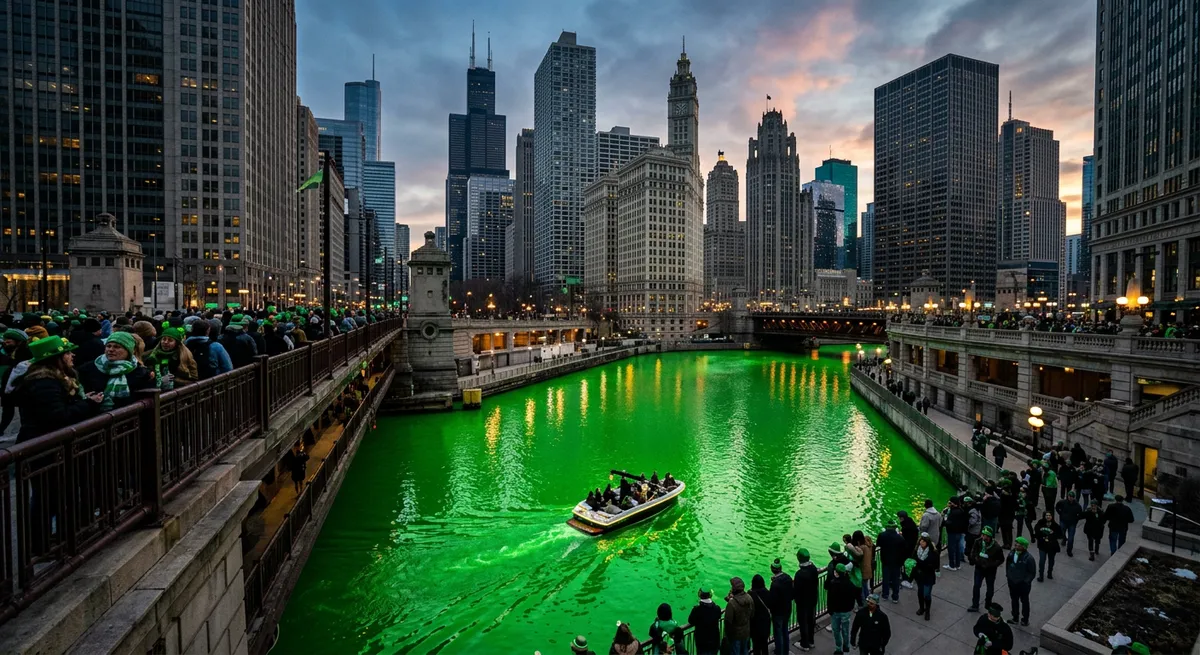
Two Weeks Out, the Chicago River Is Already Nervous About St. Patrick's Day
The Chicago River has known this was coming. It always knows. Since 1962, when Plumbers Union Local 130 first poured 100 pounds of fluorescent dye into its waters as a way to trace illegal sewage discharge and accidentally invented one of the more photographed municipal traditions in the country, the river has had a complicated relationship with the second Saturday of March. Not a bad relationship — the river is a good sport about the whole thing, and genuinely seems to understand the cultural weight of what it’s participating in — but a complicated one, in the way that any entity with feelings would have a complicated relationship with being dyed a different color once a year while several hundred thousand people take photographs of it from the bridges.
The dye, an orange powder called Chemstream FLT Yellow-Green 3SF, turns a vivid emerald green when it hits the water. It is environmentally safe — the union and the city have gone through several reformulations over the decades to ensure this, and the current formula is certified benign — but it is not subtle. The river goes from the particular shade of brownish-olive that is its natural 2026 color to a green so saturated it seems to be making an argument. The color lasts four to six hours on the main stem and somewhat longer in the branches, where it gets a little more time to sit and think. Whether the river has opinions about the color is a question I’ve been sitting with for several years. I believe it does. I believe the initial moment of contact — when the orange powder hits the water and begins its transformation — is one that the river finds surprising every time, even though it has done this 64 times, because some things do not become less surprising through repetition.
Plumbers Local 130 begins the operation before dawn on St. Patrick’s Day morning, arriving by boat with the dye and the equipment and the institutional knowledge of 65 years of doing this specific thing in this specific water. The crew has changed over the generations but the method has not changed much: the powder goes into the river from a boat, the boat moves to distribute it, the dye spreads, and then, as the light comes up over the city, the river turns green in front of an audience that grows larger every year. The union is not required to explain its methods, and for many years it declined to, which gave the tradition an additional mystique on top of the one it already had from simply being a city that dyes its river. They have since been somewhat more forthcoming about the formula, but they still manage the operation with a privacy that I find appropriate. Some things should be a little bit mysterious. The green river is one of them.
The two-week window before the event is when the preparations become visible in other ways. The city installs crowd-control barriers along Wacker Drive and Michigan Avenue, which the barriers experience as a low-key assignment compared to what’s coming. The riverboat tour companies position their St. Patrick’s Day vessels. The bars along the river begin accepting reservations for the early-morning windows, when the crowd is largest and most committed, meaning people who have arrived before 6 a.m. in green hats to watch orange powder become something else in front of them and find this fully worth it. Chicago has many traditions, and this is one of the weirder ones if you describe it plainly, and it is also the one most likely to make someone who moved here from somewhere else feel that they have arrived somewhere specific, with a specific identity, that takes its pleasures seriously.
The river itself, in the two weeks before the event, runs its normal course. It flows roughly southward through the city in the direction it has been flowing since the Army Corps of Engineers reversed it in 1900, which is itself a remarkable thing to have done to a river and which the river has never entirely stopped processing. It receives the water from its northern branches and sends it south toward the Illinois and the Mississippi and eventually the Gulf of Mexico, doing the work of being a river in a major metropolitan area, which is complicated and largely unacknowledged. In March, it is cold. Its surface reflects the gray sky and the buildings and the Riverwalk, which is mostly empty in the first two weeks of March but which, on the Saturday of St. Patrick’s Day, will be standing-room on every inch of its poured-concrete length.
The tradition is now in its seventh decade. There are people in Chicago who have watched the river turn green every year of their lives and will watch it again this year, and people who have never seen it and are planning to see it this year for the first time, and people who saw it once and moved away and still think about it occasionally, the way you think about things that are strange and specific and irreplaceable. There are people whose grandparents were in the crowd in 1962 when it happened for the first time, when no one knew quite what was going to happen when the dye hit the water, and then it happened, and everyone could see that this was going to be a thing. It became a thing. It has been a thing for 65 years.
The river will be green on March 15th, between roughly 8:30 in the morning and early afternoon. The crowds will be on the bridges. The orange powder will do what it has always done. The color will be unreasonable. The river, for its part, has been preparing in the way that rivers prepare for things: by continuing to be itself, in the dark, flowing south, waiting for what comes next. It is not nervous, exactly. It just knows the feeling of being looked at by half a million people, and it is getting ready to be looked at again.