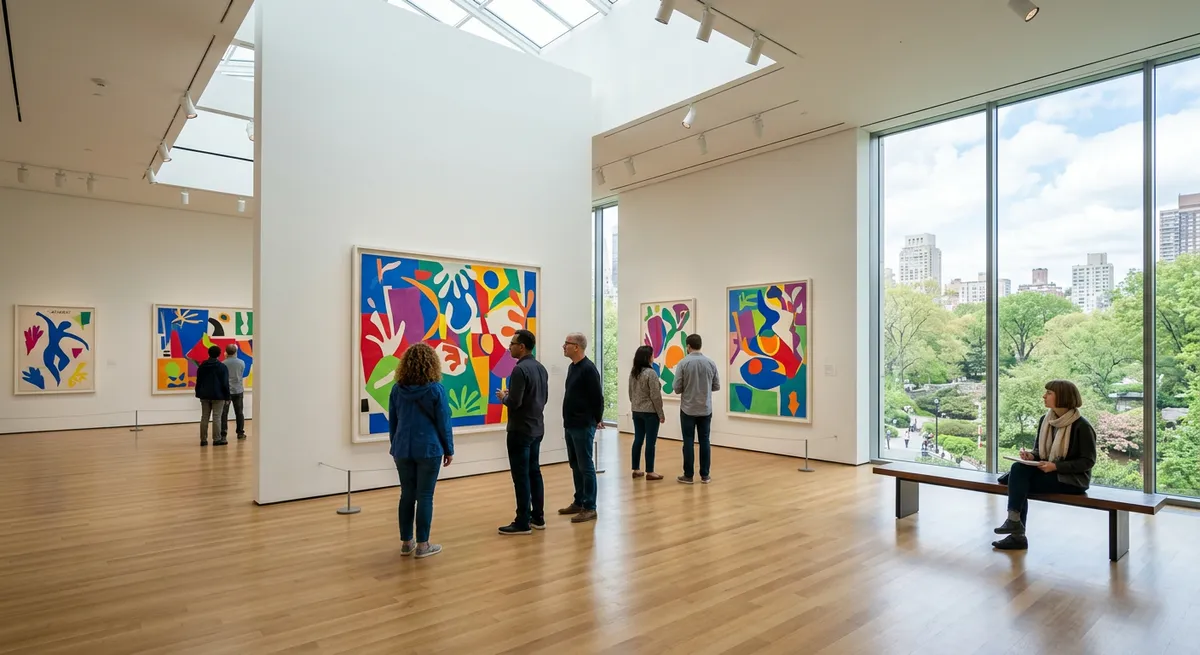
The Matisse Cut-Outs at the Art Institute Have Been Here Six Weeks and Are Starting to Form Opinions About Chicago
The twenty plates of Henri Matisse’s Jazz series have been hanging in Gallery 296 of the Art Institute’s Modern Wing since late January, which means they have now been in Chicago long enough to have feelings about it. Not opinions, exactly — Matisse’s cut-outs do not traffic in opinions, which are small and bounded. They traffic in impressions, in the specific quality of color against color, in the way a warm ochre reads differently under a February sky than it does in Paris, where the Pompidou Centre has lent them to the Art Institute through May 18th and where they will presumably return having learned something, though what that something is remains, as of this writing, unclear.
What is clear is that the works are settling in. The morning light in Gallery 296, which comes through the Renzo Piano-designed roof in long thin slabs that shift across the walls between 9 and 11 a.m., has been particularly noted. The Icarus plate — Matisse’s leaping figure in deepest blue, surrounded by yellow starbursts, the one that everyone stands in front of for approximately forty-five seconds and then photographs for approximately ninety — has been observed to receive this morning light on its upper left quadrant in a way that the Pompidou cannot replicate, because the Pompidou is a different building and Chicago is not Paris and the light here has a specific quality that people who live here stop noticing after about two years and that visitors notice immediately. Icarus appears to appreciate this. It is speculation, but it is informed speculation, and I stand by it.
The Jazz series was created between 1943 and 1947, when Matisse was in his seventies and recovering from surgery and could no longer paint in the traditional sense. He turned to scissors and paper — gouache-coated sheets that he cut into shapes with what he described as “drawing with scissors” — and produced something that did not look like a workaround and did not feel like a consolation. It felt like arrival. The twenty plates in the Jazz portfolio were published in 1947 in a limited edition of 250, with handwritten text by Matisse in the margins, and they represent one of the more significant late-career reinventions in the history of modern art, which is a history that contains a considerable number of significant late-career reinventions and is better for it. The Art Institute’s show places all twenty in sequence, which you rarely get to see, and which produces an effect not unlike hearing an album straight through instead of shuffling — the pieces speak to each other across the room in ways they cannot when separated.
The gallery itself has been configured to give the cut-outs room to breathe, which is the right decision. Modern Wing galleries are high-ceilinged and white-walled and designed to make even modestly sized works feel spacious, and the Jazz plates — each roughly 41 by 65 centimeters — have room here to project themselves in a way that reproductions in books simply do not allow. The colors are different in person. This is always true of color-field work and it is always surprising no matter how many times you encounter it. The yellow in The Cowboy is not the yellow in any book. The red in The Knife Thrower is not the red in any print. These are the colors Matisse mixed himself, and they do what he wanted them to do, which is to feel primary in the sense that the primary elements of experience feel primary — like they are happening for the first time, in your exact body, in the specific present.
The HVAC system in Gallery 296 is the one area of mild disagreement. Climate control in museum galleries runs continuously to maintain the humidity and temperature conditions required for works on paper, which is correct and necessary and must happen. It also produces, at irregular intervals, a low-frequency mechanical hum that is below the threshold of conscious hearing for most visitors and well within the threshold of awareness for twenty pieces of colored paper that have been in museums for roughly eighty years and have developed, over that time, a sensitivity to ambient vibration. The Lagoon plates, which are the more meditative works in the series — slow, oceanic shapes in blues and greens — seem particularly aware of it. Whether they mind is a question that requires more data. They have not complained through official channels.
Visitor response through the first six weeks has been what the Art Institute describes as “strong” and what I would describe as the specific kind of strong where people come in expecting to see something nice and leave having seen something that they need to sit with for a while. The gallery’s exit leads to a bench area by the large windows overlooking Millennium Park, and that bench has been occupied continuously, at all hours, since late January, by people who have just left the Matisse show and appear to be reconsidering something. Not in crisis — in the more pleasant sense of reconsidering. In the sense of having been reminded that some things were made by a person who was old and sick and still had something to say, and said it in a way that makes the whole enterprise of being alive seem, for a moment, more manageable than it usually does.
The Jazz series runs at the Art Institute through May 18th. The morning light in Gallery 296 is best between 9 and 11 a.m. The bench by the window is usually available after 3 p.m. on weekdays. The HVAC situation is ongoing. Icarus is doing well.