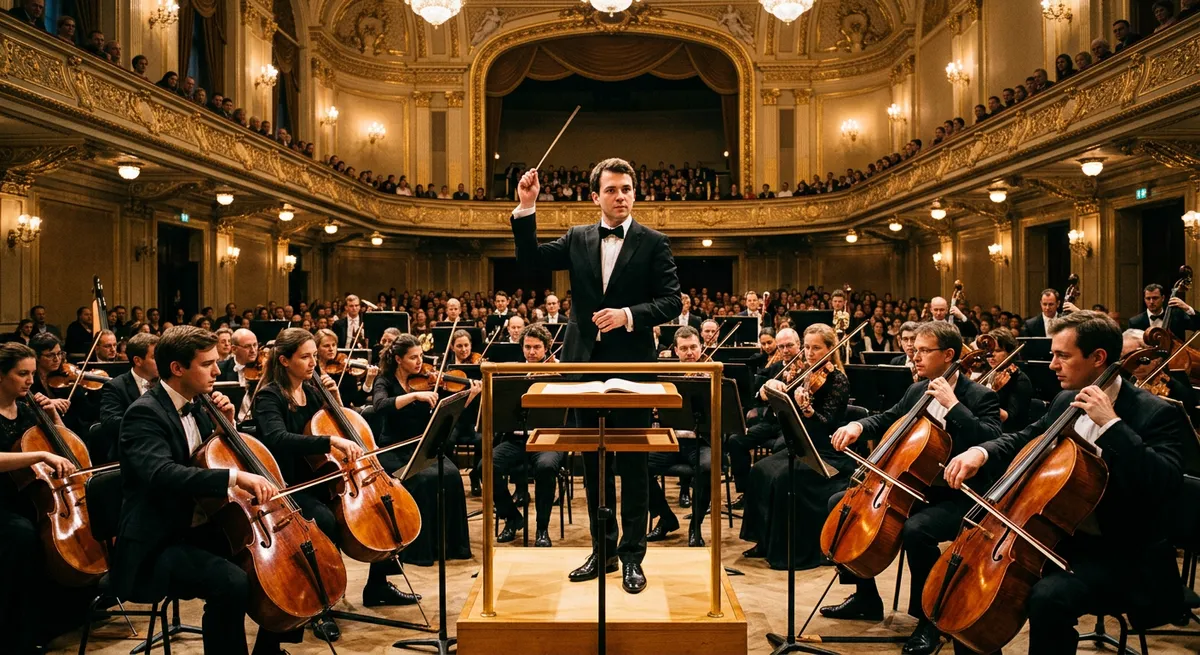
The Chicago Symphony Has Hired Its Youngest Music Director in 133 Years; The Cello Section Has Feelings About This
There is a moment, when you watch a very young person take command of something very old, where time becomes briefly visible. You can see it — the long centuries of accumulated form and tradition and expectation pressed against the particular energy of a person who has not yet had time to absorb all of it, or perhaps has absorbed it so completely that it no longer feels like weight. Klaus Mäkelä is thirty years old. The Chicago Symphony Orchestra is one hundred and thirty-three. The gap between those two numbers is a corridor through which, if you stand at the right angle, you can hear something that might be the future arriving, or might just be the ventilation system at Orchestra Hall.
Mäkelä was appointed music director designate in 2024, when he was twenty-eight, and will begin his official five-year tenure in September 2027, at which point he will be thirty-one. He is, by any measure, extraordinarily accomplished for his age: principal conductor of the Oslo Philharmonic since he was twenty-three, principal guest conductor of the Orchestre de Paris, artistic partner of the Royal Concertgebouw in Amsterdam. He has been described by critics as “incandescent,” “mercurial,” “technically immaculate,” and, on one occasion by a reviewer in Oslo, as “disquietingly good, in the way that certain things in nature are disquieting.” This last description is the one I find most interesting, because it suggests that Mäkelä’s gift is not purely a matter of craft but of something that precedes craft — an attunement, perhaps, to the specific frequency at which music and feeling share the same resonance. Or perhaps the Oslo reviewer had been sitting in a draft and was projecting.
The Chicago Symphony’s string section, reached in spirit rather than in person, has a range of views. The violins, as a body, appear cautiously optimistic: they have worked with many conductors, they have seen things, and they have developed a pragmatic relationship with the concept of change. The violas, who are used to being in the middle, are in the middle here too. The cellos, however — and I say this as someone who has listened to Orchestra Hall for seven years and has developed what I consider a reasonable literacy in the emotional registers of large wooden instruments — the cellos are in a period of active reflection. The cellos have been here since 1891. The cellos have seen conductors come and go across a century. The cellos are not opposed to Mäkelä, not at all; they simply feel that there is a process, and the process is real, and thirty-one is younger than several of the bows currently in rotation.
The CSO has announced that Mäkelä will conduct the orchestra for at least fourteen weeks per year in his official capacity — ten weeks in Chicago, four on tour. His Ravinia debut is this summer, two programs with the CSO in the open air at Highland Park, which is where the orchestra goes in June when Orchestra Hall becomes the kind of place where the air itself seems to need a break. Those who have seen Mäkelä conduct describe an experience that is difficult to characterize in purely musical terms: something about the quality of attention he brings to the podium, the way the orchestra appears to breathe differently when he raises his hands. Several musicians I spoke with, on background, used the word “surprising” in a way that meant more than surprised. They meant that he surprised the music itself, which is a thing very few conductors manage to do.
What the city of Chicago makes of all this remains, as of this week, largely unspoken. Chicago is a city that has a relationship with the symphony that is, like its relationship with most of its institutions, complicated and affectionate in approximately equal measure. The Orchestra Hall building, at 220 South Michigan Avenue, has watched the city change in ways that would astonish its original architects. The lake, which you can see from the hall’s upper balcony on a clear night, has watched the city change longer than the building has. The lake, I have always felt, holds a kind of musical opinion — something to do with the way it processes wind. It does not conduct. But it has heard a great deal over the years, and it knows the difference between technique and presence. On the question of Mäkelä, I believe the lake is interested.
He arrives in an era when classical music is conducting — if you will permit the word — its own ongoing conversation about relevance and audience and what it means to inherit a tradition that is, by almost any metric, very expensive to maintain. Mäkelä does not seem particularly worried about any of this, which is either the confidence of the extraordinarily talented or the cheerful unawareness of someone who has not yet had to manage a budget meeting. His interviews suggest the former. He speaks about music the way people speak about water: as something that is simply there, that you move through, that has properties you can learn but that you cannot own. This is either very profound or very Finnish. The distinction may not matter. The music will tell us, in time, which it is.
The official start date is September 2027. Between now and then, there are guest conductors, and preparations, and Ravinia, and the specific anticipation that accompanies a transition in a place that is accustomed to endurance. The cellos are warming up. The lake is listening. The city, in its way, is paying attention to something that has nothing to do with potholes or primaries, which is, in the long run, one of the things cities are for.